[Asia Economy Sejong=Reporter Dongwoo Lee] Regulations on recycling waste such as scrap metal and waste glass will be significantly improved going forward. Pyrolysis oil extracted from waste vinyl and waste plastic will also be allowed for use in plastic raw material production. This is expected to reduce annual waste disposal costs by approximately 210 billion KRW.
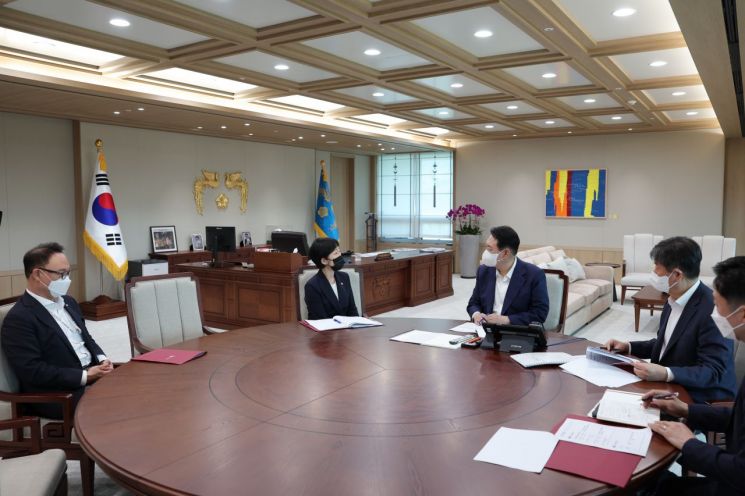
On the 26th, the Ministry of Environment reported these details in the "Environmental Regulation Innovation Plan" to President Yoon Seok-yeol at the 1st Regulatory Innovation Strategy Meeting held at Ajin X-Tech in the Seongseo Industrial Complex, Daegu. Innovation in environmental regulations focused on rationalizing existing environment-related regulations and improving regulations related to environmental policy goals such as carbon neutrality and the circular economy.
Transition from Closed Regulations to Open Regulations
The Ministry of Environment’s regulatory innovation plan consists of four main points. These include transitioning to 'negative' (open) regulations that allow all actions except those explicitly prohibited, applying differentiated regulations proportional to risk, shifting to interactive communication and consultative regulations, and prioritizing improvements to regulations directly related to carbon neutrality and the circular economy.
The Ministry explained, "As the international community prioritizes carbon neutrality and sustainability, environmental regulations must also lead private innovation and enhance on-site applicability."
First, in the waste sector, the current 'closed regulations' that prohibit everything except what is allowed will be changed to 'open regulations' that allow everything except what is prohibited. This change addresses concerns that complex application and approval procedures required for waste regulation exemptions have hindered recycling.
The applicable targets include waste paper, scrap metal, waste glass, and coffee grounds. In particular, coffee grounds can now be circulated into plastic products, cosmetic raw materials, and biofuels. Other resources will no longer be subject to waste regulations without separate application or review procedures.
Regulations such as business permits for handling facilities will be applied differentially according to the hazard and risk of chemical substances. Handling management standards will be strengthened for acutely toxic substances with high chemical accident risks and dangerous upon human contact, while for chronic toxic substances with lower accident risks but potential long-term human exposure effects, the focus will be on reducing exposure.
Reduction of Environmental Impact Assessment Procedures and Enhancement of Transparency
Environmental impact assessment procedures will be reduced and transparency strengthened. Currently, all projects above a certain scale undergo environmental impact assessments, but the plan is to define exemption targets by law and only require assessments for projects that do not meet these exemptions. To avoid redundancy, an information system will be established to increase transparency.
Regulations that hinder the realization of carbon neutrality and the circular economy will be prioritized for innovation. In the transition to carbon neutrality, improvements will be made to the emissions trading system, and carbon capture, utilization, and storage (CCUS) will be activated. The emissions trading system will be refined to promote greenhouse gas reduction activities. Conditions for additional greenhouse gas emission allowances unfavorable to newly established or merged companies will be rationalized, and procedures for converting overseas reduction achievements into domestic achievements will be simplified.
Minister Han stated, "Past efforts to innovate environmental regulations often faced social backlash because they were pursued without considering the high public demand for environmental protection," adding, "We will improve environmental regulations to induce private innovation and ensure they function well on-site so that the public can enjoy a safer and better environment."
© The Asia Business Daily(www.asiae.co.kr). All rights reserved.
![Clutching a Stolen Dior Bag, Saying "I Hate Being Poor but Real"... The Grotesque Con of a "Human Knockoff" [Slate]](https://cwcontent.asiae.co.kr/asiaresize/183/2026021902243444107_1771435474.jpg)















