"Large Scale and Excellent Stone Carving Techniques"
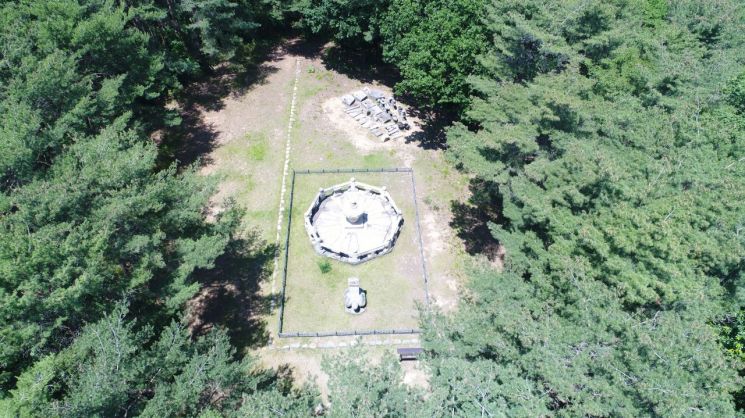
The 'Yeongcheon Injong Daewang Taesil,' which enshrines the placenta of King Injong of Joseon, has been designated as a national treasure. It was established in 1521, six years after Injong's birth, according to ceremonial rites. There is a stele erected to add dignity to the Taesil. The latter was created in the first year of King Myeongjong's reign (1546), as Injong's reign period (1544?1545) was short.
The Taesil is located on a flat ground at the top of Taesilbong. Following the formal layout depicted in the royal protocol, the overall floor plan is octagonal. In the center, there is a Jungdongseok (a round stone placed on a square pedestal) indicating the enshrinement of the placenta. The front of the stele bears the inscription "Injong Daewang Taesil (仁宗大王胎室)," and the back is inscribed with "Built in May, 25th year of Gajeong (1546) (嘉靖二十五年五月日建)."
The Injong Daewang Taesil has suffered several damages. Part of it was damaged in 1680, and during the Japanese colonial period, the placenta jar and placenta stone were relocated to Seosamneung in Goyang by the Joseon Governor-General's Office. After being neglected for some time, it was excavated in 1999 and restored to its current form in 2007. The Cultural Heritage Administration evaluated that it adheres to the formalities of the Joseon Taesil protocol, is large in scale, and exhibits excellent stone crafting techniques, thus holding high academic, historical, artistic, and technical value. Plans are underway to collaborate with Yeongcheon City and others for its preservation and management.
© The Asia Business Daily(www.asiae.co.kr). All rights reserved.
![Clutching a Stolen Dior Bag, Saying "I Hate Being Poor but Real"... The Grotesque Con of a "Human Knockoff" [Slate]](https://cwcontent.asiae.co.kr/asiaresize/183/2026021902243444107_1771435474.jpg)















