FOMC Unanimously Raises Benchmark Interest Rate by 0.25%p
Maintains Existing Forward Guidance...Big Step Not Considered
Inflation Expected to Rise Until Next Year...Peak Likely to Come Sooner
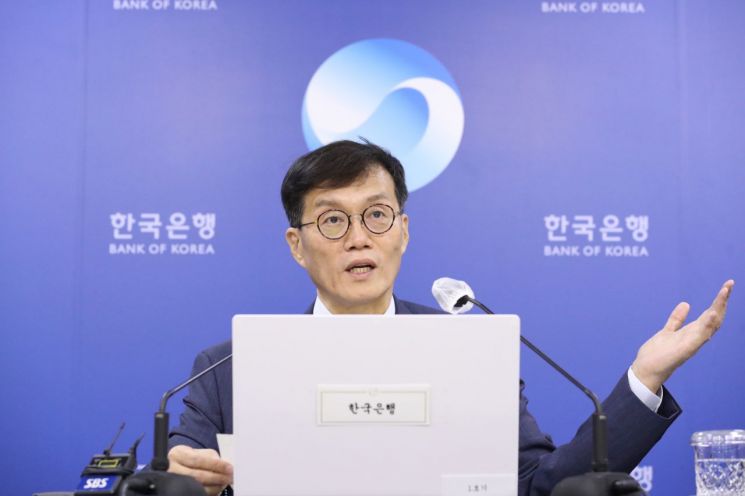 Lee Chang-yong, Governor of the Bank of Korea, is speaking at the Monetary Policy Direction press conference held at the Bank of Korea in Jung-gu, Seoul, on the morning of the 25th. (Photo by Bank of Korea)
Lee Chang-yong, Governor of the Bank of Korea, announced that he will maintain the policy of gradually raising the base interest rate by 0.25 percentage points for the time being. Regarding inflation, he predicted that the high upward trend will continue until the first half of next year, but the peak is expected to come earlier than the previously anticipated 'late 3rd quarter to early 4th quarter.'
At a press conference held at the Bank of Korea headquarters in Jung-gu, Seoul, immediately after the regular Monetary Policy Committee meeting, Governor Lee said, "I believe it is appropriate to operate monetary policy focusing on inflation for the time being and to continue the policy of raising interest rates."
The Monetary Policy Committee unanimously raised the base interest rate by 0.25 percentage points from 2.25% to 2.50% per annum on the same day.
Regarding this, Governor Lee explained, "Since the current economic situation is not significantly different from the domestic inflation and growth trends expected in July, we judged that a gradual increase of 25bp (1bp=0.01 percentage points), as presented at last month's monetary policy direction meeting, is appropriate."
Although the won-dollar exchange rate is soaring due to a strong preference for the dollar recently, the emphasis was placed on a baby step (0.25 percentage point increase in the base interest rate) rather than a big step (0.50 percentage point increase). When asked about the possibility of a big step, Governor Lee responded, "If a shock occurs, it can be considered in principle, but it is not being considered under the current circumstances."
Governor Lee also evaluated the market expectation that the year-end base interest rate will rise to around 2.75?3.00% as 'reasonable,' consistent with last month.
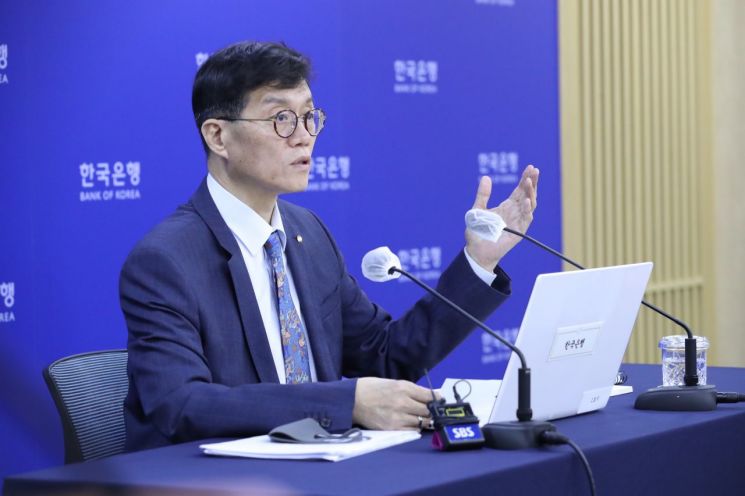 Bank of Korea Governor Lee Chang-yong is speaking at the monetary policy direction press conference held at the Bank of Korea in Jung-gu, Seoul, on the morning of the 25th. (Photo by Bank of Korea)
He forecasted that consumer prices will continue to face strong upward pressure in the 5?6% range.
He said, "The high consumer price increase in the 5?6% range is expected to continue until early next year. However, due to a sharp decline in international oil prices over the past two months, the consumer price inflation rate in August is expected to be lower than in July."
He added, "The peak may come earlier than the July forecast, but due to high volatility, it is difficult to assume that the trend will stabilize immediately after the inflation peak." Previously, Governor Lee had expected the inflation peak to be from late 3rd quarter to early 4th quarter, so this means it could be somewhat earlier.
In the revised economic outlook released that day, the Bank of Korea raised this year's consumer price inflation forecast to 5.2%, 0.7 percentage points higher than the May forecast of 4.5%. This is the first time since the inflation targeting system was implemented in April 1998 that the Bank of Korea has set an inflation forecast above 5%.
Governor Lee also emphasized downside risks to the economy that day. The Monetary Policy Committee lowered the annual real Gross Domestic Product (GDP) growth forecast for this year from 2.7% to 2.6%, and judged that growth will be only 2.1% next year.
He said, "The reason for lowering next year's growth rate to 2.1% is partly due to internal factors, but mainly because overseas factors are deteriorating. It is unreasonable for us to maintain a high growth rate while global growth is declining, and I consider 2.1% a relatively good result if we can achieve it."
He continued, "(This) is higher than the potential growth rate, so it is difficult to call it stagflation," adding, "Compared to global conditions, we are doing relatively well, and it is important to strive to maintain this trend."
© The Asia Business Daily(www.asiae.co.kr). All rights reserved.
![Clutching a Stolen Dior Bag, Saying "I Hate Being Poor but Real"... The Grotesque Con of a "Human Knockoff" [Slate]](https://cwcontent.asiae.co.kr/asiaresize/183/2026021902243444107_1771435474.jpg)
















