Antibiotics and Active Vitamins
Imported Raw Material Purchase Prices Rise
No Production or Supply Issues
But Import Burden Increases
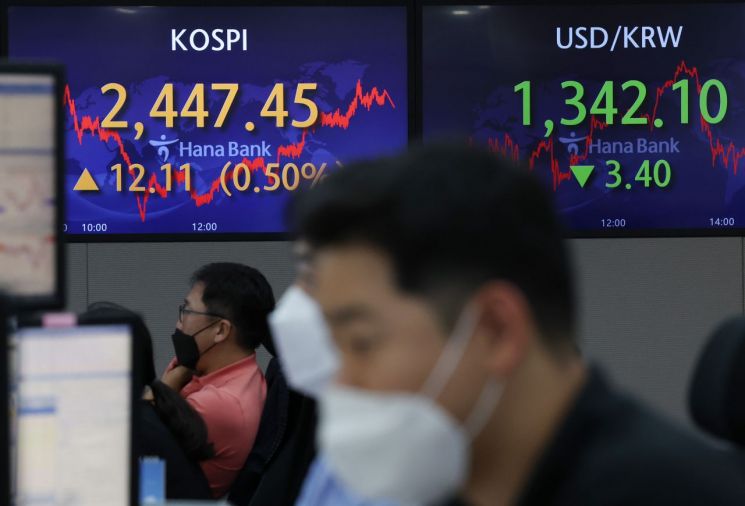 On the 24th, the closing prices of the KOSPI and the KRW/USD exchange rate are displayed on the electronic board in the dealing room of the Myeongdong Hana Bank headquarters. [Image source=Yonhap News]
[Asia Economy Reporter Lee Gwan-ju] As high exchange rates and high inflation lead to rising prices of raw materials necessary for the production of finished pharmaceuticals, the domestic pharmaceutical industry is closely monitoring the situation.
On the 25th, an analysis of the semi-annual reports of major domestic pharmaceutical companies revealed that the international price increases caused by the Ukraine war and the rise in exchange rates in the first half of this year have also affected pharmaceutical companies.
First, the prices of major raw materials for antibiotics showed an upward trend. The purchase price of 'Minocycline,' a raw material for skin inflammation treatment imported by Daewoong Pharmaceutical, rose from 1.24 million KRW per kg last year to 1.35 million KRW in the first half of this year. The price of Cefepime, a fourth-generation antibiotic raw material, also increased. The price of Cefepime for the first half of this year at Boryung (formerly Boryung Pharmaceutical) was 1,016 KRW per gram, up 87 KRW from 929 KRW last year.
The price of thiamine hydrochloride, a raw material used in active vitamin products that have recently gained popularity, is also soaring. According to the purchase price at Ildong Pharmaceutical, it increased by about 24%, from 32 USD per unit last year to 39.5 USD this year. Considering the rising exchange rate compared to last year, the actual burden may be even greater. Herbal medicine raw materials have also been affected. The import price of bezoar, the raw material for Kwangdong Pharmaceutical’s flagship product Cheongsimwon, surged from 82.29 million KRW per kg in 2020 and 89.54 million KRW last year to 98.54 million KRW this year.
The rise in raw material prices leads to increased production costs for pharmaceutical companies. Especially, the simultaneous rise in inflation and exchange rates acts as a burden. Since the proportion of imported, produced, or distributed raw materials or finished pharmaceuticals is not small, the rise in exchange rates can directly lead to increased costs.
In particular, for prescription drugs whose prices are effectively fixed, an increase in costs worsens profitability. If designated as 'delisting prevention drugs' that the government deems essential to maintain, prices can be adjusted through negotiations, but other prescription drugs must bear the cost burden entirely.
Fortunately, no immediate disruption in production and supply is expected. The industry’s response is that there is no major problem at present as each pharmaceutical company has established safeguards such as sourcing raw materials domestically to minimize exchange rate burdens, diversifying import routes, and securing long-term contracts. However, since rising exchange rates and inflation could be factors in deteriorating profitability, the situation is being closely monitored.
A pharmaceutical industry official said, “If the dependence on imported raw materials is high, the profitability fluctuation due to exchange rates is also significant,” but added, “Since various risk defense measures have been taken over a long period, although there may be temporary impacts, we expect to respond flexibly in the long term.”
© The Asia Business Daily(www.asiae.co.kr). All rights reserved.
![Clutching a Stolen Dior Bag, Saying "I Hate Being Poor but Real"... The Grotesque Con of a "Human Knockoff" [Slate]](https://cwcontent.asiae.co.kr/asiaresize/183/2026021902243444107_1771435474.jpg)















