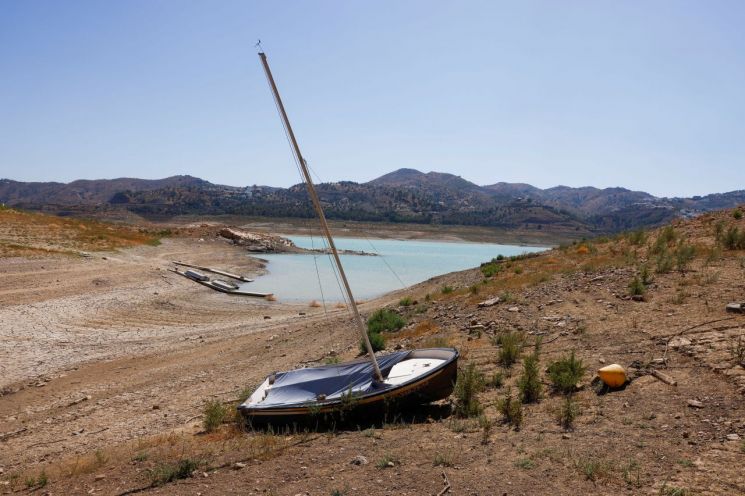
[Asia Economy Reporter Park Byung-hee] The severe drought that struck Europe this summer is expected to continue until November, warned the European Union (EU) Joint Research Centre (JRC). The JRC cautioned that prolonged drought will exacerbate food and energy shortages. It stated that crop yields will decline, hydropower generation will be disrupted, and nuclear power plant operations may also be affected due to cooling water shortages.
In a report released on the same day, the JRC announced that 47% of the EU region is at the drought warning stage, while 17% is at the alert stage. The alert stage indicates expected damage to crop production. The JRC predicted that the harvests of corn, sunflower, and soybean will decrease by 12-16% compared to the average of the past five years.
The JRC analyzed that Italy, southeastern and northwestern France, eastern Germany, Eastern Europe, southern Norway, and the Balkan Peninsula are experiencing severe drought. The JRC especially forecasted that drought in the western Mediterranean region could continue through autumn.
Furthermore, the JRC warned that even if most of Europe experiences weather conditions above average levels, the prolonged dry weather lasting over half a year may not be sufficient to compensate for the accumulated water shortages during this period.
The area affected by wildfires this year has been estimated to be more than 4.6 times the damage area over the past 19 years. The JRC highlighted that wildfire damage in Portugal is particularly severe. The EU Commission announced that it has sent two firefighting helicopters to Portugal for the first time. Glaciers in the Alps are also melting at the fastest rate ever recorded.
Maria Gabriel, Chair of the JRC, stated, "The combination of severe drought and heatwaves has led to an unprecedentedly serious water level situation across the entire EU," adding, "Wildfires are occurring more frequently than usual and are significantly impacting crop production."
The European Environment Agency warned in June that warming in Europe is more severe than in other regions. According to a report released by the agency at that time, the average temperature in Europe over the past decade was about 2 degrees Celsius higher than before industrialization. The global average was 1 degree Celsius higher than pre-industrial levels.
© The Asia Business Daily(www.asiae.co.kr). All rights reserved.
![Clutching a Stolen Dior Bag, Saying "I Hate Being Poor but Real"... The Grotesque Con of a "Human Knockoff" [Slate]](https://cwcontent.asiae.co.kr/asiaresize/183/2026021902243444107_1771435474.jpg)















