The Jeong Byeong-uk House Cherishing Yun Dong-ju's Handwritten Manuscript 'Sky, Wind, Star, and Poem'
[Asia Economy Honam Reporting Headquarters, Reporter Heo Seonsik] Around Cheoseo, when preparations for the full-fledged autumn begin, Mangdeok Port on the Seomjin River becomes quietly bustling with travelers welcoming the fall.
Mangdeok Port, where the Seomjin River, having run tirelessly for 550 ri, catches its breath, is also a place of rest for those who have endured the intense heat of summer.
Walking along Mangdeok Port, which traces a parabolic curve along the Seomjin River sparkling like jewels, one encounters old, faded houses that have preserved long histories.
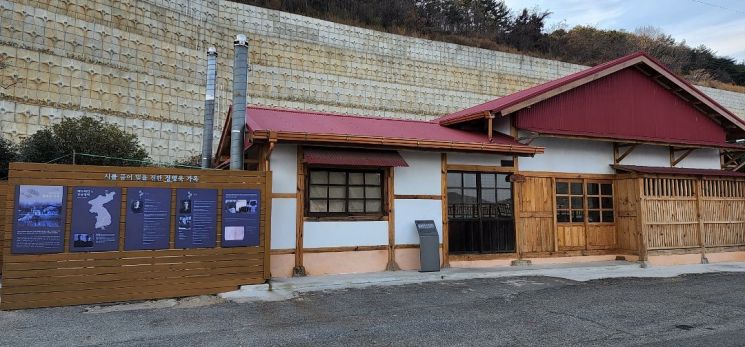
This house, known by the long name of Yoon Dong-ju Posthumous Manuscript Preservation Jeong Byeong-uk House (Registered Cultural Property No. 341), is the living space where the handwritten poems of Yoon Dong-ju, who aimed his pure verses at the heart of Japanese imperialism, survived.
In 1941, Yoon Dong-ju dreamed of publishing a poetry collection to commemorate his graduation from Yonhui College, and he bound three copies of his handwritten "Sky, Wind, Star, and Poem" to give to his mentor Professor Lee Yang-ha and his cherished junior Jeong Byeong-uk.
Due to the circumstances of the time, the publication of the poetry collection was thwarted. Yoon Dong-ju, imprisoned on charges of independence activism while studying in Japan, passed away on February 16, 1945, in the cold Fukuoka Prison, six months before liberation.
Fortunately, Jeong Byeong-uk, who was conscripted as a student soldier, entrusted Yoon Dong-ju’s handwritten manuscripts to a mother in Mangdeok Port, Gwangyang. Wrapped neatly in a silk cloth, they were hidden in a jar under the floor of the house, avoiding strict surveillance.
Although the manuscripts held by Yoon Dong-ju and Professor Lee Yang-ha were lost, the manuscripts that survived in Jeong Byeong-uk’s house in Mangdeok Port were published as a posthumous collection on January 30, 1948, reviving Yoon Dong-ju as a poet.
In his memoir "Unforgettable Brother Yoon Dong-ju," Jeong Byeong-uk said, “If someone asks me what the most rewarding and proud thing I have done in my life is, I would answer without hesitation that it was preserving Dong-ju’s poems and bringing them to the world.”
Jeong Byeong-uk, who celebrated his 100th birthday this year, graduated from Yonhui College and then from Seoul National University’s Department of Korean Literature in 1948. He served as a professor at Busan National University, Yonsei University, and for 27 years at Seoul National University’s Department of Korean Literature.
He laid the foundation for classical literature, including classical poetry and novels, founded the Korean Language and Literature Society, and established the Pansori Society, dedicating himself to the research and popularization of Pansori. He also left outstanding achievements in classical Chinese literature and bibliography.
He wrote the Korean literature section of the Britannica Encyclopedia and served as a visiting professor at Harvard University and the University of Paris. He also participated in various international academic conferences, greatly enhancing the status of Korean literature.
For his achievements, he received the Korean Publishing Culture Award for authorship in 1967, the Oesol Award in 1979, and the Samil Cultural Award in 1980. On Hangeul Day in 1991, he was posthumously awarded the Silver Crown Cultural Medal for his lifelong dedication to classical poetry research.
Although he made great contributions to the history of Korean literature, Jeong Byeong-uk considered revealing Yoon Dong-ju’s poems to the world as his lifelong pride and joy. He confessed that his pen name Baekyeong (白影) also means "White Shadow," referring to Yoon Dong-ju’s poem "White Shadow."
Now, both Yoon Dong-ju and Jeong Byeong-uk are gone, but Yoon Dong-ju’s "Sky, Wind, Star, and Poem" quietly flows throughout Mangdeok Port on the Seomjin River, along with Jeong Byeong-uk’s deep friendship.
Walking from Jeong Byeong-uk’s house along Mangdeok Port, there is the "Yoon Dong-ju Poetry Garden" and "Yoon Dong-ju Rest Area," where 31 poetry monuments stand solemnly.
The "Star Counting Bridge," which leads from Mangdeok Port to Baealdo Island Garden, is also inspired by Yoon Dong-ju’s poem "Counting the Stars at Night."
The autumn of Seomjin River’s Mangdeok Port deepens with Yoon Dong-ju’s "Foreword," which wished to live without shame until the day of death, and "Counting the Stars at Night," which agonized even over the wind shaking the leaves.
Jeong Gu-young, head of tourism, said, “Mangdeok Port on the Seomjin River is a place where Yoon Dong-ju’s stars, which illuminated the darkness of the era with pure verses even under the dark Japanese colonial rule, and Jeong Byeong-uk’s heartfelt friendship flow.” He added, “We hope visitors will find meaning in autumn by visiting Jeong Byeong-uk’s house, Yoon Dong-ju Poetry Garden, and Star Counting Bridge to honor the spirits of these two figures.”
Asia Economy Honam Reporting Headquarters, Reporter Heo Seonsik hss79@asiae.co.kr
© The Asia Business Daily(www.asiae.co.kr). All rights reserved.
![Clutching a Stolen Dior Bag, Saying "I Hate Being Poor but Real"... The Grotesque Con of a "Human Knockoff" [Slate]](https://cwcontent.asiae.co.kr/asiaresize/183/2026021902243444107_1771435474.jpg)















