From the 23rd, Indicators to Be Released on 'Jeonwolse Information Mongttang' within Seoul Housing Portal

[Asia Economy Reporter Hwang Seoyul] To prevent tenants from entering into unfavorable contracts when searching for housing, the Seoul Metropolitan Government will provide housing transaction information by analyzing actual transaction data of Jeonse and monthly rent.
On the 23rd, Seoul announced that it will pilot the release of the "Jeonse and Monthly Rent Market Indicators," segmented by region, area, and type within Seoul for the second quarter of this year, through the Seoul Housing Portal (Seoul City Jeonse and Monthly Rent Information Mongttang) starting today. The city plans to analyze and disclose these indicators quarterly.
With the release of these indicators, tenants will be provided with sufficient information such as the volume of rental units available and transaction prices by region when signing housing lease contracts. The city explained that approximately 470,000 households (about 23% of all tenant households) that enter into Jeonse or monthly rent contracts annually in Seoul will be able to compare and select listings based on this information.
Unlike existing market indicators from various institutions where those in need of information must extract and analyze data themselves, the city’s data is interpreted in an easy-to-understand manner and provided along with numerical and graphical visual materials. The analysis materials provided by the city are based on actual transaction reports of housing sales and Jeonse and monthly rent contracts.
To announce these indicators, the city developed the "Seoul City Jeonse and Monthly Rent Information Mongttang" page and discloses ▲Jeonse and monthly rent rental volume forecast information (by legal dong, area, housing type, and building age) ▲Jeonse price ratio by autonomous district ▲Jeonse and monthly rent conversion rate by autonomous district.
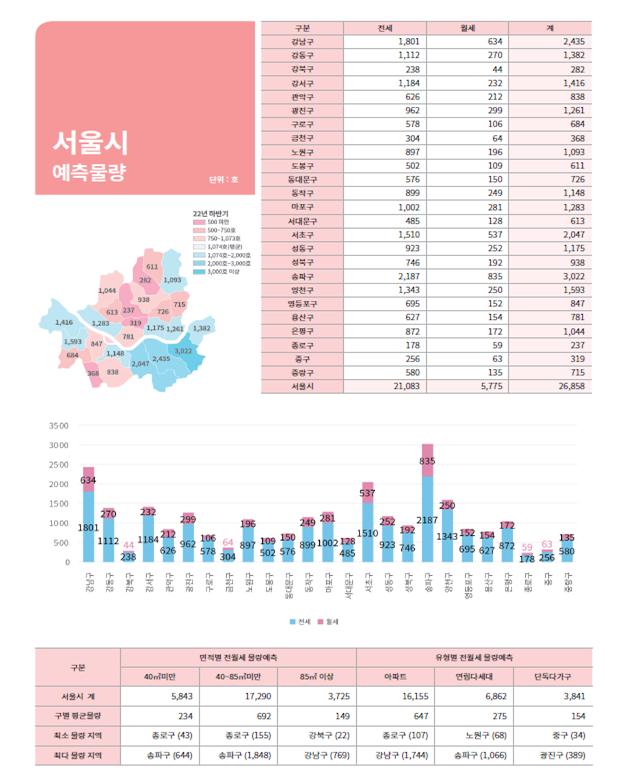
The "Jeonse and Monthly Rent Rental Volume Forecast Information" assumes new Jeonse and monthly rent contracts entering the rental market and analyzes the expiration timing of renewal contracts on a monthly basis to forecast and disclose the volume by autonomous district. The city expects this information to reduce cases where tenants hastily sign contracts due to anxiety that no listings will be available when searching for Jeonse or monthly rent.
The volume forecast can be checked with detailed analysis by region, area, and type. According to the analysis, the total forecasted volume of Jeonse and monthly rent contracts expiring in the second half of this year (August to December) in Seoul is expected to be up to 26,858 cases. The actual volume entering the market may differ due to tacit renewals and new housing supply. By area and type, the average number per district is 647 for apartments, 275 for multi-family and row houses, and 154 for detached and single-family houses.
To prevent "empty Jeonse," where the Jeonse price exceeds the sale price, the city also provides "Jeonse Price Ratio by Region." By distinguishing areas with debt ratios above 80% and 90%, tenants can check in advance whether a contract is an empty Jeonse.
Looking at the city’s analysis of the Jeonse price ratio by autonomous district for the second quarter of this year, the average for new apartment contracts was 54.2%, and for renewal contracts, 38.3%. For multi-family and row houses, the average Jeonse price ratio was 84.5% for new contracts and 77.5% for renewals, somewhat higher than apartments, with higher ratios observed in districts with many newly built villas such as Gangseo, Yangcheon, Geumcheon, and Gangdong.
Additionally, the city provides "Jeonse and Monthly Rent Conversion Rate Information" so that tenants can directly compare the rent proposed by landlords and use it effectively in contract negotiations. The conversion rate for the second quarter of this year was 3.9% on average for apartments and 5.2% for multi-family and row houses.
The city plans to update and disclose the "Jeonse and Monthly Rent Market Indicators" quarterly. The data can be downloaded and utilized from the "Seoul Housing Portal Homepage → Notifications and Communication → Jeonse and Monthly Rent Information Mongttang," and will also be distributed in booklet form through each district office.
Yoo Changsoo, Director of the Seoul Housing Policy Office, said, "We expect that tenants will be able to use transparently disclosed market indicators to avoid entering into unfavorable contracts."
© The Asia Business Daily(www.asiae.co.kr). All rights reserved.
![Clutching a Stolen Dior Bag, Saying "I Hate Being Poor but Real"... The Grotesque Con of a "Human Knockoff" [Slate]](https://cwcontent.asiae.co.kr/asiaresize/183/2026021902243444107_1771435474.jpg)

















