2008 Hwaseong City Hall Official Discovered While Cleaning
Nearly Complete Skeleton with All Bones in Place
Valuable Academic Material for Understanding Ceratopsian Dinosaur Evolution Process
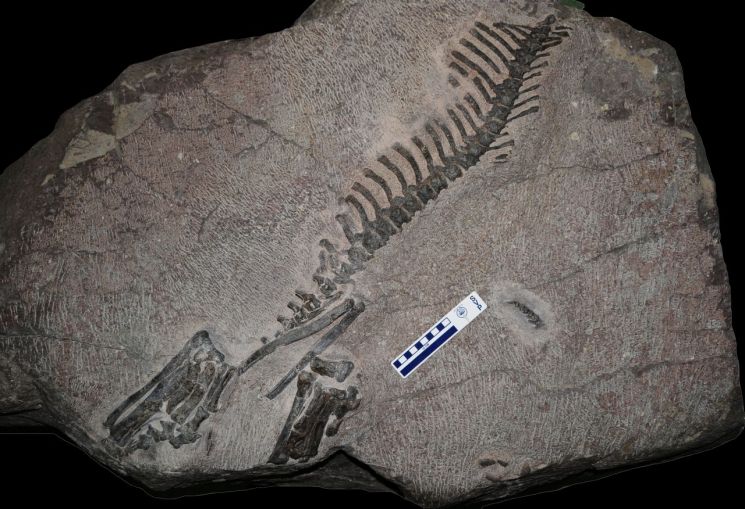
The newly discovered ceratopsian skeleton fossil, the first of its kind found in Korea, will be designated as a national natural monument. It is the skeleton fossil of the Hwaseong horned dinosaur (Koreaceratops hwaseongensis). The Cultural Heritage Administration announced on the 22nd that it will finalize the designation after collecting opinions from various sectors for a month and undergoing a review by the Cultural Heritage Committee.
The Hwaseong horned dinosaur skeleton fossil is the lower body skeleton fossil of a ceratopsian, commonly known as a horned dinosaur. In 2008, a Hwaseong city official discovered the bones of both legs, feet, pelvis, and tail while cleaning around the Jeongok Port breakwater. The bones were almost completely intact and in their original positions. Through academic research by Professor Lee Yoong-nam of the Department of Earth and Environmental Sciences at Seoul National University, it was recognized as a new species of ceratopsian first discovered in Korea and named Koreaceratops hwaseongensis, meaning the Korean horned dinosaur found in Hwaseong. It is displayed at the Dinosaur Egg Fossil Site Visitor Center in Hwaseong.
The Hwaseong horned dinosaur skeleton fossil proves that ceratopsians lived on the Korean Peninsula about 120 million years ago during the Early Cretaceous period of the Mesozoic era. The total length is approximately 2.3 meters. Based on the remaining skeleton, it is estimated that it was bipedal. Professor Lee recently discovered through histological studies of the skeleton that this dinosaur died at the age of eight.
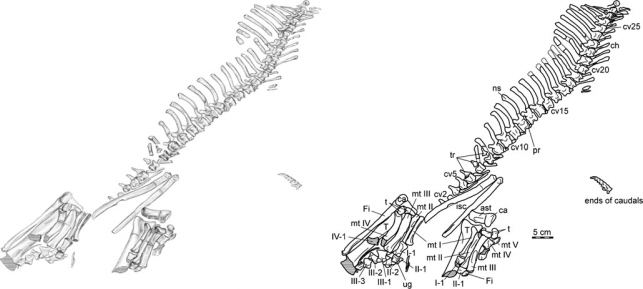
The Cultural Heritage Administration explained, "It is one of the very few dinosaur skeleton fossils found in Korea and is well-preserved in its original form. It has also been internationally recognized as a new species of ceratopsian." They evaluated it as "a valuable academic resource for understanding the evolutionary process of ceratopsian dinosaurs on the Korean Peninsula, where dinosaur skeleton fossils are scarce."
So far, thirteen dinosaur-related relics have been designated as natural monuments. These include the Uiseong Jeori Dinosaur Footprint Fossil Site (1993), Haenam Uhwang-ri Dinosaur, Pterosaur, and Bird Footprint Fossil Site (1998), Jinju Gajin-ri Bird and Dinosaur Footprint Fossil Site (1998), Goseong Deokmyeong-ri Dinosaur and Bird Footprint Fossil Site (1999), Hwaseong Gojung-ri Dinosaur Egg Fossil Site (2000), Boseong Bibong-ri Dinosaur Egg Fossil Site (2000), Yeosu Nangdo-ri Dinosaur Footprint Fossil Site (2003), Sacheon Adu Island Dinosaur Fossil Site (2006), Hwasun Seoyuri Dinosaur Footprint Fossil Site (2007), Jinju Chungmugong-dong Pterosaur, Bird, and Dinosaur Footprint Fossil Site (2011), Sinan Amhaedo Theropod Dinosaur Nest Fossil (2012), Gunsan Sanbuk-dong Dinosaur and Pterosaur Footprint Fossil Site (2014), and Jinju Jeongchon-myeon Cretaceous Dinosaur and Pterosaur Footprint Fossil Site (2021).
© The Asia Business Daily(www.asiae.co.kr). All rights reserved.
![Clutching a Stolen Dior Bag, Saying "I Hate Being Poor but Real"... The Grotesque Con of a "Human Knockoff" [Slate]](https://cwcontent.asiae.co.kr/asiaresize/183/2026021902243444107_1771435474.jpg)
















