Shooting Practice Completely Different from Reality
Frontline Police Officers Question Effectiveness
Unclear Civil Liability Also a Burden
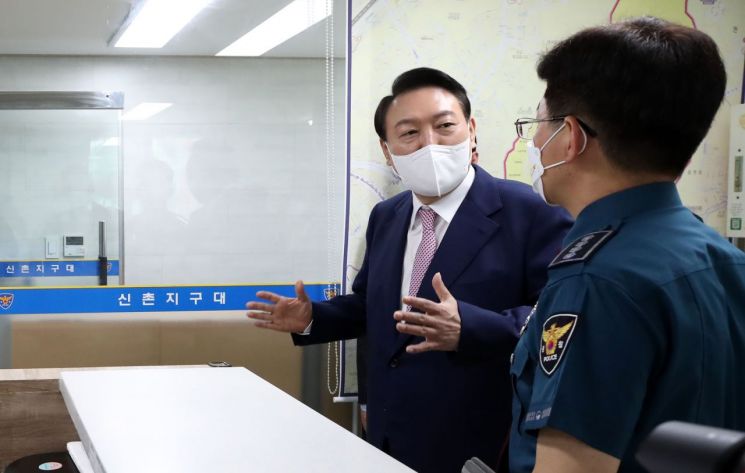
[Asia Economy Reporters Byungseon Gong, Sehee Jang] Frontline police officers have doubts about the effectiveness of the police's 'one person, one firearm possession' policy.
According to a summary of Asia Economy's coverage on the 22nd, police officers working at district police stations and patrol offices said that since they rarely have to actually use handguns, the policy would not be of much help on the ground. They emphasized that they use taser guns more often than handguns, which cause direct harm to life.
Never Used in 20 Years... Questions on Effectiveness
A sergeant working at a frontline police station in Seoul said, "Shooting practice with a handgun and shooting at an actual person are completely different. You cannot fire unless you are 100% certain, and so far, I have never used it even once."
A team leader working at a district police station in Seoul said, "In my 20 years of service, I have never fired a handgun to subdue a suspect," adding, "It is more desirable to increase the supply of taser guns rather than handguns that cannot even be used."
Another sergeant said, "Unlike foreign countries, it is extremely rare for civilians to use guns in our country," and added, "Most cases involve physical force, so protective equipment such as shields that can respond to close-range physical force is necessary."
The biggest issue is the unclear responsibility. Even in cases where subduing was necessary, if the victim's family files a civil lawsuit, the police have to bear all the litigation costs.
One police officer said, "Support measures for dealing with lawsuits should be provided when firing is truly necessary and the shot hits the body above the thigh." Another officer also said, "If the suspect is carrying a dangerous object and threatens the police and citizens, they should be able to subdue without hesitation and not be held responsible." A patrol officer working at a district police station in Gyeonggi Province questioned, "During training, we are told to shoot based on the situation on site, but who would take such a risky action when they are not free from civil and criminal liability?"
"Strengthen Taser Gun Training, Free from Civil and Criminal Liability"
There is also an opinion that training on taser guns, which are used more frequently, needs to be strengthened. A patrol officer said, "If you shoot a taser gun at padded clothing in winter, it does not penetrate at all, so you have to shoot past the thigh to the buttocks," adding, "Taser gun cartridges cost 60,000 won each, which is very expensive, so we cannot train as often as actual shooting."
There are also side effects from handgun possession. In 2015, a police officer belonging to the Mapo Police Station in Seoul took his own life using the handgun he carried.
Professor Woonghyuk Lee of Konkuk University's Department of Police Science said, "Not using firearms is the culture on the ground," and added, "A legal and institutional foundation must first be established so that officers can be free from criminal and civil liability."
He continued, "There are cases where officers are disciplined or investigated for using firearms unnecessarily. Rather than pointing out problems with firearm use itself within the organization, the facts should be ascertained and dealt with accordingly."
© The Asia Business Daily(www.asiae.co.kr). All rights reserved.
![Clutching a Stolen Dior Bag, Saying "I Hate Being Poor but Real"... The Grotesque Con of a "Human Knockoff" [Slate]](https://cwcontent.asiae.co.kr/asiaresize/183/2026021902243444107_1771435474.jpg)
















