[Asia Economy Reporter Yoo In-ho] Our government has gained time for negotiations to seek a solution to the compensation issue for forced labor victims with the Japanese government.
According to diplomatic circles on the 21st, the judiciary's decision to forcibly sell the domestic assets of Japanese war crime companies to pay compensation to forced labor victims was postponed on the 19th.
The Supreme Court delayed its final judgment, stating that it would take a closer look at the special cash conversion order case concerning two patents of Japan's Mitsubishi Heavy Industries.
The Supreme Court's Third Division did not decide whether to dismiss the retrial filed by Mitsubishi against the special cash conversion order on the two patents on that day.
A dismissal without review means that the Supreme Court rejects the case without further examination and maintains the lower court's ruling. According to the Special Act on Appellate Procedures, the court must decide whether to dismiss within four months of receiving the case. This case, received on April 19, had a decision deadline on the 19th of this month.
With the cash conversion procedure postponed, our government believes it has gained time to consult with the Japanese government on the forced labor compensation issue, which is considered the biggest conflict factor in Korea-Japan relations.
The government stated, "We respect the judiciary's judgment," while showing a sense of relief internally. President Yoon Seok-yeol recently reiterated his commitment to improving Korea-Japan relations in his Liberation Day speech and the 100-day inauguration press conference.
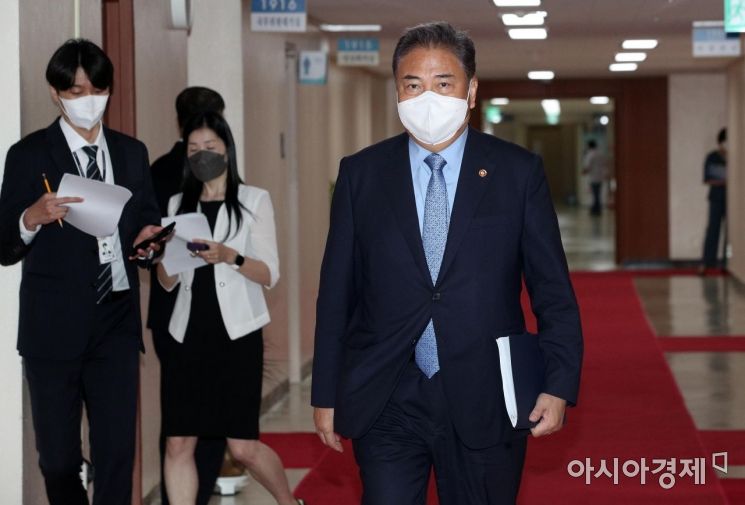 Foreign Minister Park Jin is attending the Cabinet meeting held at the Government Seoul Office in Jongno-gu, Seoul on the 16th. Photo by Kim Hyun-min kimhyun81@
In this regard, Foreign Minister Park Jin said regarding the possibility of the Supreme Court's final decision on the sale (cash conversion) of domestic assets of Japanese companies that refused to comply with the forced labor compensation ruling, "I do not know how the Supreme Court will decide, but we will respect it."
However, while the victims' side demanded immediate cash conversion and opposed the Supreme Court's decision on the day, the Japanese government still opposes accepting the cash conversion of Japanese companies' assets for compensation to forced labor victims, making it unlikely that the gap in positions will narrow easily in the future.
© The Asia Business Daily(www.asiae.co.kr). All rights reserved.
![Clutching a Stolen Dior Bag, Saying "I Hate Being Poor but Real"... The Grotesque Con of a "Human Knockoff" [Slate]](https://cwcontent.asiae.co.kr/asiaresize/183/2026021902243444107_1771435474.jpg)















