Exhibition of Three Large Swords of 'Isaji Wang' from Geumgwanchong Excavation at Gyeongju National Museum
Evidence to Identify Geumgwanchong Owner: "Presumed Silla King or High-Ranking Royal Family Member"
The Geumgwanchong Tomb in Gyeongju is the first tomb where a Silla gold crown was discovered. It was found in September 1921 during the Japanese colonial period. While constructing a house, artifacts were unearthed, and the Japanese Government-General of Korea conducted the excavation. Skipping formal investigation, amateur archaeologists and the general public were involved, collecting only the burial goods. No materials useful for research were obtained.
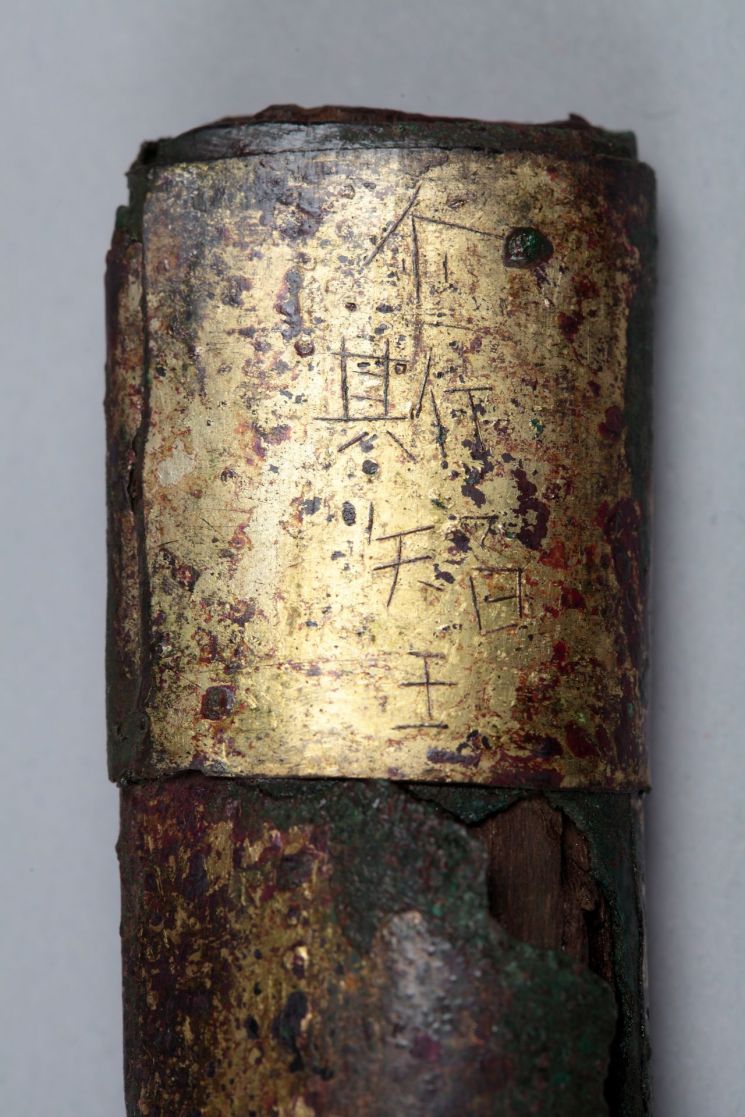
To gather basic data, the National Museum of Korea and the Gyeongju National Museum launched a re-excavation project in 2015. During the tomb dismantling investigation phase, the excavation team found a sword sheath tip ornament. On both sides, inscriptions reading '?斯智王刀 (Isajiwangdo)' and '十 (ten)' were engraved. The former means "Sword of King Isaji." Among Silla tomb artifacts, it is the only one bearing a king's name.
Since the 19th, the Gyeongju National Museum has been permanently exhibiting three large swords inscribed with "Isajiwang" excavated from Geumgwanchong. Another sword of Isajiwang is a ring-handled large sword. The National Museum of Korea discovered the inscription "Isajiwang" while organizing and preserving unpublished materials from the Government-General Museum in 2013. Two years later, the sword sheath tip ornament inscribed "Isajiwangdo" was confirmed, highlighting the basis for estimating the owner of Geumgwanchong as King Isaji. Most Silla tombs' owners remain unidentified.
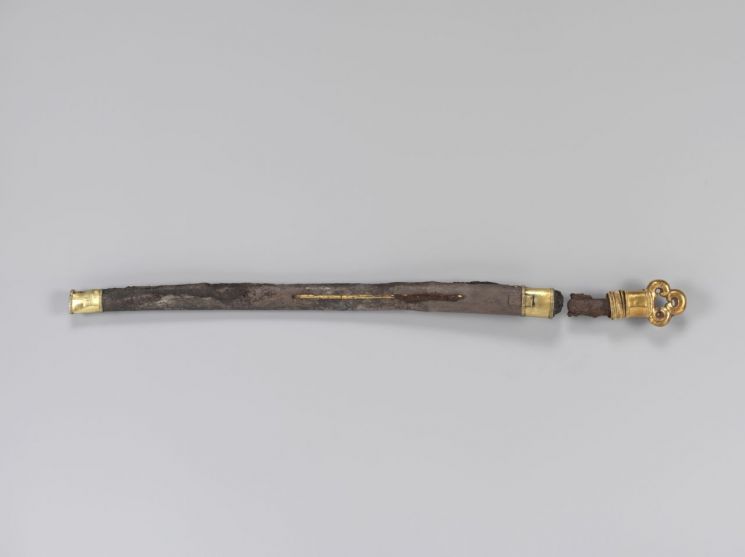
The exact identity of King Isaji is unclear. A representative from the Gyeongju National Museum stated, "He is presumed to be a Silla king or a high-ranking royal who died about 500 years ago," adding, "Before discovering this sword, the oldest known Silla king's name was Jijeungwang (至都盧葛文王, King Jijeung) inscribed on the Naengsuri Silla Stele (estimated 503 AD), but Isajiwang appears to predate him." They further noted, "It is one of the oldest artifacts bearing a Silla king's name, holding great academic significance."
The two "Isajiwang" swords had been exhibited at the National Museum of Korea. Due to increased interest in Geumgwanchong and related artifacts, they were moved to the Gyeongju National Museum. A museum official said, "This is an opportunity to see the three large swords as well as major artifacts from Geumgwanchong in one place," adding, "By leveraging connections with nearby historical sites, we aim to provide a more meaningful experience within the context of the thousand-year-old capital, Gyeongju."
© The Asia Business Daily(www.asiae.co.kr). All rights reserved.
![Clutching a Stolen Dior Bag, Saying "I Hate Being Poor but Real"... The Grotesque Con of a "Human Knockoff" [Slate]](https://cwcontent.asiae.co.kr/asiaresize/183/2026021902243444107_1771435474.jpg)
















