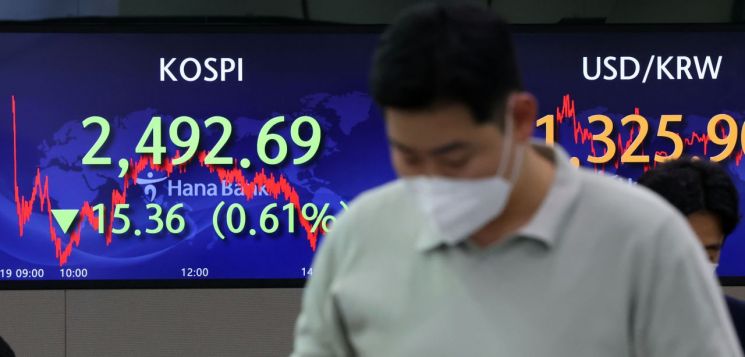
[Asia Economy Reporter Kwon Jae-hee] The KOSPI closed below the 2,500 mark again on the 19th, falling for the third consecutive day. This is attributed to the burden on foreign investors' supply and demand, as the exchange rate briefly surpassed a new high during the session.
On the day, the KOSPI closed at 2,492.69, down 0.61% (15.36 points) from the previous trading day. It was the first time in six trading days since the 10th (2,480.88) that the closing price fell below 2,500.
The index opened at 2,510.72, up 0.11% (2.67 points) from the previous close, but turned downward early in the session and continued a weak trend.
By investor type, institutions and foreigners sold net amounts of 201.4 billion KRW and 90.5 billion KRW, respectively. Institutions maintained a net selling position for the fourth consecutive trading day.
On the other hand, individual investors bought stocks worth 271.6 billion KRW, absorbing the supply poured into the market.
Earlier, the July Federal Open Market Committee (FOMC) minutes reaffirmed the Federal Reserve's (Fed) intention to raise interest rates, and hawkish remarks from Fed officials the previous day further highlighted concerns about tightening monetary policy.
James Bullard, President of the Federal Reserve Bank of St. Louis and a representative hawk, expressed support for a 0.75 percentage point rate hike in September. Neel Kashkari, President of the Federal Reserve Bank of Minneapolis, also emphasized the need for rapid rate increases.
Hawkish remarks from Fed officials, rising U.S. Treasury yields, and the simultaneous weakness of the euro and yuan accelerated the strength of the dollar.
The won-dollar exchange rate closed at 1,325.9 won, up 5.2 won from the previous day. During the session, it surged to 1,328.8 won, setting a new high.
The deepening weakness of the won negatively affected the supply and demand conditions for foreigners, who have recently supported KOSPI's supply and demand, prompting stock price declines and leading to a vicious cycle of further exchange rate increases.
Lee Kyung-min, a researcher at Daishin Securities, explained, "The rise in the won-dollar exchange rate due to increased pressure from dollar strength created unfavorable conditions for foreign investors' supply and demand, limiting the upper bound of the KOSPI. Investor sentiment also retreated somewhat as they digested the Fed presidents' remarks on monetary policy directions."
Among the top market capitalization stocks, Samsung Electronics (-0.98%), LG Energy Solution (-1.11%), Samsung Biologics (-0.80%), LG Chem (-1.69%), Samsung SDI (-0.96%), and NAVER (-0.80%) all declined consecutively.
In particular, KakaoBank fell 8.17%, hitting its lowest price since listing due to the block deal (large off-hours trade) of shares held by KB Kookmin Bank, and its parent company Kakao also dropped 3.16%.
Conversely, Hyundai Motor (2.15%) and Kia (0.65%), which had fallen recently after being excluded from U.S. electric vehicle tax benefits, and Hyundai Mobis (1.66%), which had plunged on news of splitting its module and parts business, rebounded on buying interest.
By sector, only transportation equipment (1.25%), insurance (1.06%), telecommunications (0.45%), and textiles/apparel (0.24%) showed strength, while most sectors such as medical precision (-2.77%), non-metallic minerals (-1.85%), chemicals (-1.20%), transportation and warehousing (-1.13%), and construction (-1.11%) were weak.
The KOSDAQ index closed at 814.17, down 1.44% (11.89 points) from the previous trading day.
The index opened at 827.25, up 0.14% (1.19 points) from the previous day, but turned downward and widened its losses.
In the KOSDAQ market, foreigners and institutions sold net amounts of 150.4 billion KRW and 128.5 billion KRW, respectively. Individuals bought net 280.9 billion KRW.
Among the top market capitalization stocks on KOSDAQ, 18 stocks declined except for HLB (1.31%) and Pearl Abyss, which closed flat. The largest declines were seen in EcoPro BM (-3.14%), L&F (-5.33%), Kakao Games (-3.15%), EcoPro (-4.46%), Chunbo (-4.51%), and Wemade (-4.27%).
The daily trading volume was about 7.0719 trillion KRW on the KOSPI market and about 6.497 trillion KRW on the KOSDAQ market.
© The Asia Business Daily(www.asiae.co.kr). All rights reserved.
![Clutching a Stolen Dior Bag, Saying "I Hate Being Poor but Real"... The Grotesque Con of a "Human Knockoff" [Slate]](https://cwcontent.asiae.co.kr/asiaresize/183/2026021902243444107_1771435474.jpg)











