Changwon National University and Naval Academy Joint Special Exhibition Free Until November 30
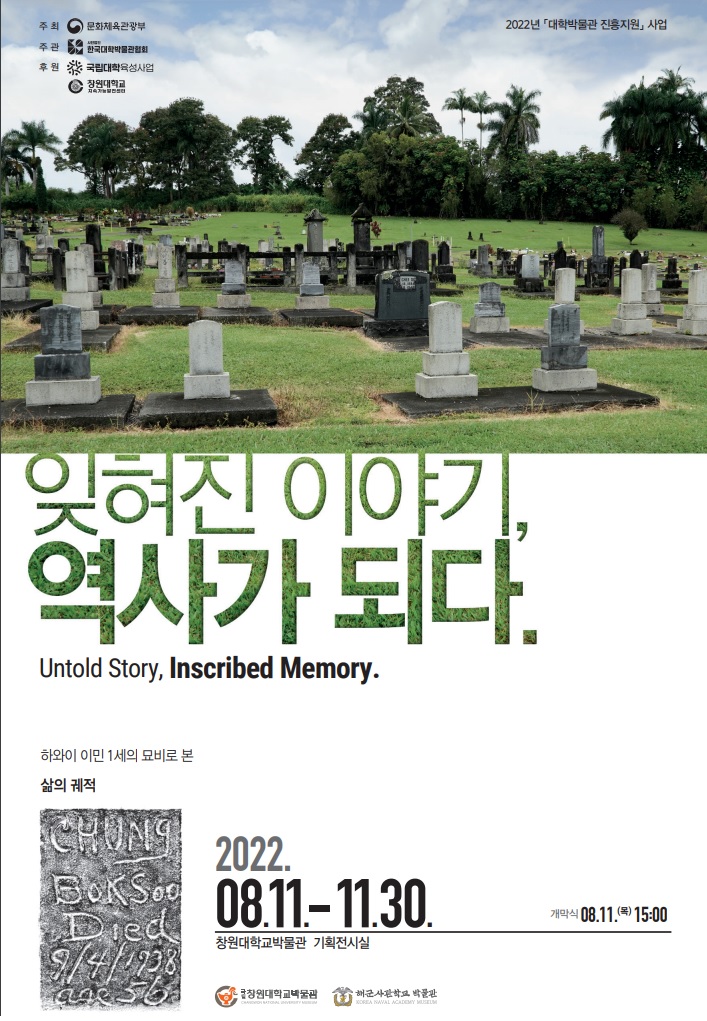
[Asia Economy Yeongnam Reporting Headquarters Reporter Lee Se-ryeong] Changwon National University Museum and the Naval Academy Museum have prepared a joint special exhibition titled "Forgotten Stories Become History - The Life Trajectory Seen Through the Tombstones of First-Generation Hawaiian Immigrants" to commemorate the 140th anniversary of Korea-US diplomatic relations and the 120th anniversary of Hawaiian immigration.
The exhibition held at Changwon National University Museum will showcase for the first time rubbings of tombstones of early Hawaiian immigrants.
Passports from that time, ship passenger lists, donor lists for independence movement funds, and picture brides will also be exhibited.
Visitors can also see treasures held by the Naval Academy Museum, including the calligraphy of independence activist Ahn Jung-geun, "임적선진 위장의무 (臨敵先進爲將義務)" and "청초당 (靑草塘)".
In December 1902, 121 Koreans departed for Hawaii from Incheon Port aboard the Gaelic, most of whom worked in sugarcane fields.
Despite the hardships of living in a foreign land, they longed for their homeland and prayed for the independence of their country.
They organized Korean associations and military groups, and raised funds for lawyers to defend Ahn Jung-geun and to support his bereaved family, actively participating in fundraising for the independence movement.
The average daily wage earned by immigrants was $0.7. Although barely enough to make ends meet, they collected amounts ranging from $0.25 to $3 to support independence fighters.
As time passed, they gradually passed away one by one, and to preserve each other's lives, they erected tombstones at gravesites, inscribing names with fingers or nails before the cement hardened.
Changwon National University Museum recognized that these stories were gradually being forgotten and that the graves, many without proper tombstones, were being neglected or disappearing.
In 2019, the university museum, together with the Changwon National University Regional Future Link Center, conducted local investigations in Hawaii to trace the traces of first-generation Korean immigrants.
While making rubbings of the tombstones of first-generation Korean immigrants, they collected related materials and, after follow-up research, published a report titled "Transnational Space of the Dead: Early Korean Immigrant Tombstones on Hawaii's Big Island."
This year, after conducting additional local investigations in Hawaii, the museum secured more tombstone rubbings and related materials, which served as the basis for holding this exhibition.
Lee Ho-young, president of Changwon National University, said, "The investigation project of Hawaiian immigrant tombstones is a very valuable work that a regional national university can undertake, and we will continue to provide support. We will do our best to make exchange and cooperation projects for the local community more active together with the Naval Academy."
Ahn Sang-min, superintendent of the Naval Academy, said, "The calligraphy '임전선진위장의무' by General Ahn Jung-geun, an independence activist and lieutenant general of the Korean military, means that advancing first against the enemy is the duty of a commander, highlighting an important virtue that soldiers and officers must possess. It is very meaningful that this calligraphy is exhibited together with the tombstone rubbings of Hawaiian Korean immigrants and materials showing their donations for General Ahn Jung-geun."
Yoon Sang, director of the museum, said, "This is a diverse exhibition where you can confirm the life trajectory of first-generation Hawaiian immigrants along with Ahn Jung-geun's calligraphy. We hope many people will show interest and support for the efforts of museum researchers to restore forgotten stories as history."
Moon Kyung-hee, professor of International Relations and leader of the local investigation team, emphasized, "This exhibition provides materials that offer clues to Hawaiian immigration history by revealing the social and economic conditions of Hawaii at the time, the identity of immigrant groups, language usage habits by immigrant generation, and the immigrants' regions of origin, allowing us to understand their lives and deaths."
Kim Ju-yong, curator in charge of the local investigation, explained, "This exhibition is the first research result confirming the owners of the tombstones through various materials such as rubbings, ship passenger lists, passport issuance records, and picture bride records, and will be a new achievement in Hawaiian immigration history research."
This special exhibition will run until November 30 and can be viewed free of charge from Monday to Saturday, 10 a.m. to 5 p.m.
© The Asia Business Daily(www.asiae.co.kr). All rights reserved.
![Clutching a Stolen Dior Bag, Saying "I Hate Being Poor but Real"... The Grotesque Con of a "Human Knockoff" [Slate]](https://cwcontent.asiae.co.kr/asiaresize/183/2026021902243444107_1771435474.jpg)















