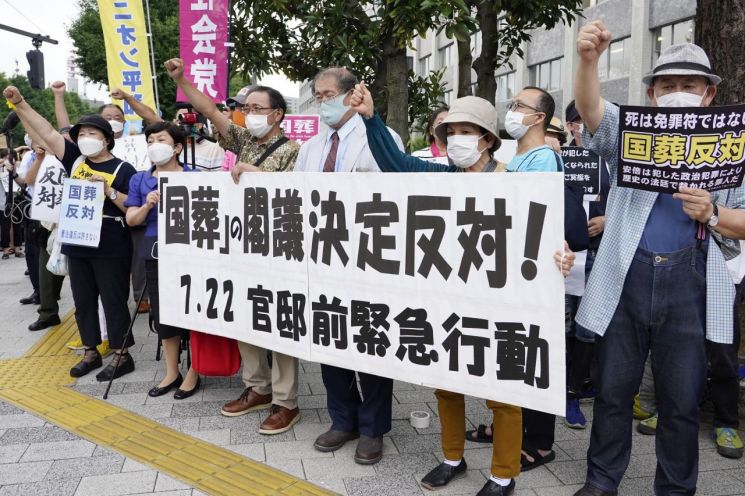
 On the 22nd of last month, protesters gathered in front of the Prime Minister's Official Residence in Tokyo, Japan, to protest the Cabinet's decision to hold a state funeral for former Prime Minister Shinzo Abe. [Image source=Yonhap News]
[Asia Economy Reporter Lee Ji-eun] Opposition within Japan is intensifying over holding former Prime Minister Shinzo Abe's funeral as a state funeral. The reason is that it is considered inappropriate for the government to cover all the costs of a former prime minister's funeral. Despite this public opinion, Prime Minister Fumio Kishida is maintaining his stance. Analysts say he is pushing for the state funeral for political purposes, such as consolidating the conservative base.
On the 19th, the Nihon Keizai Shimbun reported that the Japanese government is coordinating the number of attendees for Abe's state funeral, scheduled for the 27th of next month, to be 6,000 people. Foreign delegations are also expected to attend the state funeral, and the Japanese government has sent invitations to 195 countries and 80 international organizations. Each country can send up to three representatives, and international organizations up to two.
This will be the first state funeral for a former prime minister in Japan in 55 years, since former Prime Minister Shigeru Yoshida in 1967.
Initially, it was expected that Abe's funeral would be a joint funeral by the Liberal Democratic Party and the Cabinet, following precedent. When former Prime Minister Keizo Obuchi died of a stroke in 2000, a family funeral was held first, followed by a joint funeral. However, the Japanese government announced that considering Abe's significant achievements in diplomacy and his status as the longest-serving prime minister in history, they decided to hold a state funeral.
Some opposition parties have opposed the government's decision. According to NHK, four opposition parties?the Constitutional Democratic Party, Nippon Ishin no Kai, Democratic Party for the People, and the Communist Party?have expressed their intention to review the decision on Abe's state funeral in a special Diet session. The Communist Party opposed the state funeral, citing concerns that it could force people to express condolences amid sharply divided political evaluations of Abe. They also pointed out that unlike a joint funeral, a state funeral requires the government to bear all funeral costs, leading to significant budget expenditure.
Public opinion also shows more opposition than support for the state funeral. A Kyodo News poll conducted on the 30th and 31st of last month among voters found that 56% could not accept the decision for Abe's state funeral, surpassing the 42.5% who found it acceptable.
Nevertheless, the Japanese government held a cabinet meeting on the 22nd of last month and finalized the decision to hold the state funeral at Tokyo's Budokan on September 27. Japanese media reported that the unusual decision to hold Abe's funeral as a state funeral largely reflects Prime Minister Kishida's intentions. Although voices within the party were mindful of public opinion, Kishida actively incorporated opinions from his circle that the state funeral was appropriate considering Abe's achievements.
Some analysts suggest that Kishida, who has generally respected opposition parties and public opinion, is showing considerable deference to the Abe faction by not yielding on the state funeral issue. The Abe faction, the largest faction within the Liberal Democratic Party accounting for one-quarter of its members, has lost its central figure following Abe's death.
There is also a view that Kishida is using the state funeral as a means to prevent conservative supporters of the Liberal Democratic Party from defecting. A Liberal Democratic Party lawmaker told Nippon TV in an interview, "To easily push future policies and secure conservatives as a support base, it may have been judged appropriate to hold the state funeral that they demand."
Additionally, there are opinions that Kishida intends to use the state funeral to conduct "condolence diplomacy." The plan is to hold summit meetings with foreign leaders visiting Japan for the state funeral and to convey the perception that he is the legitimate successor to former Prime Minister Abe.
Currently, former U.S. President Barack Obama, former German Chancellor Angela Merkel, and French President Emmanuel Macron, among other former and current presidents, are coordinating their attendance at the state funeral. South Korea plans to send a condolence delegation to Japan, including Prime Minister Han Duck-soo.
A senior official from the Ministry of Foreign Affairs told Yomiuri, "We see this as an excellent opportunity to promote the 'Free and Open Indo-Pacific' vision, which the Abe Cabinet pursued as a joint diplomatic strategy with the United States, to the international community," adding, "Government officials believe this condolence diplomacy will benefit national interests."
© The Asia Business Daily(www.asiae.co.kr). All rights reserved.

















