[Asia Economy Reporter Oh Hyung-gil] Domestic gasoline prices are expected to return to pre-Russia-Ukraine war levels this month. Prices have sharply dropped by 130 KRW per liter in just three weeks.
The effect of the fuel tax reduction combined with a sharp decline in international oil prices is expected to lower prices to around 1,600 KRW per liter by the end of this month.
According to the Korea National Oil Corporation's oil price information site Opinet on the 21st, the average gasoline price at gas stations nationwide in the third week of this month was 1,780.1 KRW, about 100 KRW lower than the 1,881.8 KRW recorded in the first week.
As of the 19th, the nationwide average gasoline price was 1,760.2 KRW, down 129.6 KRW from 1,889.8 KRW on the 1st.
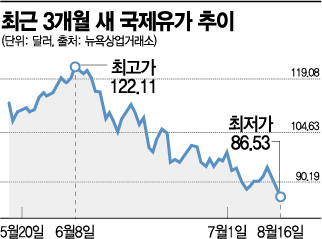
As international oil prices have fallen to pre-Russia-Ukraine war levels, domestic fuel prices are also showing a downward trend.
According to the New York Mercantile Exchange (NYMEX), the price of WTI (West Texas Intermediate) crude oil for September delivery was $86.53 per barrel on the 16th (local time), down 3.22% from the previous day. This is the lowest price in seven months since January 25 ($85.6 per barrel), effectively returning to the price level one month before the Russia-Ukraine war outbreak (February 24).
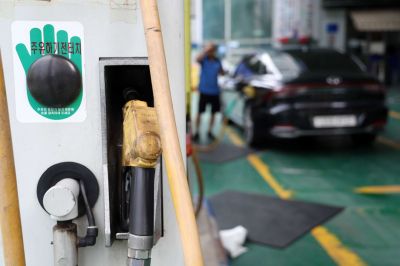 Domestic gas prices at gas stations have fallen for five consecutive weeks due to the expanded reduction rate of fuel tax and the decline in international oil prices. According to Opinet, the oil price information service of the Korea National Oil Corporation, the average selling price of gasoline at gas stations nationwide in the first week of August was 1,881.9 KRW per liter, down 55.8 KRW from the previous week. This is the first time in five months since the second week of March that the average gasoline price has dropped to the 1,800 KRW per liter range. Photo by Moon Honam munonam@
Considering the downward trend in international oil prices, domestic fuel prices are also expected to return to pre-war levels soon. On February 24, the day the Russia-Ukraine war broke out, the domestic gasoline price was 1,746.2 KRW.
In particular, concerns over an economic slowdown in China, the world's largest crude oil importer, are expected to keep international oil prices weak for the time being.
On the 15th, China's National Bureau of Statistics announced that industrial production in July increased by 3.8% compared to the same month last year. This figure is lower than the market expectation (around 4.5%) and even lower than June's growth rate of 3.9%, which was affected by lockdowns.
Retail sales also increased by only 2.7%, falling short of both market expectations (around 5%) and the previous month's growth rate (3.1%). The Wall Street Journal (WSJ) analyzed this as "meaning that demand in China, which consumes 15% of the world's oil, is weakening."
As fuel prices continue to decline, interest is growing in the timing of restoring the currently implemented fuel tax reduction.
Initially, the government expanded the fuel tax reduction rate from 30% to 37% and extended the implementation period from the end of July to the end of the year, a five-month extension. Additionally, the government increased the flexible fuel tax adjustment limit to 50%, securing room for further reductions.
However, if international oil prices continue to decline in the long term, concerns over reduced tax revenue may outweigh inflation management. The government reports that the 30% fuel tax reduction in May and June resulted in a tax revenue loss of 1.3 trillion KRW. The tax revenue loss due to the 37% fuel tax reduction until the end of the year is estimated at 5 trillion KRW.
© The Asia Business Daily(www.asiae.co.kr). All rights reserved.
![Clutching a Stolen Dior Bag, Saying "I Hate Being Poor but Real"... The Grotesque Con of a "Human Knockoff" [Slate]](https://cwcontent.asiae.co.kr/asiaresize/183/2026021902243444107_1771435474.jpg)
















