Operation of 'High-Risk Group Management Task Force' for Confirmed COVID-19 Elderly Living Alone and Patients with Underlying Conditions Aged 60 and Over in Jung-gu, Seoul
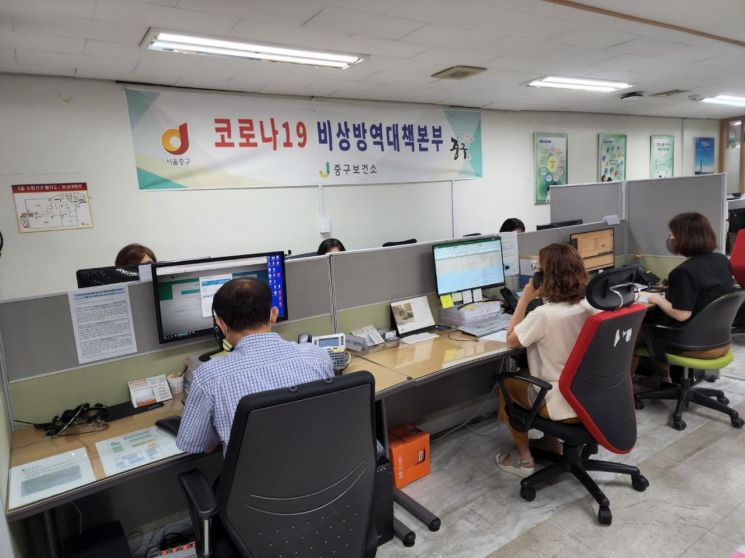
[Asia Economy Reporter Jong-il Park] “I truly thought I was going to die. One phone call saved my life.”
Mr. oo, in his 70s, living in Jung-gu, Seoul, was recently diagnosed with COVID-19. Living alone without a husband or children, Mr. oo’s worries about having no one to care for him outweighed the pain. To make matters worse, on the 14th, while undergoing home treatment, his sore throat worsened and his ear started hurting, increasing his anxiety. Although it was called home treatment, it was not easy for a solitary elderly person to take care of his health or obtain information.
“How am I supposed to know which hospital to go to right now, or how to make a reservation?” Just as he was fretting over these concerns, the phone rang.
“Sir, how is your health right now?”
It was a call from the ‘High-Risk Group Management Task Force’ operated by Jung-gu. After explaining his symptoms, Mr. oo was able to visit a hospital and receive in-person treatment immediately following the call. This was possible because the nurse from the task force reassured him and made a reservation at a hospital where he could be treated.
“Sir, don’t worry. I will contact the hospital and help you make an outpatient appointment.” For Mr. oo, this call washed away all his previous anxieties.
Jung-gu, Seoul (District Mayor Kim Gil-seong) is actively providing health care for high-risk groups among those undergoing home treatment after contracting COVID-19. This move is notable as it actually strengthens the intensive management of home treatment, which was abolished in August.
Jung-gu conducts health monitoring for high-risk groups such as elderly living alone aged 60 and above who have low access to medical information and require care, as well as patients with underlying conditions whose health may suddenly deteriorate, all of whom are undergoing home treatment after being diagnosed with COVID-19. This is to prepare for emergency situations.
Health monitoring involves specialized nurses standing by 24 hours a day, calling high-risk individuals such as elderly living alone daily to check their health status. This enables proactive prevention and rapid response to emergencies. The specialized personnel perform their duties without interruption during weekends, holidays, and nighttime hours.
Especially in the current situation where the number of severe COVID-19 cases is increasing, Jung-gu, which has a higher elderly population compared to other districts, requires systematic management of these individuals.
This is why health monitoring continues despite the government’s directive on August 1 to abolish intensive home treatment management.
From August 1 to 17, about 160 people were subject to health monitoring, averaging about 9 people per day. The district plans to respond swiftly to ensure there are no gaps in home treatment for COVID-19 patients through continuous management.
Additionally, since the 9th, Seoul Baek Hospital has been designated as a medical mobile task force for nursing facilities, providing in-person treatment and hospitalization so that elderly residents in infection-vulnerable facilities such as nursing homes can immediately receive prescriptions and treatment for COVID-19 and other underlying diseases.
District Mayor Kim Gil-seong stated, “We are monitoring high-risk COVID-19 patients 24 hours a day to ensure their safety,” and added, “We will continue to respond quickly to the COVID-19 situation to create a Jung-gu where residents can feel safe.”
© The Asia Business Daily(www.asiae.co.kr). All rights reserved.
![Clutching a Stolen Dior Bag, Saying "I Hate Being Poor but Real"... The Grotesque Con of a "Human Knockoff" [Slate]](https://cwcontent.asiae.co.kr/asiaresize/183/2026021902243444107_1771435474.jpg)















