Global Stock Prices and Major Currencies Decline, Leading to a Decrease in External Financial Assets
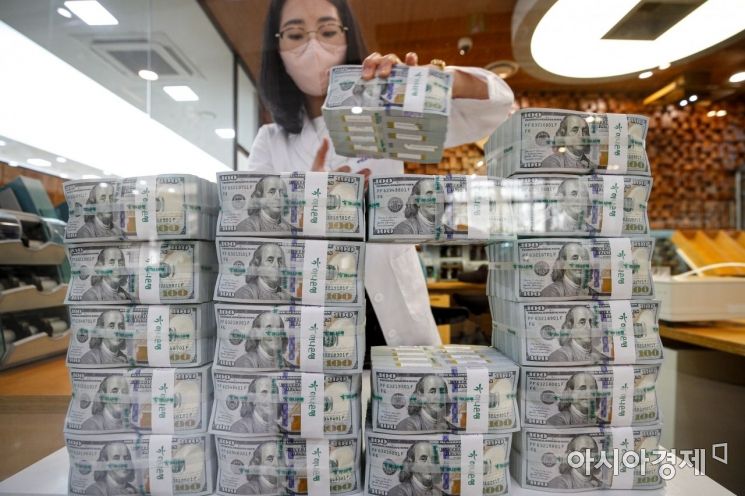
[Asia Economy Reporter Seo So-jeong] South Korea's short-term external debt ratio has risen to its highest level in 10 years. At the end of the second quarter, South Korea's external financial assets decreased by $65.8 billion compared to the previous quarter due to global stock price declines and depreciation of major currencies against the US dollar, marking the largest drop ever. This marks the first decline in nine quarters since the first quarter of 2020, when the COVID-19 pandemic began.
According to the 'International Investment Position' released by the Bank of Korea on the 18th, as of the end of June, the ratio of short-term external debt to South Korea's reserve assets (foreign exchange reserves) was 41.9%, up 3.7 percentage points from the end of the previous quarter. This is the highest level in 10 years since the second quarter of 2012 (45.6%).
The proportion of short-term external debt, which matures within one year, accounted for 27.8%, an increase of 1.0 percentage point from the end of the previous quarter.
Yoo Bok-geun, head of the Bank of Korea's Overseas Investment Statistics Team, said, "The short-term external debt increased and foreign exchange reserves decreased, causing the short-term external debt ratio to rise. Due to the strong dollar, emerging countries are commonly implementing measures to ease foreign exchange market volatility, and since foreign exchange reserves have not decreased since July, there is no concern about a decline in creditworthiness."
As of the end of June, external financial assets (external investments) stood at $2.1235 trillion, down $65.8 billion from $2.1893 trillion at the end of March.
Among external financial assets, residents' direct investment decreased by $0.8 billion compared to the end of the previous quarter, mainly in debt instruments.
Overseas securities investment fell by $68.4 billion due to global stock price declines and depreciation of major currencies against the US dollar. This is the largest decrease ever recorded.
Team leader Yoo explained, "External financial assets decreased by $65.8 billion compared to the end of the previous quarter, mainly due to residents' securities investments, marking a decline for the first time in nine quarters since the first quarter of 2020. Residents' securities investments showed the largest decrease ever due to non-transaction factors such as global stock price declines."
External financial liabilities (foreigners' domestic investments) amounted to $1.3794 trillion, down $113.9 billion from the end of the previous quarter, mainly due to foreigners' securities investments. Direct investment decreased by $14.9 billion, centered on equity investments, while foreigners' securities investments fell by $137.8 billion due to non-transaction factors such as domestic stock price declines and depreciation of the Korean won against the US dollar, marking the largest decrease ever.
Although both external financial assets and liabilities decreased, the larger decrease in external financial liabilities led to an increase in South Korea's net external financial assets, which reflect the country's external payment capacity, to $744.1 billion, up $48.1 billion from the previous quarter. This is the highest level ever recorded.
As of the end of June, South Korea's external debt stood at $662 billion, up $7.9 billion from $654.1 billion at the end of March, marking a record high.
During the same period, external claims amounted to $1.0482 trillion, down $31.7 billion from the end of the previous quarter. Depository institutions increased by $3.9 billion, but general government (-$0.7 billion), central bank (-$19.4 billion), and other sectors (-$15.4 billion) decreased.
Net external claims, calculated by subtracting external debt from external claims, stood at $386.1 billion, down $39.6 billion from the previous quarter, marking the largest decrease ever.
Team leader Yoo said, "External claims decreased by $31.7 billion mainly due to reserve assets and debt securities, while external debt increased by $7.9 billion mainly due to borrowings by depository institutions."
© The Asia Business Daily(www.asiae.co.kr). All rights reserved.
![Clutching a Stolen Dior Bag, Saying "I Hate Being Poor but Real"... The Grotesque Con of a "Human Knockoff" [Slate]](https://cwcontent.asiae.co.kr/asiaresize/183/2026021902243444107_1771435474.jpg)















