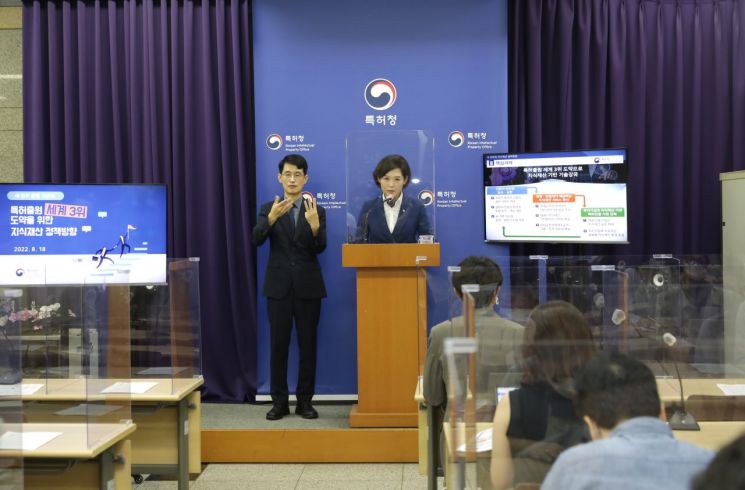
 Lee In-sil, Commissioner of the Korean Intellectual Property Office, is introducing the intellectual property policy direction and promotion strategy of the Korean Intellectual Property Office at the Government Complex Daejeon on the 18th. Photo by Je-go, Korean Intellectual Property Office
[Asia Economy (Daejeon) Reporter Jeong Il-woong] The Korean Intellectual Property Office (KIPO) has a strategy to secure leadership in intellectual property acquisition in advanced technology fields such as semiconductors, thereby enhancing the competitiveness of South Korea's industrial sector.
KIPO announced this direction for its intellectual property policy. The basic direction of the intellectual property policy focuses on strengthening the weak foundation through internal innovation in examination and trial, which are KIPO's core tasks, improving services from the perspective of intellectual property users, and restoring the domestic intellectual property ecosystem.
It also places emphasis on strengthening the global intellectual property competitiveness of companies by responding to the increasing intellectual property damages and disputes faced by domestic companies overseas.
◆ Solid foundation in examination and trial = KIPO plans to actively deploy retired private researchers in patent examinations. By involving retired personnel in examinations, it aims to enhance the professionalism and speed of examinations and prevent the leakage of excellent domestic technologies overseas through these retirees.
The deployment of retired personnel in examinations will start with the semiconductor field next year and gradually expand to batteries, 5G·6G, hydrogen, advanced robotics, bio, space·aerospace, and other fields in 2024.
In particular, advanced technologies such as semiconductors will be included in the priority examination targets to shorten the examination period, enabling patent preemption in advanced technology fields. For example, if the semiconductor field is included in the priority examination targets, the examination period is expected to shorten from an average of 12.7 months to 2.5 months, speeding up by more than 10 months, according to KIPO.
KIPO also plans to improve the quality of examination and trial by utilizing artificial intelligence technology. By 2027, an AI-based intelligent examination system will be introduced to increase the accuracy of similar patent and trademark searches and automate the examination of formal requirements stipulated by law (such as the appropriateness of the applicant and the method of document description), thereby supporting examination tasks.
◆ Innovation in intellectual property services = KIPO is also drawing a blueprint to establish a support system for discovering and developing promising technologies in science and industry (creation), fostering the growth of small and venture companies holding excellent intellectual property (utilization), and strengthening intellectual property protection (protection) through innovation in intellectual property services.
First, KIPO will analyze patent big data in advanced strategic industry fields to discover promising technologies and expand support for establishing national research and development (R&D) directions.
It also plans to build an AI-based real-time monitoring system within this year that automatically analyzes global patent big data by industry to detect changes in technology trends and warning signs of crises, thereby monitoring industrial trends.
KIPO will also pursue a strategy to activate intellectual property finance and transactions to support the growth of small and venture companies holding excellent intellectual property. The goal is to increase the scale of intellectual property finance from 6 trillion won in 2021 to 23 trillion won in 2027 and to raise the number of cost support projects for intellectual property valuation from 2,500 cases this year to 4,200 cases in 2027, enabling small and venture companies to raise business funds based on intellectual property.
To protect the created intellectual property, KIPO plans to modernize the litigation system by introducing expert fact-finding, witness examination between parties, and preservation orders for evidence, making it easier to obtain evidence held by infringers in patent infringement lawsuits.
◆ Strengthening intellectual property protection for overseas expanding companies = KIPO will also place emphasis on protecting companies' intellectual property not only domestically but also overseas.
To this end, KIPO will expand the dispatch of patent attach?s based on regions with high risks of intellectual property infringement and market importance, and establish regional IP-DESKs in areas with high demand for domestic companies' expansion to support preventing intellectual property damages locally overseas.
KIPO will also strive to create a global intellectual property environment favorable to Korean companies. It plans to expand the export of Korean-style intellectual property systems to regions such as the Gulf Cooperation Council (GCC) and South America, enabling companies to protect their intellectual property under systems similar to those in Korea.
Additionally, KIPO's strategy includes expanding the participation of Korean experts in the World Intellectual Property Organization (WIPO) to help shape international intellectual property norms favorable to Korean companies.
Lee In-sil, Commissioner of KIPO, said, “As demonstrated by various empirical studies in advanced countries, intellectual property is the key and driving force to restore the growth potential of the national economy. KIPO will firmly strengthen the domestic intellectual property foundation as a source of national and corporate competitiveness in the era of technological hegemony and lead South Korea’s dynamic economic growth.”
© The Asia Business Daily(www.asiae.co.kr). All rights reserved.
![Clutching a Stolen Dior Bag, Saying "I Hate Being Poor but Real"... The Grotesque Con of a "Human Knockoff" [Slate]](https://cwcontent.asiae.co.kr/asiaresize/183/2026021902243444107_1771435474.jpg)















