Three Major Supermarkets Fiercely Compete in 'Low-Price Chicken Battle'... Homeplus Offers Pizzas Starting at 2000 Won
Ultra-Low-Priced Products as an 'Attraction' Drawing Consumers Amid Economic Downturn
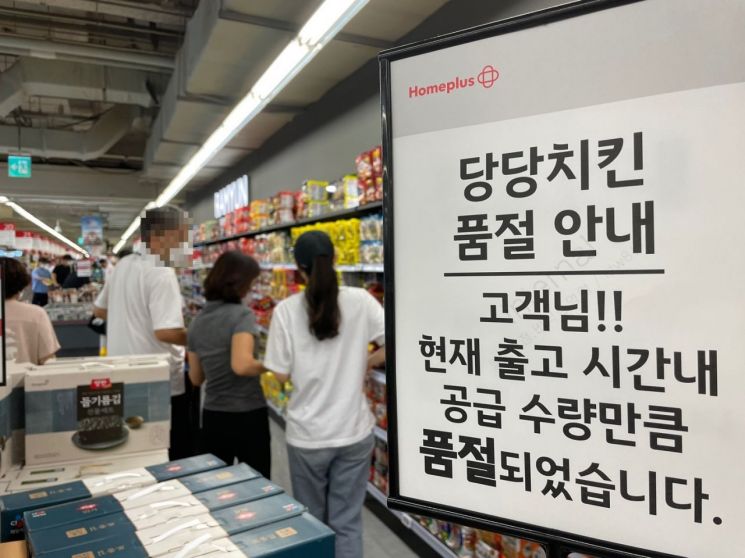
[Asia Economy Reporter Yoon Seul-gi] Starting with cost-effective mart chicken, the three major large marts have entered an ultra-low price competition. After Homeplus launched the 'Dangdang Chicken' priced at 6,990 won per chicken, which gained tremendous popularity, Lotte Mart and E-Mart also consecutively released low-priced chicken. In the current high inflation situation, as low-priced product marketing attracts consumers' attention, large marts have expanded their ultra-low price items.
The popularity of Homeplus's 6,990 won Dangdang Chicken, released at the end of June, continues. According to Homeplus, the cumulative sales volume of Dangdang Chicken surpassed 260,000 chickens as of the 2nd. Also, from July 28 to August 3, the weekly search volume for the keyword 'chicken' on Homeplus online increased by 1,036% compared to the same period last month.
In response, E-Mart and Lotte Mart have also joined the ultra-low price competition. E-Mart has been selling '5-Minute Chicken' priced at 9,980 won per whole chicken since the end of last month and announced that it will sell one fried chicken for 5,980 won until the 24th. After launching '5-Minute Chicken' last month, E-Mart's sales in July increased by about 26% compared to the same period last year.
Lotte Mart, the originator of low-priced chicken, is selling 'Hantong Chicken' (one and a half chickens) priced at 15,800 won at half price, 8,800 won, from the 11th to the 18th. Hantong Chicken, consisting of one and a half chickens, is Lotte Mart's representative product, selling an average of 35,000 units per month.
There is also a trend of increasing ultra-low price items. Homeplus announced that from the 18th, the 'Homeplus Signature Mushroom Pizza,' previously sold at 4,990 won, will be sold at 2,490 won. E-Mart is also selling an 18-piece assorted sushi set at 12,980 won, discounted by 5,000 won from the usual price.
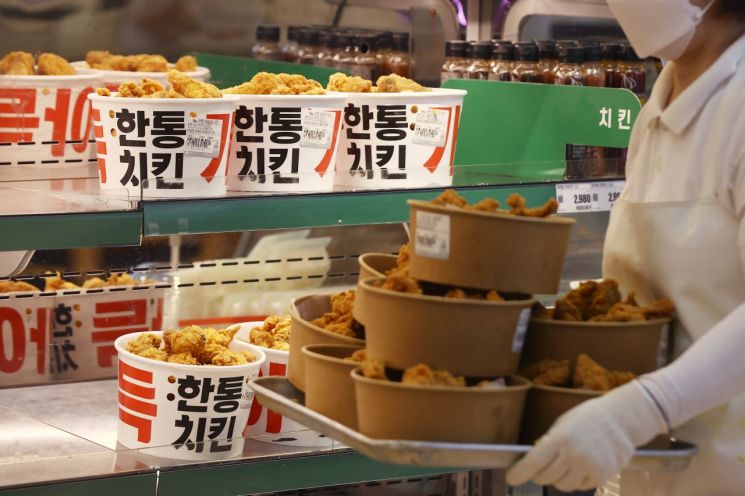 On the 10th, at a large supermarket in downtown Seoul where affordable supermarket chicken is gaining popularity, an employee is displaying chicken. [Image source=Yonhap News]
The three major large marts have engaged in 'ultra-low price competition' to attract consumers to their stores. Typically, low-price marketing is used as an inducement during economic recessions, a so-called 'foot-in-the-door' technique. As more consumers close their wallets due to soaring prices, the strategy is to first attract customers to the marts with low-priced products and then lead them to purchase other items.
However, there are concerns that the overheated ultra-low price competition could become a 'self-cannibalization' for large marts. Consumers may only buy cheap products and leave, or they can use smartphones to always search for the lowest price and decide whether to purchase. Office worker A (25) said, "Coupang is often cheaper than marts, so I always compare before buying," adding, "Since delivery is fast, there's no need to insist on buying from marts."
Professor Lee Eun-hee of Inha University's Department of Consumer Studies analyzed, "In the case of manufactured goods, large marts find it difficult to compete with the lowest online prices," adding, "Therefore, marts are competing in low prices with food items like Dangdang Chicken to attract consumers to their stores." She explained, "The problem is that consumers might only buy cheap products and leave, so even if there is a customer attraction effect, it may not lead to increased sales. Large marts need to pay attention to overall price reductions beyond chicken to gain consumer choice."
© The Asia Business Daily(www.asiae.co.kr). All rights reserved.
![Clutching a Stolen Dior Bag, Saying "I Hate Being Poor but Real"... The Grotesque Con of a "Human Knockoff" [Slate]](https://cwcontent.asiae.co.kr/asiaresize/183/2026021902243444107_1771435474.jpg)
















