Ministry of Economy and Finance Announces 'Public Institution Management System Reform Plan'
[Asia Economy Sejong=Reporters Son Seon-hee and Lee Dong-woo] The government emphasized "autonomous and responsible management, and capacity building" of each institution as the key point in its announcement of the public institution management system reform plan. The plan aims to completely overhaul the management and supervision system, which has been overly concentrated in the Ministry of Economy and Finance, while increasing the autonomy of each institution. The core of the plan is to significantly improve the chronic problem of excessive debt in major public enterprises with large scale, instead of converting smaller institutions into other public institutions.
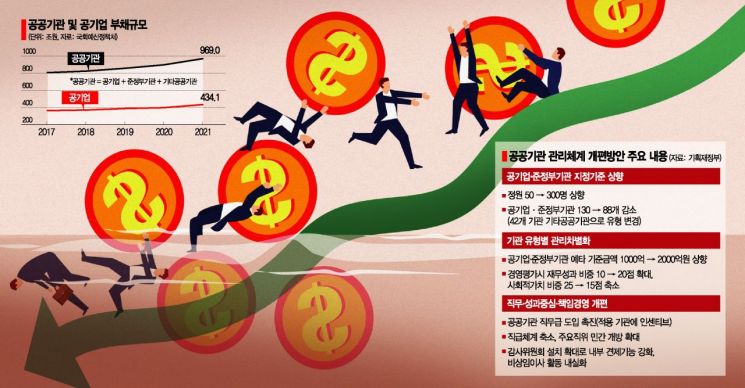
◆Why revise the public institution classification criteria for the first time in 15 years?= The "Public Institution Management System Reform Plan" announced by the Ministry of Economy and Finance on the 18th involves amending the "Act on the Management of Public Institutions (Public Institution Act) and its Enforcement Decree," which was enacted in 2007. According to the current law, institutions are classified as public enterprises or quasi-governmental institutions if they meet the criteria of "50 employees, 3 billion KRW in revenue, and 1 billion KRW in assets." This standard will be significantly raised to "300 employees, 20 billion KRW in revenue, and 3 billion KRW in assets." The employee criterion considers the small and medium enterprise classification standard (less than 300 employees) stipulated in the current Framework Act on Small and Medium Enterprises.
When the Public Institution Act was first enacted, there were a total of 102 public enterprises and quasi-governmental institutions. Over the past 15 years, the number of public institutions has increased by about 30% to 130 as of this year. However, there have been many criticisms that the Ministry of Economy and Finance still manages the overall operations of each institution in a "centralized" manner, resulting in inefficiency.
In particular, productivity and fairness have declined because salary, personnel, and organizational management have been uniformly applied based on years of service regardless of the workload or job difficulty of each institution. Accordingly, the Ministry of Economy and Finance plans to encourage each institution to autonomously introduce job-based pay systems tailored to their characteristics.
This reform plan is part of the Yoon Seok-yeol administration's core national agenda of "public institution innovation" and follows the "Financial Risk Institution Intensive Management System" announced last month. Additionally, a "Plan to Strengthen Cooperation between Private and Public Institutions" will be announced next month.
This has sparked criticism from some opposition parties, who see it as a step toward privatization, and political debate is expected. The Ministry of Economy and Finance firmly denies any possibility of privatization. Choi Sang-dae, the 2nd Vice Minister of the Ministry of Economy and Finance, emphasized, "There are no plans for artificial restructuring or privatization," and "The government has never considered privatization and has no plans to consider or pursue it in the future."
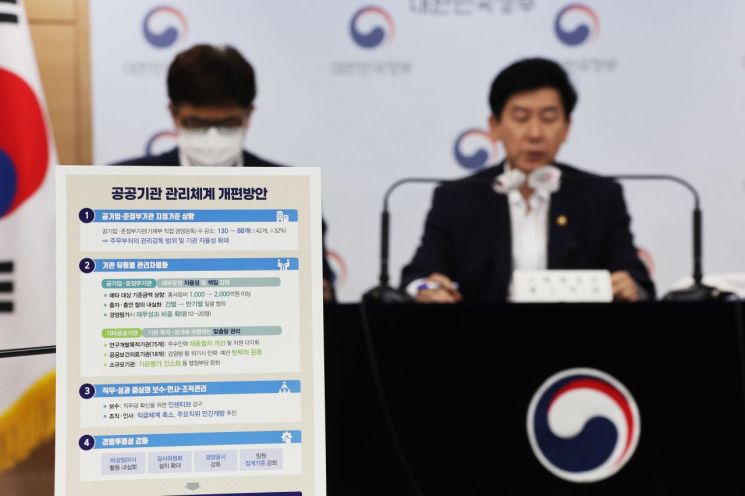 Choi Sang-dae, the 2nd Vice Minister of the Ministry of Economy and Finance, is briefing on the reorganization plan of the public institution management system at the briefing room of the Government Seoul Office Building on the 18th. 2022.8.18 Photo by Yonhap News
◆Financial performance evaluation scores doubled... Ministry of Trade, Industry and Energy’s affiliated institutions on alert= According to this reform, from next year, the number of public enterprises and quasi-governmental institutions will be reduced by about 30% to 88. Although the number of public enterprises and quasi-governmental institutions directly managed by the Ministry of Economy and Finance has significantly decreased, management will be further strengthened. The weight of financial performance in management evaluations will be doubled from the current 10 points to 20 points immediately.
The Ministry of Trade, Industry and Energy, which oversees public enterprises with the highest debt ratio, is on high alert as the government pushes to expand financial performance indicators in public institution management evaluations. Last year, the debt of public enterprises under the Ministry of Trade, Industry and Energy accounted for 49.5% of the total public enterprise debt of 434.1 trillion KRW, nearly half.
According to the "2021 Fiscal Year Public Institution Settlement Analysis" released by the National Assembly Budget Office, the debt of public enterprises under the Ministry of Trade, Industry and Energy reached 215.1 trillion KRW last year, a 28.8% (48.1 trillion KRW) increase compared to 2017 (167 trillion KRW), the early years of the Moon Jae-in administration. Among these, Korea Electric Power Corporation (KEPCO) alone has debt amounting to 145.8 trillion KRW. This represents 33.6% of public enterprise debt and 15.0% of the total debt of 350 public institutions (969 trillion KRW), making it the largest scale. KEPCO’s debt ratio last year was 223.2%, rising 74.1 percentage points over the past five years. The Budget Office analyzed that the increase in KEPCO’s debt was due to rising cost of sales caused by sharp increases in raw material prices such as coal and liquefied natural gas (LNG).
Besides KEPCO, public enterprises with rapidly increasing debt ratios include Korea Railroad Corporation (KORAIL), which increased by 39.5 percentage points compared to the previous year, followed by Incheon International Airport Corporation (21.9 percentage points), and Korea District Heating Corporation (20.8 percentage points). Public enterprises with debt ratios exceeding 200% include Korea Gas Corporation (378.9%), KORAIL (287.3%), District Heating Corporation (257.5%), KEPCO (223.2%), and Korea Land and Housing Corporation (LH, 221.3%), totaling five institutions.
© The Asia Business Daily(www.asiae.co.kr). All rights reserved.
![Clutching a Stolen Dior Bag, Saying "I Hate Being Poor but Real"... The Grotesque Con of a "Human Knockoff" [Slate]](https://cwcontent.asiae.co.kr/asiaresize/183/2026021902243444107_1771435474.jpg)
















