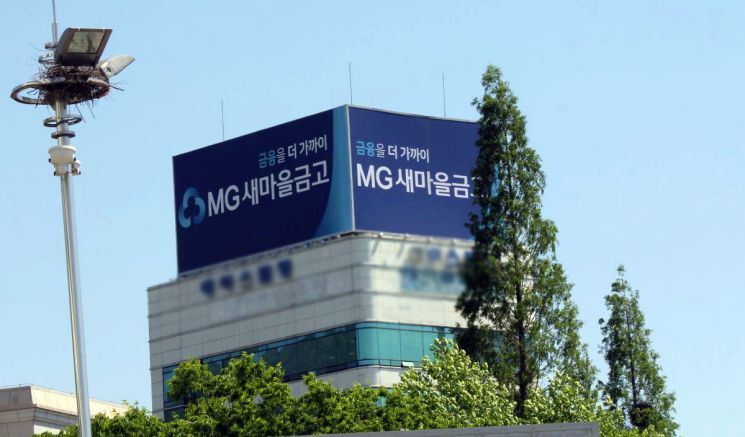
[Asia Economy Reporter Eunju Lee] Recently, due to heavy concentrated rainfall, an incident occurred at a Saemaeul Geumgo branch where a significant portion of vouchers and original loan documents were damaged. At the branch, many of the damaged documents were not separately saved in digital form, making recovery difficult. Although Saemaeul Geumgo has guided each branch at the central association level to digitize and store paper documents, it only remained a recommendation without mandatory enforcement, leading to criticism that the accident was unavoidable.
According to the industry on the 18th, flooding damage occurred recently at a Saemaeul Geumgo branch in Seoul due to heavy rain, causing significant damage to customer-related documents stored separately in the underground space. Muddy water entered the branch interior due to the heavy rain, severely damaging original documents such as vouchers and loan closure accounts stored as paper documents underground. In particular, a large portion of the damaged loan-related documents were not saved as digital files, and no separate copies exist.
Saemaeul Geumgo places the responsibility for document management on individual branches themselves. Therefore, the branch had no obligation to scan related documents and additionally store them on the central association’s server as a ‘backup.’ A Saemaeul Geumgo Central Association official explained, “Since 2015, the central association has guided each branch to scan original loan documents and store them on a centralized integrated server,” adding, “We will monitor and support each branch more closely.”
The situation of leaving the ‘digital storage’ of paper documents to the discretion of each branch is similar in some other mutual finance sectors. A representative from the Credit Union explained, “Each branch can scan paper documents and store them electronically, but it is not mandatory.” The Credit Union also allows each branch to autonomously decide how to store document files. The Fisheries Cooperative also manages paper documents individually at each branch. However, a Fisheries Cooperative official stated, “Since early this year, all branches have been operating a ‘paperless’ system, so documents are uniformly stored digitally on the server.”
On the other hand, in the savings bank sector, digital storage is automated through a central server system established by the Korea Federation of Savings Banks. Except for some savings banks with their own IT systems, 67 out of 79 savings banks operate their systems and store documents through the Integrated Financial Information System (IFIS). A savings bank official said, “Savings banks are small-scale, so not many have their own IT systems,” and added, “The central association has built a central system to digitize and store documents.”
There are calls for mutual finance sectors such as Saemaeul Geumgo, Credit Union, and Fisheries Cooperative to also enforce mandatory ‘digital storage’ at each branch at the central association level, similar to the savings bank sector. Especially for small-scale Saemaeul Geumgo branches, the need is greater because the pace of ‘paperless’ adoption is slower compared to other banks, and paper documents are still frequently used. Oh Jung-geun, president of the Korea Financial ICT Convergence Society, said, “Saemaeul Geumgo branches have few staff and lack technology, so simply recommending digital storage from the central association is unlikely to progress,” adding, “We need to consider enforcing mandatory digital storage and providing education rather than just recommendations.”
© The Asia Business Daily(www.asiae.co.kr). All rights reserved.
![Clutching a Stolen Dior Bag, Saying "I Hate Being Poor but Real"... The Grotesque Con of a "Human Knockoff" [Slate]](https://cwcontent.asiae.co.kr/asiaresize/183/2026021902243444107_1771435474.jpg)















