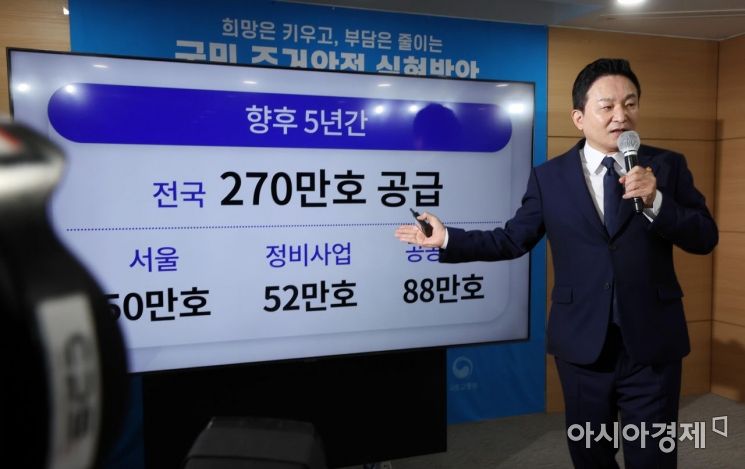
 Minister of Land, Infrastructure and Transport Won Hee-ryong is announcing the Yoon Seok-yeol administration's first housing supply plan on the 16th at the Government Seoul Office in Jongno-gu, Seoul. Photo by Kim Hyun-min kimhyun81@
[Asia Economy Reporter Kim Min-young] Minister Won Hee-ryong stated that there will be no grace period for the Reconstruction Excess Profit Recovery System (재초환) and promised to prepare a reasonable plan that residents can agree with.
In an interview with YTN News Rider on the 17th, Minister Won said, "To state the main principle, if property value increases significantly through reconstruction, an appropriate portion should be returned to society," adding, "This does not mean we should unilaterally favor anyone."
The Ministry of Land, Infrastructure and Transport plans to announce specific reduction measures within a month or two after reviewing the status by region and complex. Minister Won said, "(The 재초환 burden) varies greatly by region and complex. Since the law must be amended to allow reductions, it is not that we have no plans to announce them," and added, "We will adjust to a reasonable level through consultations with local governments and persuasion in the National Assembly, so please wait for a month or two."
Minister Won expressed his position that the 재초환 burden should be reduced for long-term residents, elderly people, and households without income. He further explained that specific reduction conditions and amounts will be reflected in the system to be established in the future.
Regarding concerns that amending the law to revise 재초환 may be difficult due to the current political situation of a ruling party minority and opposition majority, he said, "I do not think this is an issue that the ruling and opposition parties will split unilaterally," adding, "The key is how to create an appropriate level and institutional measures that the majority of the public can agree on."
On easing safety inspections, which mainly involves lowering the structural stability ratio, he explained, "The second detailed safety inspection will be abolished in principle, and the system will be changed so that local governments can review appropriateness only when residents’ enthusiasm is ahead and there is an imbalance within the rest of the area."
Regarding concerns that private-led high-density development around station areas may cause traffic problems, he said, "If density increases, parking spaces and transportation transfer facilities will be developed underground with joint investment from private and public sectors," adding, "Instead, to ensure that increased density does not become a privilege for a few, we will maximize the supply of public rental and public sale units to benefit low-income households without homes."
Minister Won reiterated his determination to normalize reconstruction and redevelopment projects in line with the downward stabilization trend of housing prices.
He said, "Housing prices will generally stabilize downward due to interest rates and economic trends," adding, "We will supply sufficiently during this downward stabilization period. There has been a reluctance to touch reconstruction and redevelopment due to soaring prices, but I believe the time has come to manage comprehensively and normalize appropriately."
© The Asia Business Daily(www.asiae.co.kr). All rights reserved.
![Clutching a Stolen Dior Bag, Saying "I Hate Being Poor but Real"... The Grotesque Con of a "Human Knockoff" [Slate]](https://cwcontent.asiae.co.kr/asiaresize/183/2026021902243444107_1771435474.jpg)
















