Hanjayeon Announces Industry Trend Report
[Asia Economy Reporter Kiho Sung] As the United States enacted the 'Inflation Reduction Act' excluding China not only in semiconductors but also in batteries and renewable energy, an analysis has emerged that the domestic automotive industry should establish a 'dual strategy' toward the United States and China to respond effectively.
The Korea Automotive Technology Institute (KATECH) advised in an industrial trend report on the 18th, "While pursuing comprehensive cooperation with the United States, cooperation with China should be promoted through the Regional Comprehensive Economic Partnership (RCEP) to ensure that the position in the Chinese market is not weakened."
The Inflation Reduction Act passed by the U.S. aims to invest $375 billion (approximately 489 trillion KRW) in energy security and climate change response to reduce greenhouse gas emissions by 40% by 2030. Among this, tax credits are differentiated based on the proportion of battery components manufactured and assembled in North America among North American electric vehicles and the usage ratio of critical minerals mined in countries that have free trade agreements (FTA) with the U.S. or North America.
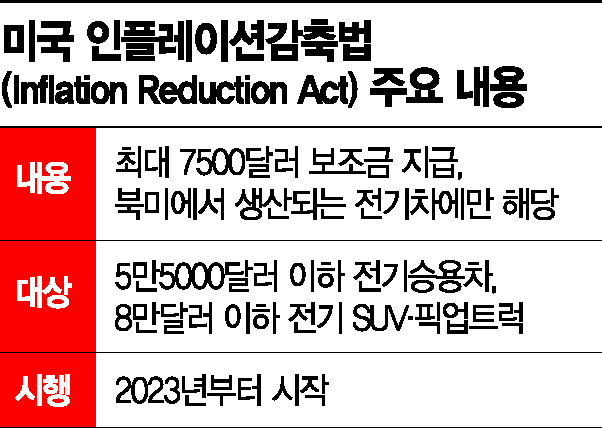
Specifically, starting next year, half of the $7,500 (approximately 984,000 KRW) tax credit will be supported differentially according to the origin ratio of critical minerals, and the other half according to the usage ratio of North American battery components.
Imported electric vehicles are excluded from the tax credit. Passenger cars priced above $55,000 (approximately 72 million KRW) and SUVs or pickup trucks priced above $80,000 (approximately 105 million KRW) are also excluded from the tax credit.
KATECH analyzed, "The U.S. aims to strengthen its position as a semiconductor leader and build a supply chain of critical minerals for electric vehicles with allied countries to produce EV batteries domestically," adding, "It seeks to establish an assembly and supply base for key EV components with Mexico to secure a competitive advantage over China in the electric vehicle industry."
Along with this, it proposed that the Korean automotive industry and government should supplement future vehicle development policies. KATECH emphasized, "The great competition in the future vehicle industry is likely to begin from 2026," and "there is a need for close strengthening of industrial and trade policies to enhance the competitiveness of the domestic future vehicle industry."
It further explained, "If Korean companies, which are resource-poor, diversify their import sources of critical minerals for electric vehicles, it could lead to cost increases resulting in higher EV prices and increased government subsidy burdens," and "while simultaneously concluding FTAs with the U.S., cooperation on minerals with critical mineral-producing countries such as Australia, Chile, and Indonesia should be strengthened."
KATECH also stated, "To expand cooperation with U.S. companies in technology, capital, and litigation, detailed cooperation strategies should be prepared by analyzing the strategies and industrial trends of U.S. companies," but "cooperation with the U.S. should not weaken the competitive position of domestic companies in the Chinese market, so communication and cooperation with China through RCEP must be strengthened."
© The Asia Business Daily(www.asiae.co.kr). All rights reserved.
![Clutching a Stolen Dior Bag, Saying "I Hate Being Poor but Real"... The Grotesque Con of a "Human Knockoff" [Slate]](https://cwcontent.asiae.co.kr/asiaresize/183/2026021902243444107_1771435474.jpg)















