Seoul City Analyzes Water Usage by Household and Housing Characteristics... 130,000 Households Enrolled in Eco Mileage
More Household Members Lead to Lower Per Capita Usage... Larger Housing Size Increases Water Consumption
[Asia Economy Reporter Lim Cheol-young] The average daily water usage per person (LPCD) among Seoul citizens was highest in single-person households and decreased as the number of household members increased. In particular, even with the same number of household members, tap water usage was found to increase as the residential area expanded.
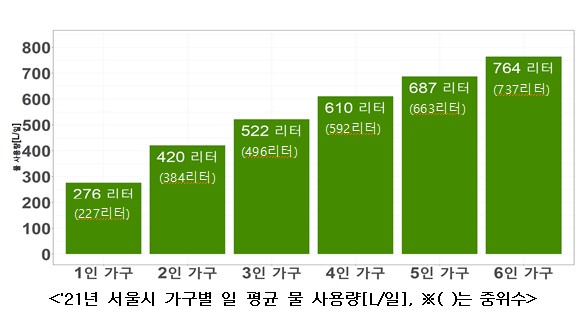
On the 18th, the Seoul Water Institute analyzed the average daily tap water usage of Seoul citizens according to the number of household members. The results showed that last year, the average daily water usage for a single-person household in Seoul was 276 liters, 420 liters for a two-person household, 522 liters for a three-person household, 610 liters for a four-person household, 687 liters for a five-person household, and 764 liters for a six-person household. This analysis combined big data on households and residences from 130,419 households subscribed to Seoul's Eco Mileage program with water meter reading data from the Waterworks Headquarters (2018?2021) to examine characteristics of household tap water usage.
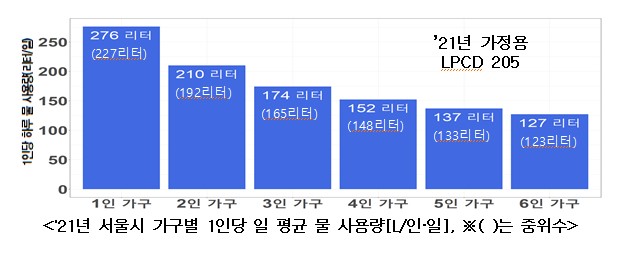
The average daily water usage per person (LPCD) decreased as the number of household members increased. For example, in a four-person household, the daily water usage per person was nearly half (45%) less than that of a single-person household. The average daily household water usage per person was 276 liters for single-person households, 210 liters for two-person households, 174 liters for three-person households, 152 liters for four-person households, 137 liters for five-person households, and 127 liters for six-person households.
When converted to a monthly basis (30 days), single-person households pay approximately 9,480 KRW (8,280 liters → 8 tons), two-person households 14,730 KRW (12,600 liters → 13 tons), three-person households 17,880 KRW (15,660 liters → 16 tons), four-person households 19,980 KRW (18,300 liters → 18 tons), five-person households 23,130 KRW (20,610 liters → 21 tons), and six-person households 25,230 KRW (22,920 liters → 23 tons) in water bills. Although total water usage increases with more household members, the growth rate of water usage slows down due to shared water use for laundry, dishwashing, cleaning, and other communal activities.
Water Usage Increases with Larger Homes... 8% More Water Used in 132㎡ Compared to 33~66㎡
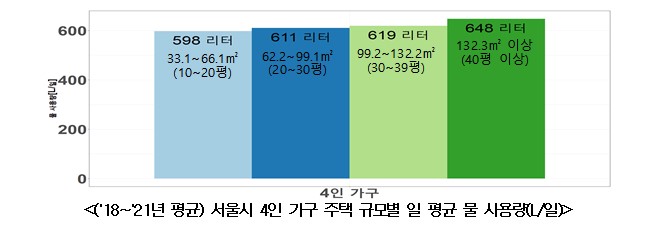
It was confirmed that average water usage also increases with larger homes. For four-person households living in Seoul, water usage increased by about 8% (50 liters) in homes sized 132㎡ (40 pyeong) or more compared to those sized 33~66㎡ (10~20 pyeong). The average water usage by residential area for four-person households in Seoul was 598 liters for 33~66㎡ (10~20 pyeong), 611 liters for 62~99㎡ (20~30 pyeong), 619 liters for 99~132㎡ (30~39 pyeong), and 648 liters for 132㎡ (40 pyeong) or larger.
The institute analyzed that as asset size increases, there is more flexibility in tap water usage, and the increase in bathroom water fixtures and cleaning water contributes to this result.
Differences in average water usage were also observed depending on housing type. Comparing apartments, multi-family houses, and row houses, multi-family houses had the highest average water usage (626 liters/day), followed by row houses (615 liters/day), and apartments (572 liters/day).
The institute plans to conduct in-depth research on various factors affecting tap water usage, such as changes in floating population due to commuting and holidays, to utilize this for more precise tap water production forecasting. Professor Cha Yoon-kyung of the Department of Environmental Engineering at the University of Seoul said, "It is significant that this is the first domestic analysis of tap water usage by household size using big data in response to socio-economic changes such as the increase in single-person households." She added, "I hope the research will expand to analyze tap water usage in commercial buildings using big data from the remote reading of water meters currently being established in Seoul."
Son Jeong-su, Director of the Seoul Water Institute, said, "By providing citizens with information on average tap water usage, we expect this opportunity to encourage reflection on water use habits and promote water conservation." He added, "In the mid to long term, we plan to use this data to predict tap water demand and prevent complaints related to meter readings.”
© The Asia Business Daily(www.asiae.co.kr). All rights reserved.
![Clutching a Stolen Dior Bag, Saying "I Hate Being Poor but Real"... The Grotesque Con of a "Human Knockoff" [Slate]](https://cwcontent.asiae.co.kr/asiaresize/183/2026021902243444107_1771435474.jpg)

















