Chairman Promotion Difficult Due to National Agricultural Scandal
Chairman Promotion Imminent with Liberation Day Special Pardon
Possibility of Chairman Promotion While Unregistered Executive
Criticism Over Exercising Management Rights Without Legal Responsibility Remains an Issue
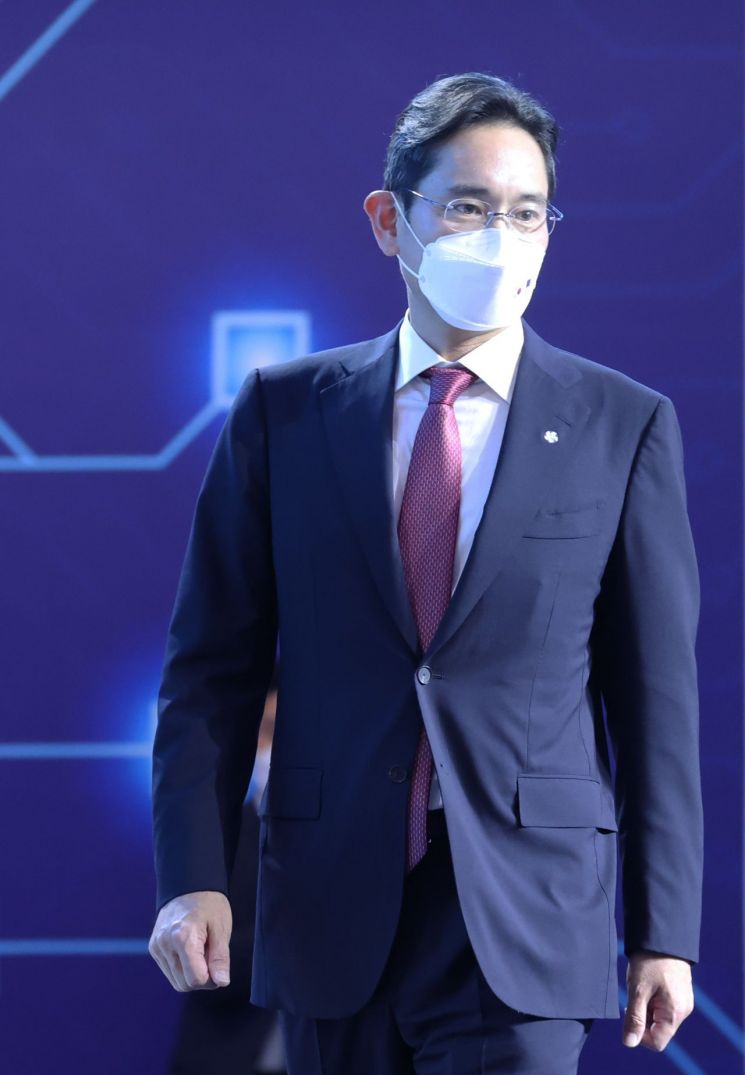
[Asia Economy Reporter Park Sun-mi] As Samsung Electronics Vice Chairman Lee Jae-yong is expected to proceed with the promotion to chairman following the special pardon on Liberation Day, Samsung's dilemma over whether to reappoint him as a registered director has deepened. Currently an unregistered executive, Vice Chairman Lee is considered to have the best scenario of transitioning to a registered director through the regular shareholders' meeting in March next year before ascending to the chairman position. However, since the timing of assuming the chairman role is more urgent than the transition to a registered director, and there are many cases in the business world where chairmen serve while unregistered, the timing is reportedly being carefully weighed.
On the 17th, the business community emphasized the likelihood that Vice Chairman Lee, whose five-year employment restriction was lifted by the August 15 Liberation Day special pardon, could be promoted to chairman soon, serving as a central figure for Samsung. The biggest reason Samsung left the chairman position vacant for a long time after the late Chairman Lee Kun-hee's absence was Vice Chairman Lee's judicial risk.
Vice Chairman Lee, who was promoted to vice chairman at the end of 2012, could have assumed the vacant chairman position after Chairman Lee's death in October 2020, but at that time, he carried judicial risks due to the political scandal, making promotion to chairman difficult. Despite effectively being responsible for Samsung's entire management, he could not take the chairman position because of these judicial risks.
Samsung's dilemma in pushing for Vice Chairman Lee's promotion to chairman lies in whether to maintain his status as an unregistered executive. Lee stepped down as a registered executive on October 26, 2019, after completing a three-year term. Currently, he is an unpaid unregistered executive. Until now, he could not serve as a registered executive due to being on parole.
To assume the chairman role after transitioning to a registered executive, he must wait at least until the shareholders' meeting in March next year. Given Samsung's urgent need for a central figure capable of making bold decisions and organizational reforms amid global economic uncertainties, promoting him to chairman after becoming a registered executive carries the risk of slowing the pace of Samsung's management normalization. The prevailing view is that for large-scale mergers and acquisitions (M&A), investments, and governance restructuring, Lee's promotion to chairman must be carried out as quickly as possible.
Accordingly, if Samsung intends to promote Vice Chairman Lee to chairman after transitioning him to a registered executive, it must hold an extraordinary shareholders' meeting, similar to the one held in October 2016 when he was appointed as a registered director. Since Lee's judicial risks have not been fully resolved, there is a possibility of controversy arising during the shareholders' approval process for his transition to a registered executive.
Many in the business community also question whether there is a need to rush the transition to a registered director.
They argue that it is entirely possible to be promoted to chairman while remaining an unregistered executive. In fact, many owners in the business world hold unregistered chairman positions. SK Chairman Chey Tae-won participates in management as an unregistered chairman of key affiliates such as SK Telecom, SK Hynix, and SK Innovation, and CJ Chairman Lee Jae-hyun is also an unregistered executive. Hanwha Chairman Kim Seung-yeon similarly engages in management as an unregistered executive at Hanwha Corporation, Hanwha Solutions, and Hanwha Construction.
Especially since Samsung has set its management direction as a board-centered and professional management system, there is a possibility that Vice Chairman Lee will only hold the chairman position and be involved in major decisions outside the board. However, in this case, he may face criticism for exercising significant authority and influence in key decision-making processes while avoiding responsibility. Unregistered executives exercise management rights but have no legal responsibility.
Meanwhile, the long-standing issue of Samsung's governance restructuring is also likely to accelerate after Vice Chairman Lee's promotion to chairman. Samsung has been pursuing governance restructuring since 2013, but the process was delayed after Lee was sentenced to two and a half years in prison.
Currently, Samsung's governance structure flows from the owner family including Vice Chairman Lee → Samsung C&T Corporation → Samsung Life Insurance → Samsung Electronics. The owner family, including Lee, holds 31.31% of Samsung C&T shares, through which they indirectly control Samsung Life Insurance and Samsung Electronics. If the opposition party's proposed amendment to the Insurance Business Act passes, Samsung Life Insurance will have to sell most of its 8.51% stake in Samsung Electronics, weakening Lee's control over the group. Additionally, the sale of Samsung Electronics shares by Samsung Life Insurance raises risks of harm to minority shareholders and exposure to foreign speculative capital.
© The Asia Business Daily(www.asiae.co.kr). All rights reserved.
![Clutching a Stolen Dior Bag, Saying "I Hate Being Poor but Real"... The Grotesque Con of a "Human Knockoff" [Slate]](https://cwcontent.asiae.co.kr/asiaresize/183/2026021902243444107_1771435474.jpg)















