Homeplus and Emart Introduce 'Cost-Effective Chicken'
Large Marts Launch Affordable Chicken with Simple Distribution Structure
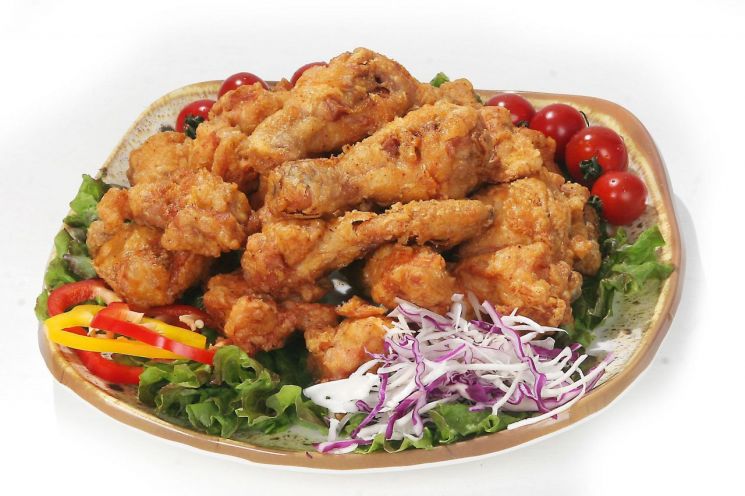
[Asia Economy Reporter Heo Midam] As franchise chicken prices soar to around 20,000 won, 'cost-effective chicken' from large supermarkets is gaining popularity through word of mouth. Consumers are enthusiastically engaging in 'open runs' (purchasing items as soon as the store opens), but franchise chicken business owners express that simply comparing cost-effective chicken with their products is inappropriate.
Recently, as franchise chicken prices have risen, consumers have voiced complaints. Currently, the prices for fried chicken from major franchise companies are ▲BBQ Golden Olive Chicken 20,000 won ▲bhc Fried Chicken 17,000 won ▲Kyochon Original Chicken 16,000 won. Adding delivery fees increases the burden even more. Last month, some Kyochon Chicken franchise stores raised delivery fees from 3,000 won to 4,000 won, among other price hikes.
On the other hand, large supermarkets are targeting cost-conscious consumers by continuously releasing affordable chicken. Homeplus started selling 'Dangdang Chicken' at 5,990 won per whole chicken since June, and E-Mart launched '5-Minute Chicken' priced at 9,980 won last month.
The reason franchise chicken is notably more expensive than supermarket chicken lies in differences in distribution structure and marketing costs. First, the distribution process for franchise chicken is relatively more complex compared to large supermarkets. Supermarkets purchase raw chicken in bulk and fry it directly in-store for sale. However, franchise stores procure chicken at prices that include slaughtering fees, transportation costs, and headquarters' margins.
Specifically, Homeplus Dangdang Chicken mainly uses size 8 chickens, whereas the franchise chicken industry uses size 10 chickens. According to the Korea Broiler Association, as of the 17th, the market price for size 7-8 chickens is 4,244 won per kilogram, and for size 9-10 chickens, it is 3,923 won per kilogram. Although size 10 is slightly cheaper, franchise stores usually receive chickens at 5,000 to 6,000 won after adding headquarters' margins and other costs.
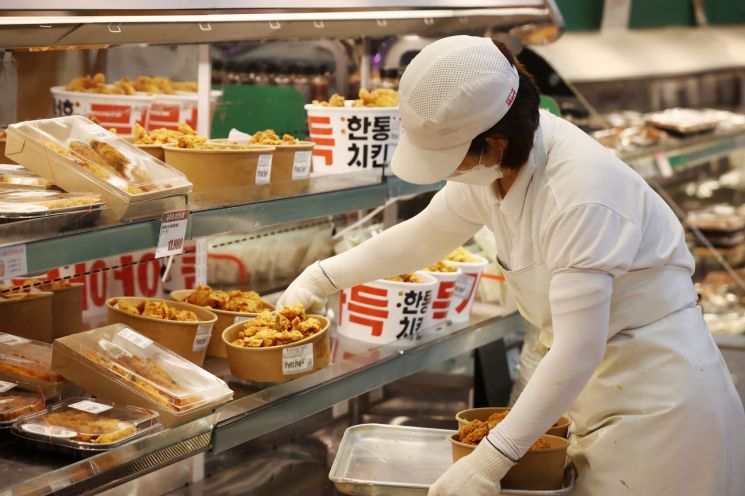 An employee is displaying chicken at a large supermarket in downtown Seoul. [Image source=Yonhap News]
Marketing costs also differ. Franchises spend heavily on marketing by hiring top stars with high consumer recognition as advertising models. However, large supermarkets mainly sell to customers who visit the store directly, so they incur no marketing expenses. Additionally, franchise stores receive packaging containers, wet wipes, and pickled radish from headquarters, and margins are added during this process as well.
Some argue that such cost-effective chicken from large supermarkets is a 'loss leader.' When consumers visit the supermarket, they tend to purchase other products as well, so even if the chicken is sold cheaply, a certain level of profitability is guaranteed. A netizen from the self-employed community 'Apeunikka Sajangida' said, "Large supermarkets sell tens of thousands of products. When customers are drawn in by Dangdang Chicken, it naturally leads to increased sales through marketing effects."
Another netizen, who identified as a franchise chicken store owner, lamented, "Running a chicken restaurant barely yields profits. When operating a franchise, you have to receive chickens, sauces, and pickled radish supplied by headquarters, but since all of these are sold at high prices, store owners have no choice." They added, "There are also additional costs such as delivery agency fees, advertising costs, rent, and labor."
Meanwhile, Han Sangin, Head of Menu Development at Homeplus, recently appeared on a YouTube channel and stated, "I don't understand the claim that (selling chicken) doesn't make a profit. Even selling at 6,990 won yields profit," adding, "We purchase ingredients in bulk. We fry and package the chicken in-store and serve it to customers. Although it is a low-margin, high-volume business, we are not operating at a loss."
© The Asia Business Daily(www.asiae.co.kr). All rights reserved.
![Clutching a Stolen Dior Bag, Saying "I Hate Being Poor but Real"... The Grotesque Con of a "Human Knockoff" [Slate]](https://cwcontent.asiae.co.kr/asiaresize/183/2026021902243444107_1771435474.jpg)
















