Justice Minister Han Dong-hoon’s Appearance in Trial Draws Attention... Constitutional Court’s Main Ruling Expected to Be Delayed
Prosecutors to Submit Opinion Letter Highlighting Need for ‘Suspension of Effect’ Injunction Possibly This Week
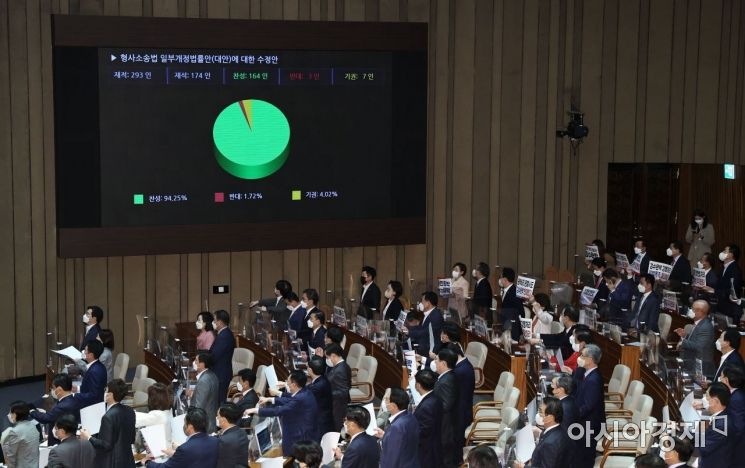 The second bill among the inspection reform bills, the amendment to the Criminal Procedure Act, passed the National Assembly plenary session on May 3rd. Photo by Yoon Dong-joo doso7@
[Asia Economy Reporter Heo Kyung-jun] With the ‘Prosecutorial Investigation Authority Transfer and Complete Abolition Act’ (commonly known as ‘Geomsu Wanbakbeop’), which significantly reduces the prosecution's direct investigative authority, set to take effect on the 10th of next month, a public hearing on the jurisdictional dispute trial requested by the Ministry of Justice and the prosecution at the Constitutional Court is scheduled to be held at the end of next month.
According to the legal community on the 17th, the public hearing on the jurisdictional dispute trial regarding the Geomsu Wanbakbeop, requested by the Ministry of Justice and the prosecution, will be held at 2 p.m. on the 27th of next month.
Although the Ministry of Justice recently proposed a revision to the enforcement decree to expand the prosecution's direct investigative authority in preparation for the Geomsu Wanbakbeop, confusion is expected as the Constitutional Court's substantive judgment has not yet been issued.
Since jurisdictional dispute trials are matters requiring ‘mandatory oral arguments,’ an oral hearing must be conducted before a substantive decision is made. Article 30 of the Constitutional Court Act stipulates that ‘trials on impeachment, dissolution of political parties, and jurisdictional disputes shall be conducted through oral arguments.’
Ultimately, whether the Geomsu Wanbakbeop will be implemented is expected to be determined based on the Constitutional Court’s decision on the provisional injunction request to suspend the effect of the Geomsu Wanbakbeop, which was filed together with the jurisdictional dispute trial by the Ministry of Justice and the prosecution.
However, there is also a possibility that the Constitutional Court will not issue a decision on the provisional injunction before the law takes effect, so the final judgment on the Geomsu Wanbakbeop by the Constitutional Court is expected to take some time. This is because the Constitutional Court often issues decisions on provisional injunctions together with substantive judgments.
The Ministry of Justice and the prosecution argue that once the Geomsu Wanbakbeop is enforced, in cases where the prosecution’s direct investigation is prohibited, police investigations must be accepted unconditionally. This infringes on the public’s right to a speedy trial and causes difficulties in exercising prosecutorial functions due to the reduction of investigative functions, ultimately transferring harm to the public.
The Ministry of Justice also raised issues regarding the legislative process of the Geomsu Wanbakbeop. They claim that reasonable opportunities for discussion were blocked during the legislative process, the principle of substantive majority rule was ignored, and the so-called ‘disguised party defection’ rendered the agenda adjustment procedure at the National Assembly’s Legislation and Judiciary Committee ineffective. Furthermore, at the plenary session stage, the ‘splitting of sessions’ method blocked unlimited debate procedures that would allow minority opinions to be expressed, and proposals unrelated to the standing committee’s agenda were submitted as amended consent proposals at the plenary session, ignoring even the deliberation process.
Whether Han Dong-hoon, Minister of Justice, will attend the public hearing next month in person is also a matter of interest. Earlier, Minister Han indicated that he might appear in person at the hearing.
The prosecution plans to submit a written opinion to the Constitutional Court as early as this week emphasizing the urgency required for the provisional injunction and arguing that the harmful effects of the Geomsu Wanbakbeop?such as complainants being unable to file objections to investigation results after the law’s enforcement?can only be prevented by the Constitutional Court’s decision on the provisional injunction.
© The Asia Business Daily(www.asiae.co.kr). All rights reserved.
![Clutching a Stolen Dior Bag, Saying "I Hate Being Poor but Real"... The Grotesque Con of a "Human Knockoff" [Slate]](https://cwcontent.asiae.co.kr/asiaresize/183/2026021902243444107_1771435474.jpg)















