Midge Larvae Found Last Month in Tap Water of Changwon and Suwon
"Inadequate Pest Control Facilities and Aging Infrastructure Cited as Causes"
Larvae Also Found in Incheon and Jeju Two Years Ago
Ministry of Environment Strengthens Hygiene Measures Including Installation of Larvae Leakage Prevention Devices
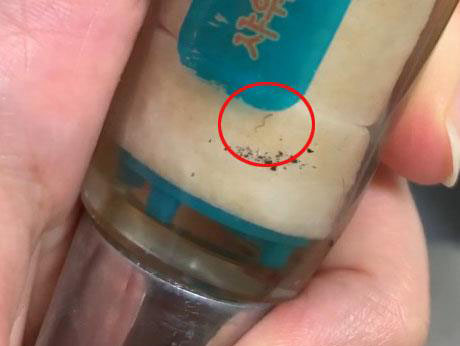 The discovery of midge larvae in tap water has increased public anxiety about "drinking water safety." The photo shows larvae inside a shower filter, posted on a mom cafe in Seo-gu, Incheon, in 2020. [Image source=Yonhap News]
[Asia Economy Reporter Park Hyun-joo] As the cause of the 'tap water midge larvae incident' that occurred last month in Changwon City, Gyeongnam Province, and Suwon City, Gyeonggi Province, was revealed to be aging facilities, citizens' anxiety is growing. Two years ago, larvae were also found in tap water in Incheon and Jeju, prompting local governments to conduct detailed investigations.
On the 16th, the Ministry of Environment announced the results of a special hygiene inspection of 485 water purification plants nationwide conducted from the 19th of last month to the 8th of this month. According to the detailed epidemiological investigation team, the reason the larvae that entered were not filtered out during the water purification process and moved all the way to homes in Changwon City and Suwon City is presumed to be due to aging facilities. Midges that entered from outside through inadequate insect-proof equipment were not removed during the water purification process due to aging ozone equipment and other factors, and thus moved to homes.
The problem is that larvae were also found in 27 water purification plants other than those in Changwon and Suwon. In particular, larvae were found in the finished water reservoir where the entire water purification process was completed at Ssangyong Water Purification Plant in Yeongwol, Gangwon Province. In the other 26 plants, larvae were found in the raw water and during the purification process, but not in the finished water after purification was completed.
As a result, anxiety is growing that larvae could be found in tap water at homes anywhere across the country at any time. This is not the first 'tap water larvae incident.' Two years ago, in 2020, after larvae were first found at the Gongchon Water Purification Plant in Incheon, the number of cases continued to increase, causing citizens to be anxious. In the same year, in Seogwipo, Jeju, after larvae were found in the tap water of a house, reports of suspected larvae followed one after another.
The Ministry of Environment plans to designate midge larvae as a drinking water quality monitoring item to ensure the safety of drinking water and conduct daily monitoring. Additionally, it plans to strengthen further hygiene management measures, such as introducing devices to block larvae from leaking out at the final water purification stage to prevent leakage into homes.
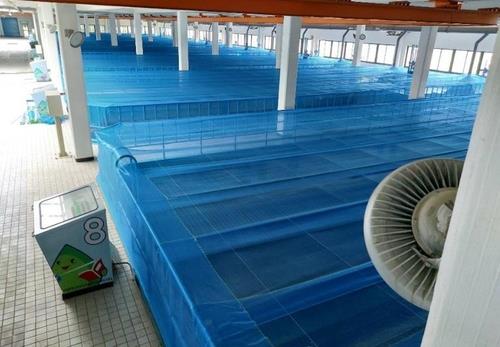 The Ministry of Environment has designated midge larvae as a water quality monitoring item and conducts daily surveillance. They plan to strengthen hygiene management measures by introducing larva outflow blocking devices. The photo shows Bupyeong Water Purification Plant with a larva inflow blocking insect screen installed on August 10, 2020.
 [Image source=Yonhap News]
Meanwhile, amendments to laws and ordinances are being promoted to make it mandatory to immediately notify residents when larvae such as midges are found in tap water. This is because when the tap water larvae incident occurred in Changwon, the city announced the discovery of larvae only 36 hours later, causing controversy over a 'delayed response.'
According to current water quality violation standards, there is no obligation to notify residents in cases of larvae, but at that time, citizens and environmental groups criticized Changwon City for "delayed disclosure." It was pointed out that residents were using tap water without knowing anything during the time Changwon City did not disclose the fact that larvae were found.
In response, on the 5th of this month, Lee Dal-gon, a member of the People Power Party, proposed a partial amendment to the Water Supply Act that would include cases where insects or larvae or other visually identifiable organisms are found in tap water as water quality violations. Jeon Hong-pyo, a Changwon City council member from the Democratic Party of Korea, also submitted a revision to the Changwon City Water Supply Ordinance to the Changwon City Council, requiring immediate notification to citizens when items deemed necessary for inspection are detected.
© The Asia Business Daily(www.asiae.co.kr). All rights reserved.
![Clutching a Stolen Dior Bag, Saying "I Hate Being Poor but Real"... The Grotesque Con of a "Human Knockoff" [Slate]](https://cwcontent.asiae.co.kr/asiaresize/183/2026021902243444107_1771435474.jpg)
















