Inflation Rate Already Exceeds Long-Term Average
If Growth in the Second Half Stays in the Low 2% Range, 'Jun-Stagflation' Begins
[Asia Economy Reporter Park Sun-mi] Concerns have been raised that the Korean economy could enter stagflation if growth remains in the low 2% range in the second half of this year.
On the 17th, the Korea Economic Research Institute (KERI) stated in its report "Experience of Stagflation and Policy Implications" that Korea has already met the criteria for stagflation in terms of inflation rate, and whether it enters stagflation will be determined by the growth rate in the second half of the year.
KERI analyzed that the consumer price inflation rate in the second quarter of this year was 5.4% (year-on-year), exceeding the stagflation judgment criterion for inflation (long-term average inflation rate of 2.34% + standard deviation of 1.25%), which is 3.59%. In particular, with the consumer price inflation rate reaching 6.3% in July, the inflation increase has grown, and it is expected that the inflation aspect will continue to meet the stagflation criteria in the second half of this year.
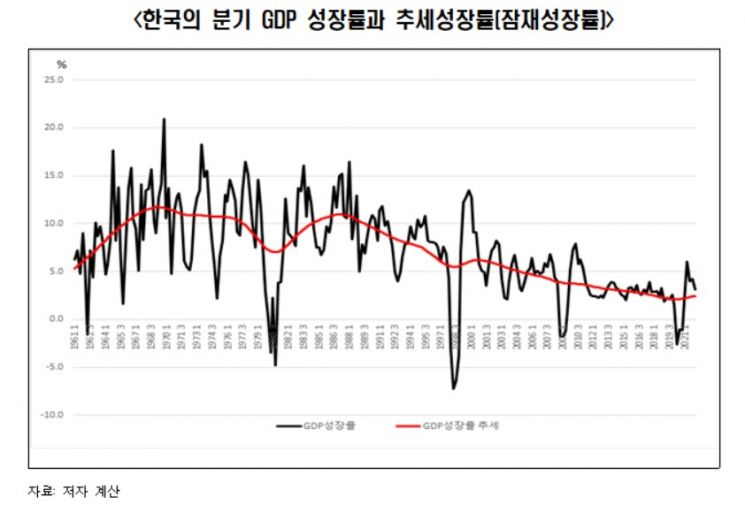
From the GDP perspective, it is judged to be on the borderline, though not yet entering stagflation. The Korean economy recorded a growth rate of 2.9% (year-on-year) in the second quarter, exceeding the potential growth rate estimated to be in the mid-2% range.
KERI analyzed that until the second quarter of this year, the GDP gap was positive, so the stagflation criteria were not met, but with the expected slowdown in growth in the second half, the possibility of stagflation could increase. In particular, if the inflation rate does not slow down and the growth rate falls to the low 2% range, the GDP gap will turn negative, meeting the stagflation criteria for both inflation and growth rate, the institute warned.
In this case, although it would not reach the stagflation level of the 1970s oil shock, it is expected to enter a ‘quasi-stagflation’ situation that feels comparable in perception.
Policy preparations with stagflation in mind have become necessary.
KERI explained that stagflation occurs when excessive liquidity is released and supply shocks are applied, advising that liquidity reduction should be prioritized and that short-term economic recession must be accepted in this process. They argued that supply-driven economic policies, which absorb cost increases and expand supply capacity through productivity improvements, enhance market dynamism through regulatory reforms, and suppress inefficient fiscal spending that stimulates inflation, are the most appropriate policy direction in the stagflation era.
Lee Tae-gyu, Senior Research Fellow at KERI, said, “If the Korean economy enters a stagflation situation, it must overcome it through reforms that endure short-term pain,” adding, “If it relies on symptomatic treatments such as demand and fiscal spending expansion, as seen in cases like France and Greece, the crisis is likely to be prolonged.”
© The Asia Business Daily(www.asiae.co.kr). All rights reserved.
![Clutching a Stolen Dior Bag, Saying "I Hate Being Poor but Real"... The Grotesque Con of a "Human Knockoff" [Slate]](https://cwcontent.asiae.co.kr/asiaresize/183/2026021902243444107_1771435474.jpg)











