Constructed at a scale of 1,000 tons per day with 'Zero Direct Landfill'... Facility equipped with design, eco-friendliness, and content
All incineration facilities underground... Above ground, a sophisticated architectural design complex cultural town
Significant support for local residents including 100 billion KRW worth of benefit facilities
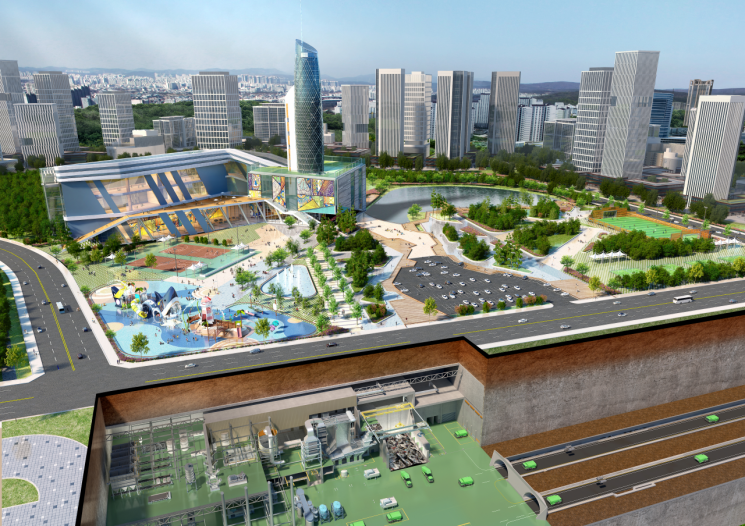
[Asia Economy Reporter Lim Cheol-young] Starting in 2026, direct landfill of municipal waste without incineration will be prohibited, and Seoul City plans to build new resource recovery facilities by 2026 in addition to the four currently operating metropolitan resource recovery facilities in Yangcheon, Nowon, Gangnam, and Mapo. The newly established resource recovery facilities will be designed to handle all waste that is inevitably being directly landfilled, with a daily incineration capacity of 1,000 tons.
In particular, Seoul City intends to develop the new resource recovery facilities not as 'undesirable facilities' but as 'anticipated facilities,' making them attractive landmarks and local attractions in every aspect including design, eco-friendliness, and content, thereby driving the development and economic revitalization of the surrounding areas.
On the 17th, Seoul City presented the vision for the new resource recovery facilities under four themes: ▲Landmark ▲Regional Development ▲Communication Space ▲Eco-friendliness, and announced the blueprint for their construction. First, Seoul plans to build the new resource recovery facilities as landmark facilities that will enhance the city's appeal. Breaking the stereotype of incineration facilities characterized by factory-like exteriors and tall chimneys, an international design competition will be held to apply world-class innovative architectural designs. The facilities will be planned as spaces that harmonize with the surrounding environment and embody the image of 'resource circulation,' aiming to become a new landmark of Seoul and increase residents' property values.
There are already several overseas examples where resource recovery facilities have become local attractions. 'Amager Bakke' in Copenhagen, Denmark, features a ski slope on top of the incineration facility and a climbing wall on the facade, making it a popular tourist spot. It was also selected as the World Building of the Year last year. Taiwan's 'Beitou' incineration facility operates an observatory and a revolving restaurant atop its 160-meter chimney, offering 360-degree panoramic views through glass walls.
The facilities will be developed as complex cultural towns that revitalize the local economy and commercial districts. The incineration facilities will be installed underground, while above ground, a sophisticated architectural design complex cultural town unimaginable for a resource recovery facility will be created. Facilities that contribute to regional development such as offices, cultural facilities, and parks will be attracted, and the tall chimneys, once symbols of avoidance, will be repurposed as tourist attractions featuring observatories, revolving restaurants, amusement rides, and skywalks.
Additionally, the facilities will operate as 'communication and experience' spaces enjoyed by both residents and tourists. Based on residents' opinions, the goal is to create spaces most needed by the community by expanding educational infrastructure such as libraries and creating various indoor gardens, indoor sports facilities, and cafeterias. High-quality cultural and experiential programs utilizing the communication spaces will be operated to provide local residents with opportunities to enrich their cultural sensitivity and interact with each other at the resource recovery facilities.
Clear incentives will be provided to local residents. Seoul City plans to invest 100 billion KRW to introduce convenience facilities desired by local residents at the resource recovery facilities and establish a 'Resident Support Fund' of about 10 billion KRW annually to be used for improving residents' welfare such as apartment management fees and heating costs.
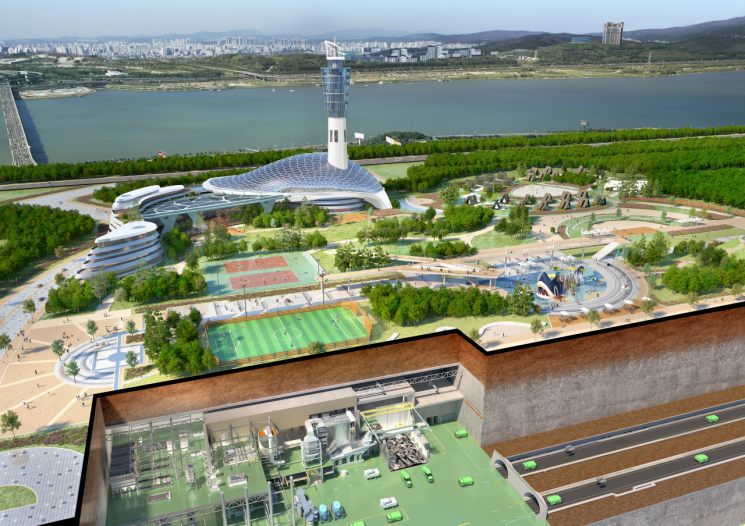
Furthermore, the facilities will be made safe and clean by adopting world-class pollution control equipment and cutting-edge automation systems. Emission standards for pollutants will be strengthened to 10-50% of the legally permitted levels, managing the facilities more strictly than existing resource recovery facilities as well as those in Europe and Japan. To prevent odor and exhaust damage, vehicle washing facilities will be installed and dedicated roads for work vehicle entry and exit will be constructed. Future technologies such as artificial intelligence (AI) and the Internet of Things (IoT) will be introduced to automate equipment operation and provide a safe working environment during hazardous processes like crane operation for waste input and incineration ash discharge.
'Site Selection Committee' to conduct final evaluation of about five candidate sites and announce results in September
The optimal candidate sites for the new resource recovery facilities are being reviewed by an independently operated 'Site Selection Committee,' which plans to decide and announce the best site in September. The committee consists of 10 members: Professor Bae Jae-geun from Seoul National University of Science and Technology as chairman, three resident representatives, four experts, two city council members, and one public official. Since February last year, the committee has selected a professional research institute to conduct feasibility studies on candidate sites.
The Site Selection Committee has established objective evaluation criteria across five categories (location, social, environmental, technical, economic) to ensure objective and quantitative assessments free from personal bias.
After announcing the optimal candidate site, Seoul City will transparently disclose the site feasibility study process and results conducted by the 'Site Selection Committee' to residents for more than 20 days through public notices and inspections. Additionally, a 'Resident Communication Council' involving local residents will be formed, and outreach resident briefings will be held regularly to open various communication channels with residents, thoroughly explaining the necessity of the resource recovery facilities, the site selection process, criteria, and procedures. Residents' opinions will be prioritized in the underground construction and landmark development of the resource recovery facilities.
Fine dust concentration near the four resource recovery facilities is lower than the Seoul city average... Also produces electricity and heating heat
Resource recovery facilities are essential environmental infrastructure necessary for hygienically processing waste generated in Seoul. These facilities incinerate non-recyclable waste, significantly reducing the volume and weight of waste sent to landfills. Seoul City explained that the operation of the four resource recovery facilities in the city has proven them to be clean and safe facilities.
In fact, last year, the average fine dust concentration near the four resource recovery facilities was 31㎍/㎥, lower than the overall Seoul city average of 38㎍/㎥. Health impact surveys conducted annually over the past 20 years on nearby residents showed no differences compared to other areas. The heat generated during incineration is also used for electricity production and heating. Last year, a total of 39 GWh of electricity was produced, supplying 10,000 households, and incineration heat (1,543,000 Gcal) was used as a heating source for 250,000 households.
Mayor Oh Se-hoon stated, "Since resource recovery facilities are essential for Seoul City and all its citizens, we ask for the understanding and cooperation of local residents when deciding the optimal candidate site," and added, "We will make this a model case of transforming an undesirable facility into an anticipated facility through the creation of a world-class landmark, clean and safe facilities, regional economic revitalization, and resident support."
© The Asia Business Daily(www.asiae.co.kr). All rights reserved.
![Clutching a Stolen Dior Bag, Saying "I Hate Being Poor but Real"... The Grotesque Con of a "Human Knockoff" [Slate]](https://cwcontent.asiae.co.kr/asiaresize/183/2026021902243444107_1771435474.jpg)

















