20s and 30s "Save on Clothes and Food to Attend English Academy"
Growing Perception That "Self-Development Is the Safest" Amid Economic Uncertainty in Gyeonggi
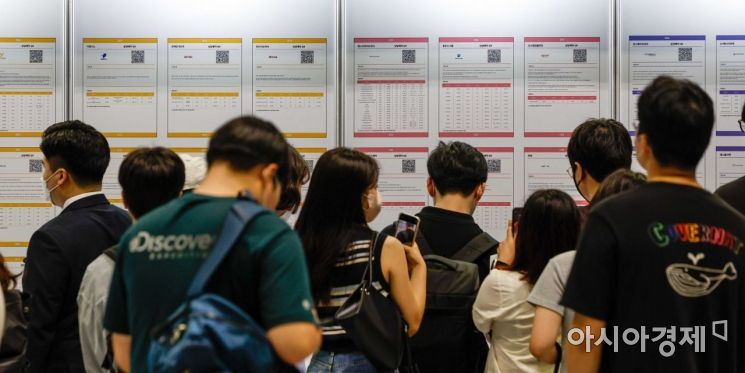 Job seekers participating in the 'Mid-sized Companies Job Fair' held at COEX in Gangnam-gu, Seoul on July 5th are looking at the recruitment bulletin board. Photo by Jinhyung Kang aymsdream@
[Asia Economy Reporter Yoon Seul-gi] #. A in their 20s, an office worker, is doing their best to save money amid the prolonged economic recession but does not skimp on self-development expenses. A said, "I don't buy luxury items like clothes or accessories, and I try to drink the coffee at the office as much as possible instead of buying coffee at lunch," adding, "But I try not to cut back on education expenses."
He said, "I'm preparing to change jobs, and given the current economic situation, it's better to increase my salary through a 'jump job change' than to make money through stocks," adding, "To get a better company, I have no choice but to focus on building 'specs' by acquiring job-related certifications or improving my English scores."
According to the 'July Consumer Price Trends' announced by Statistics Korea on the 17th, consumer prices in July rose 6.3% compared to a year ago. This is 0.3 percentage points (p) higher than June (6.0%) and the highest increase in 23 years and 8 months since November 1998 (6.8%), right after the International Monetary Fund (IMF) foreign exchange crisis.
Prices rose in general, including industrial products, services, agricultural, livestock and fishery products, and electricity, water, and gas, causing July prices to increase. Eo Un-seon, the Economic Trend Statistics Review Officer at Statistics Korea, explained, "Prices of industrial products such as petroleum products and personal services like dining out continued to rise sharply, while prices of agricultural, livestock, and fishery products such as vegetables and utility charges for electricity, gas, and water also expanded their upward trend, resulting in a 6.3% increase compared to the same month last year. However, compared to the previous month (June), in July, prices of petroleum products and livestock products such as pork turned downward, slightly slowing the upward trend (compared to the previous year)."
Food and dining-out expenses also rose significantly, increasing consumers' perceived inflation and placing a heavier burden on the relatively economically vulnerable 20s and 30s generations. As a result, there is a growing trend of people pursuing rational consumption through 'no-spending challenges' or 'jjannmul consumption' (buying used or low-quality cheap products).
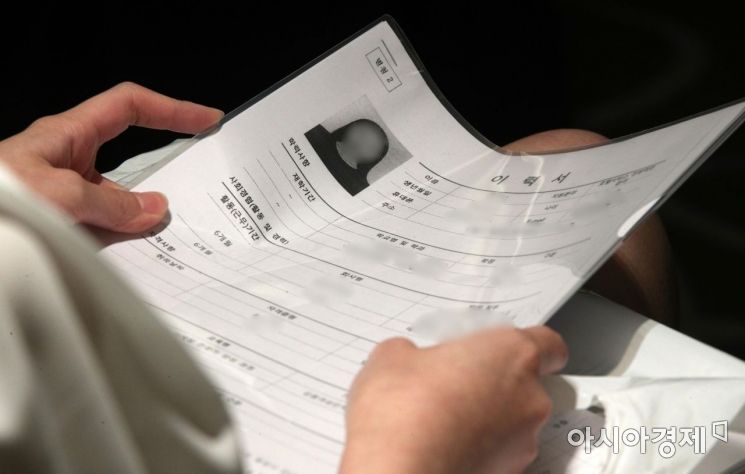 On June 29, 2022, at the Tmark Grand Hotel Myeongdong in Jung-gu, Seoul, a job seeker is waiting for a recruitment interview at the '2022 Tourism Company Mini Job Fair in Seoul.' Photo by Hyunmin Kim kimhyun81@
However, even in this situation, spending on self-development is not being cut back. Entering the era of the three highs?high inflation, high interest rates, and high exchange rates?and with a bleak economic recession outlook, people consider themselves the safest investment.
Job seeker Lee (24) said, "I'm preparing for a public corporation job and am using part-time job money for academy fees," adding, "Nowadays, TOEIC, Computer Utilization Ability (ComHwal), and Korean History (Korean History Proficiency Test) are essential, and everyone has at least one foreign language certificate besides English. To meet these requirements, I have to attend academies and improve my scores. Moreover, TOEIC and HSK (Chinese Proficiency Test) expire after two years, so if I don't get a job within that period, I have to register again at the academy and repeat the process of improving my scores."
The increasing interest in self-development is also confirmed by statistics. According to a survey conducted by market research firm Embrain Trend Monitor on the 3rd, targeting 1,000 adults aged 19 to 59 nationwide, 87.2% of respondents are currently engaged in self-development.
The most common self-development activity was physical fitness and health management (43.7%, multiple responses allowed), followed by studying finance and investment (34.1%), creating personal routines (25.5%), learning sports (25.2%), reading books in various fields (23.2%), studying English (22.5%), appearance management (20.4%), cultivating job-related knowledge (19.2%), and studying for job-related certifications (19.2%).
Especially, people in their 20s and 30s showed a strong interest in self-development for foreign language study and career competency enhancement. Among those studying foreign languages, 60.8% were in their 20s and 30s (20s 34.8%, 30s 26.0%), about twice as high as those in their 40s and 50s (29.3%; 40s 14.4%, 50s 14.8%). Studying for job-related certifications was also higher among those in their 20s (30.8%) and 30s (20.4%) compared to those in their 40s (13.2%) and 50s (12.4%).
Investment trends are also shifting from traditional stock or cryptocurrency investments to 'investment in oneself.' Young people responded that "the investment market seems unstable due to the current economic situation" (89.3% agreement), "it's difficult to be confident in any investment success these days" (83.1%), and "hitting the jackpot through investment success has become even harder" (77.5%). On the other hand, self-development was perceived as the most likely successful financial technology (63.5%).
Trend Monitor explained, "This is interpreted as an increased desire to enhance one's capabilities in preparation for an uncertain future," adding, "Also, after experiencing the COVID-19 pandemic, the concept of a lifelong job has disappeared, and with the investment market suffering continuous losses, the idea that investing in 'oneself' is the safest and most efficient investment is expanding."
© The Asia Business Daily(www.asiae.co.kr). All rights reserved.
![Clutching a Stolen Dior Bag, Saying "I Hate Being Poor but Real"... The Grotesque Con of a "Human Knockoff" [Slate]](https://cwcontent.asiae.co.kr/asiaresize/183/2026021902243444107_1771435474.jpg)
















