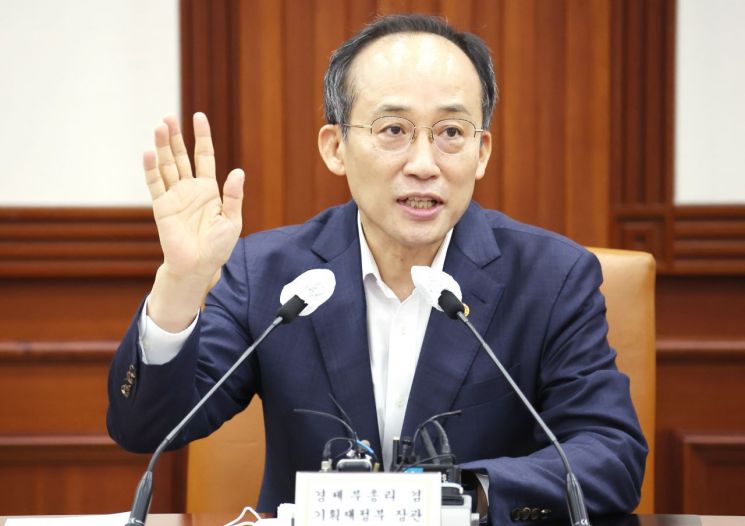
[Asia Economy Sejong=Reporter Son Sun-hee] Chu Kyung-ho, the first 'economic commander' of the Yoon Suk-yeol administration, serving as Deputy Prime Minister for Economy and Minister of Strategy and Finance, marks his 100th day in office on the 17th. Amid rising international inflation, major countries' tightening policies, and the overlapping Russia-Ukraine conflict, external risks have expanded more than ever, while domestic inflation remains a 'work in progress,' making the livelihood economy challenging.
According to the government on the 16th, Deputy Prime Minister Chu, who took office on May 10 with the launch of the new government, will mark his 100th day in office on the 17th. However, the Ministry of Strategy and Finance decided not to hold any separate meetings or schedules considering the severe economic situation.
Those who have closely observed Deputy Prime Minister Chu over the past three months cite his communication skills as his greatest strength. As a former official of the Ministry of Strategy and Finance with strong internal trust, and having served as a re-elected member of the National Assembly, his political capabilities have made his external communication skills the most outstanding among past economic commanders. In particular, he focused on expanding contact with heads of monetary and financial authorities to establish an 'economic one team' response system.
Immediately upon taking office, Deputy Prime Minister Chu ordered the establishment and operation of an Emergency Economic Response Task Force (TF), which has held 28 meetings to date. Diagnosing the current economic situation as a 'complex crisis,' he organized the largest supplementary budget in history (about 62 trillion won) shortly after taking office and passed it through the National Assembly. Additionally, nine major policy announcements, including various livelihood stabilization measures and the new government's economic policy directions, were made. Through these, policies such as compensation for small business losses, the largest-ever fuel tax cuts, and expanded tariff quotas for price stabilization were implemented.
Although the new government’s economic team has been running at a breathless pace over the past 100 days, the livelihood economy remains difficult. With Deputy Prime Minister Chu as the commander, the new government sought a major shift toward 'private-led growth (Minjuseong),' but progress has been slow in the 'minority government with opposition majority' National Assembly. Representative government policies to revitalize the private economy, such as corporate tax cuts and the sale of idle state-owned properties, have faced opposition from the opposition party, slowing progress. Amid ongoing controversy over 'tax cuts for the wealthy,' how much legislative agenda is pushed through at the first regular National Assembly session after his inauguration next month will be key to the momentum of the Yoon Suk-yeol administration’s Minjuseong policy.
Rising inflation since the launch of the Yoon administration is also seen as a regrettable point. The economic team, including Deputy Prime Minister Chu, presented 'price stabilization' as the top policy goal at the start. However, unexpected external factors such as the Russia-Ukraine conflict and rising international oil prices, combined with concerns over global economic slowdown due to major countries’ tightening after the COVID-19 pandemic, have pushed inflation to the highest level in 24 years.
While the economic team has devoted almost all efforts to price stabilization over the past 100 days, key economic pledges from the presidential election, such as pension and labor market reforms, have relatively lacked momentum and appear to have been pushed to the back burner.
© The Asia Business Daily(www.asiae.co.kr). All rights reserved.

















