Only 120 Trillion in Cash Reserves... Various Companies Including Car Semiconductors and Mobile in Consideration
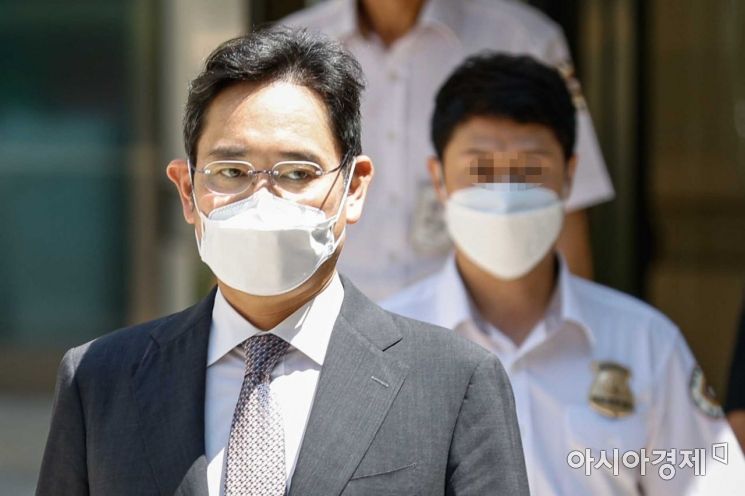 Vice Chairman Lee Jae-yong of Samsung Electronics, who was reinstated through the special pardon on August 15 Liberation Day, is moving at the Seoul Central District Court in Seocho-gu, Seoul on the 12th. Photo by Kang Jin-hyung aymsdream@
[Asia Economy Reporter Han Yeju] With Samsung Electronics Vice Chairman Lee Jae-yong reinstated through the August 15 Liberation Day special pardon, the halted clock of Samsung's mergers and acquisitions (M&A) is expected to start moving again. Samsung, which has been criticized for "losing growth momentum" due to the lack of significant M&A achievements since acquiring Harman six years ago, is in urgent need of revitalizing growth through large-scale M&A.
On the 16th, the business community placed emphasis on the possibility that Samsung, following Lee's reinstatement, could take bold steps in future investments in key industries, including large-scale M&A that had been postponed until now.
Since acquiring the automotive electronics company German Harman in 2016, Samsung has not announced any significant M&A. This was because Lee faced restrictions on management activities, including a five-year employment ban and the requirement to obtain Ministry of Justice approval for overseas business trips, making it difficult to lead new business initiatives for the group. Concerns that Samsung would inevitably fall behind in the global investment competition, which requires agile responses, were a natural outcome.
In fact, while Samsung hesitated, other semiconductor companies expanded their scale through M&A. In February, U.S. Intel acquired Israeli semiconductor foundry company Tower Semiconductor for $5.4 billion (6.5 trillion KRW). SK Hynix completed the first phase of acquiring Intel's NAND flash business for 10 trillion KRW last year.
Meanwhile, Samsung accumulated only cash assets. According to Samsung Electronics' business report, as of the end of last year, Samsung's cash assets amounted to 120.7812 trillion KRW. Cash assets increased by 37 trillion KRW over four years from 83.1842 trillion KRW at the end of 2017.
An industry insider said, "Accumulating cash is positive in terms of financial soundness," but also pointed out, "It means that Samsung has not been able to take steps toward future investments, so it can be interpreted as a 'double-edged sword.'"
Experts unanimously agree that if Samsung embarks on full-scale M&A and investment, the non-memory semiconductor sector is the most likely target. Unlike memory semiconductors, where Samsung has held the world’s number one position for a long time, nurturing the vulnerable non-memory semiconductor sector is Samsung's biggest current issue. Lee declared at the vision announcement ceremony held at Samsung Electronics' Hwaseong Campus on April 30, 2019, "Following memory, we will firmly become number one in the system semiconductor sector, including foundry."
It is known that Samsung is reviewing M&A across the board, including companies related to artificial intelligence (AI), robotics, and 5G. This is because markets for existing businesses such as smartphones and TVs have reached saturation, making it urgent to discover new growth engines corresponding to the "post-semiconductor" era. Samsung also needs to avoid a situation where sales and profits are heavily concentrated in semiconductors. In the automotive electronics sector, Samsung fired the starting shot for business expansion through M&A by acquiring the head-up display (HUD) software specialist company "Apostera" in February.
Lee's global network is expected to give wings to Samsung's M&A moves. In June, during a European business trip, Lee met with strategic partners in the semiconductor and battery sectors to discuss ways to strengthen cooperation, initiating the restoration of his global network. Recently, Samsung Electronics organized a new business task force (TF) and appointed Vice President Jung Sung-taek, who has experience at Qualcomm and Deutsche Telekom, as its head, which can be interpreted as an extension of these efforts.
Kim Dong-won, a researcher at KB Securities, said, "Since the dissolution of the Future Strategy Office in 2017, Samsung has operated task forces (TFs) in three divisions?Samsung Electronics, Samsung Life Insurance, and Samsung C&T?centered on professional managers, which limited large-scale deals," adding, "With Lee's return to management, rapid decision-making will become possible."
© The Asia Business Daily(www.asiae.co.kr). All rights reserved.
![Clutching a Stolen Dior Bag, Saying "I Hate Being Poor but Real"... The Grotesque Con of a "Human Knockoff" [Slate]](https://cwcontent.asiae.co.kr/asiaresize/183/2026021902243444107_1771435474.jpg)















