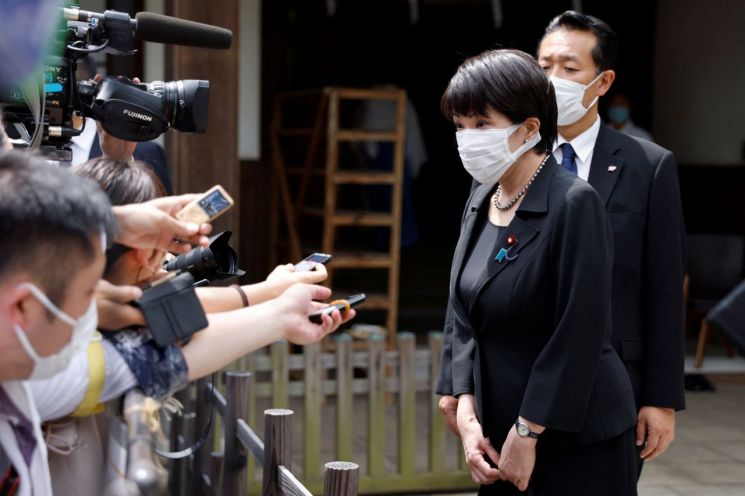
 Takaiichi Sanae, Japan's Minister in charge of Economic Security, visited Yasukuni Shrine in Tokyo on the 15th to pay respects.
 [Image source=Reuters Yonhap News]
[Asia Economy Reporter Lee Chun-hee] On August 15, Liberation Day and the anniversary of the end of World War II, Japanese Prime Minister Fumio Kishida offered tribute at the Tokyo Yasukuni Shrine, where Class-A war criminals are enshrined, while some cabinet members visited the shrine in person to pay their respects.
According to local media on the day, Prime Minister Kishida offered a tamagushi (a branch of the sakaki tree adorned with white paper strips), a type of tribute. The offering was made not in the name of the Prime Minister but as the President of the Liberal Democratic Party, with the Prime Minister personally covering the expenses.
In addition, Sanae Takaichi, Minister in charge of Economic Security, and Kenya Akiba, Minister of Reconstruction, also visited Yasukuni Shrine in the morning to pay their respects. The visits by current Japanese cabinet members on August 15 have continued for three consecutive years since 2020.
Koichi Hagiuda, Chairman of the LDP Policy Research Council, also visited the shrine and made a personal offering. Hagiuda, who previously served as Minister of Economy, Trade and Industry, was appointed as the Chairman of the Policy Research Council in the cabinet reshuffle on the 10th.
Additionally, former Environment Minister Shinjiro Koizumi visited the shrine in the morning, and on the 13th, Minister of Economy, Trade and Industry Yasutoshi Nishimura also paid respects at Yasukuni Shrine.
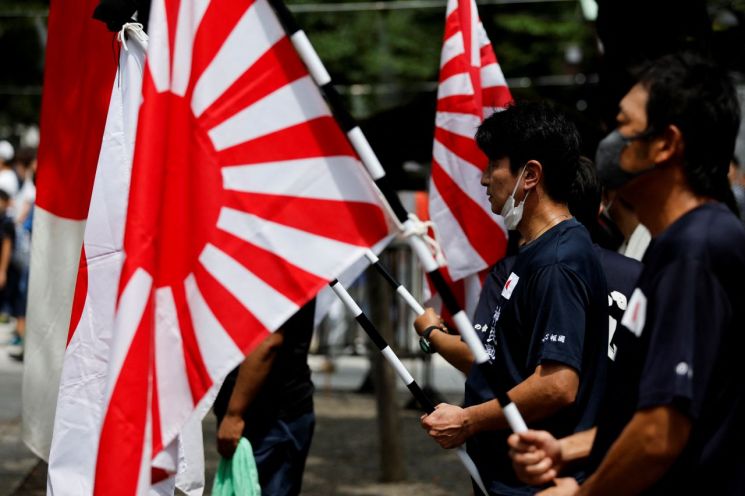 Japanese right-wing activists are paying homage at Yasukuni Shrine in Tokyo on the 15th. [Image source=Reuters Yonhap News]
Yasukuni Shrine is a facility that enshrines the spirits of those who died in Japan’s various aggressive wars during the modern era. It enshrines approximately 2,466,000 individuals, including 14 Class-A war criminals from the Pacific War such as Hideki Tojo.
Among those enshrined at Yasukuni Shrine are about 20,000 people from the Korean Peninsula. However, their enshrinement was unilaterally carried out without the consent of their bereaved families or the Korean side. It is known that even about 60 individuals who returned to Korea after liberation and lived there until their deaths, as well as survivors who were not war dead, were enshrined. Nevertheless, Yasukuni Shrine refuses requests from the individuals concerned or their families to cancel the enshrinement.
© The Asia Business Daily(www.asiae.co.kr). All rights reserved.
![Clutching a Stolen Dior Bag, Saying "I Hate Being Poor but Real"... The Grotesque Con of a "Human Knockoff" [Slate]](https://cwcontent.asiae.co.kr/asiaresize/183/2026021902243444107_1771435474.jpg)
















