[Asia Economy Sejong=Reporter Dongwoo Lee] As the government hints at further postponing the announcement of the final version of the Korean-style green taxonomy, K-Taxonomy, which includes nuclear power, originally scheduled for September, attention is focused on whether detailed plans for securing a high-level radioactive waste disposal facility (waste disposal site) will be included.
According to related ministries on the 15th, the Ministry of Environment is collecting expert opinions on the timing and methods for securing a high-level waste disposal site, assuming the inclusion of nuclear power in the K-Taxonomy. Radioactive waste refers to materials that have been used for various purposes involving radioactive substances and are no longer usable.
Since the amount of high-level radioactive waste generated is expected to increase beyond previous estimates when nuclear power is used as an eco-friendly energy source, securing waste disposal facilities is an urgent issue for stable nuclear power plant operation.
According to Korea Hydro & Nuclear Power (KHNP), as of the end of June, the saturation rates of temporary storage facilities for spent nuclear fuel at pressurized water reactor (PWR) nuclear power plant headquarters are 85.9% at Kori Nuclear Power Plant, 82.5% at Hanul Nuclear Power Plant, and 74.9% at Hanbit Nuclear Power Plant. Nuclear waste generated from PWRs is currently stored in wet storage facilities due to the absence of alternative facilities.
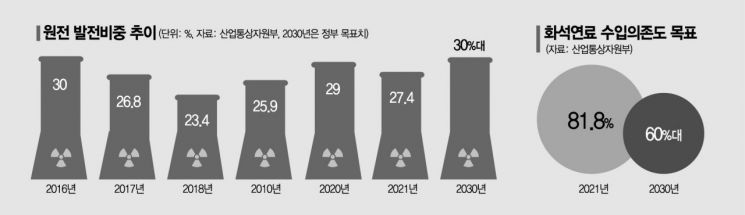
The issue lies in the timing of constructing the waste disposal site. The European Union, while including nuclear power in the EU Taxonomy, requires that ▲ construction permits be obtained before 2045 ▲ accident-tolerant fuel (ATF) be used by 2025 ▲ and a high-level radioactive waste disposal facility be secured by 2050.
According to the "2nd Basic Plan for High-Level Radioactive Waste Management" prepared by the Nuclear Energy Promotion Committee, it is predicted that a total of 37 years will be needed until one final disposal facility is stably operated. Finland, the first country in the world to construct such a facility, took 17 years from underground site investigation to selection of the site for its multi-barrier system, and over 20 years to obtain construction permits.
South Korea first attempted to build waste disposal sites at locations such as Uljin, Yeongdeok, and Yeongil in 1989 but has failed to select a site nine times since. This is why some are concerned that the essential issue of constructing a waste disposal site for eco-friendly nuclear power may face delays beyond expectations due to difficulties starting from site selection.
Securing technology is also critical. Compared to countries like the United States, Finland, and Sweden, South Korea's domestic technology for managing high-level radioactive waste currently stands at 84% in transportation, 80% in storage, and 57% in disposal.
Accordingly, the government plans to accelerate construction, including site selection, by investing 1.4 trillion won in a 37-year research and development (R&D) project from next year until 2060 through the 2nd Basic Plan for High-Level Radioactive Waste Management and the High-Level Radioactive Waste R&D Roadmap.
© The Asia Business Daily(www.asiae.co.kr). All rights reserved.
![Clutching a Stolen Dior Bag, Saying "I Hate Being Poor but Real"... The Grotesque Con of a "Human Knockoff" [Slate]](https://cwcontent.asiae.co.kr/asiaresize/183/2026021902243444107_1771435474.jpg)
















