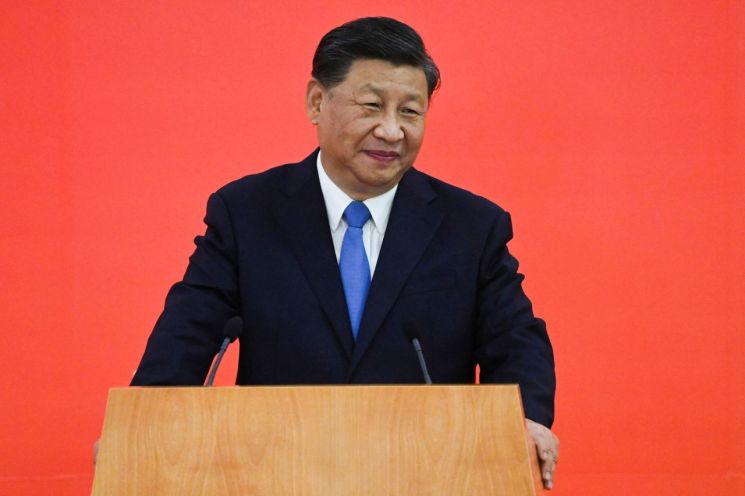
 Yanbian Korean Autonomous Prefecture, the only Korean autonomous prefecture in China, has established and begun implementing a writing regulation that prioritizes Chinese characters. The photo shows Xi Jinping, President of China.
 [Image source=Yonhap News]
[Asia Economy Intern Reporter Kim Se-eun] The Yanbian Korean Autonomous Prefecture, the only Korean autonomous region in China, has established and begun implementing a regulation prioritizing Chinese in written language notation.
The Yanbian government announced and enforced the "Regulations on the Implementation of Korean Language and Script Work." The main point of the regulation is that government agencies, enterprises, social organizations, and self-employed individuals must write both Chinese and Hangul together when displaying text.
For horizontal text, Chinese is placed first, followed by Hangul; for vertical text, Chinese is on the right and Korean on the left.
All signs, including plaques and advertisements made before the regulation was established, will be replaced.
Until now, in Yanbian as well as in places with dense Korean or Joseonjok populations such as Shenyang and Dandong in Liaoning Province, Hangul was often the primary language with Chinese used alongside. Therefore, many signs in these areas were primarily in Hangul.
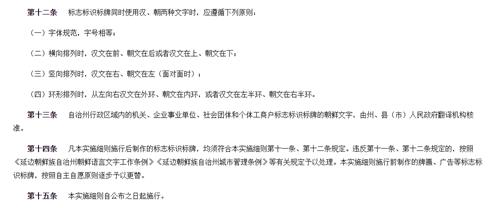 'Chinese First' Character Notation Plan in Yanbian Prefecture Implementation Rules. Photo by Yanbian Prefecture Website, Yonhap News
However, recently, there has been an emphasis on Chinese nationalism and national integration within China. Following the 2019 anti-government protests in Hong Kong and Taiwan's trend toward strengthening its independence stance, China shifted from respecting ethnic minorities to emphasizing a "Chinese national community consciousness."
Since 2020, the Chinese government has required the use of Standard Chinese during class hours in ethnic minority regions and is gradually replacing textbooks with nationally unified editions. Previously, elementary schools in minority regions conducted classes using textbooks and languages of the respective ethnic groups.
In response, thousands of Mongols in the Inner Mongolia Autonomous Region held protests.
The Chinese Joseonjok expressed concerns, saying, "For several years, the Chinese government has emphasized Chinese nationalism and national integration, reducing the autonomous space of individual ethnic groups," and warned, "Eventually, all ethnic minorities may be assimilated into the Han ethnicity."
Currently, China's population of about 1.4 billion consists of 92% Han Chinese and 8% from 55 ethnic minority groups.
© The Asia Business Daily(www.asiae.co.kr). All rights reserved.
![Clutching a Stolen Dior Bag, Saying "I Hate Being Poor but Real"... The Grotesque Con of a "Human Knockoff" [Slate]](https://cwcontent.asiae.co.kr/asiaresize/183/2026021902243444107_1771435474.jpg)
















