Follow-up Research Including On-Farm Demonstrations Planned for Next Year
[Asia Economy Reporter Ra Young-cheol] When cruciferous plants such as cabbage, Chinese cabbage, and radish are infected with the soil-borne pathogen 'root-knot disease,' the harvest yield can decrease by up to 80%.
In particular, once the pathogen occurs, complete control is difficult, and since it remains in the soil for up to 10 years causing continuous damage, prevention and response are crucial.
Accordingly, the Gyeonggi-do Agricultural Research and Extension Services' Eco-friendly Microorganism Research Institute is conducting a five-year joint research project with the Rural Development Administration starting this year, titled "Development of Useful Microorganisms and Eco-friendly Utilization Technologies for Controlling Root-knot Disease in Cabbage Family."
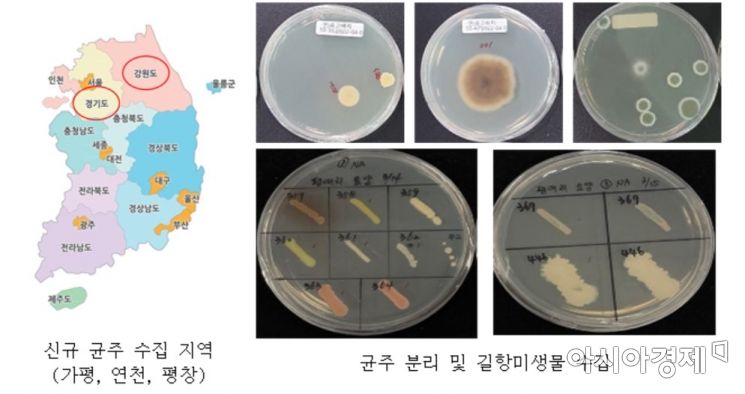
The institute announced on the 14th that "recently, we secured 111 beneficial microbial strains from substrates after shiitake mushroom harvest, roots of healthy plants in root-knot disease outbreak areas, and existing genetic resources."
Microorganisms such as fungi of the genus Penicillium, which secrete antibiotic substances, and bacteria of the genus Bacillus can kill more than half of the root-knot disease pathogens in crops by decomposing the fungal cell membranes.
The institute is also developing technology to combine microorganisms with carbon-reducing organic farming materials that have a large surface area.
Through this, it is expected to help farmers manage root-knot disease in an environmentally friendly way and produce agricultural products stably.
Depending on the progress of technology development this year, the Agricultural Research and Extension Services plan to continue follow-up research next year, including developing control functions, microbial cultivation methods, and on-site verification at Chinese cabbage farms.
Im Gap-jun, head of the Eco-friendly Microorganism Research Institute at Gyeonggi-do Agricultural Research and Extension Services, stated, "We will continue to develop eco-friendly control technologies for crops that farmers struggle with due to pests and diseases, aiming to increase consumption and provide good food."
© The Asia Business Daily(www.asiae.co.kr). All rights reserved.
![Clutching a Stolen Dior Bag, Saying "I Hate Being Poor but Real"... The Grotesque Con of a "Human Knockoff" [Slate]](https://cwcontent.asiae.co.kr/asiaresize/183/2026021902243444107_1771435474.jpg)
















