Court: "Ordinary drivers expected to use common sense... Cannot conclude a defect in management"
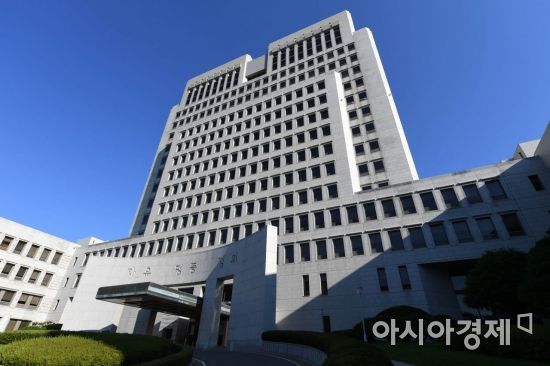
[Asia Economy Reporter Heo Kyung-jun] The Supreme Court has ruled that even if there are some defects in road signs, it cannot be concluded that there is a defect in the installation or management of the signs if, from the perspective of an ordinary driver, a reasonable and orderly use can be expected.
The Supreme Court's 2nd Division (Presiding Justice Lee Dong-won) announced on the 14th that it overturned the previous ruling, which partially ruled in favor of the plaintiff, in the damages lawsuit filed by accident driver Mr. A and his family against the local government, and sent the case back to the Seoul High Court.
Mr. A was traveling to Jeju Island around March 2017 and was involved in a traffic accident while riding a motorcycle. The accident occurred at a 'ㅏ'-shaped three-way intersection. At the time, Mr. A was waiting for a signal to make a U-turn, and the U-turn instruction sign next to the traffic light had a notice that read "When turning left, during pedestrian signal."
At the point where Mr. A was preparing to make the U-turn, there was no road allowing a left turn at all. When the traffic light turned red, Mr. A made an illegal U-turn, and a car traveling straight at 71 km/h according to the straight/left turn signal on the opposite road collided with the rear part of Mr. A's motorcycle. Mr. A was seriously injured in the accident and has not regained consciousness.
Mr. A's family filed a lawsuit against the local government, the entity responsible for the installation and management of the facility, claiming damages, arguing that the traffic signs at the accident site did not match the actual road conditions and could cause drivers to make incorrect judgments.
The first trial court ruled that the traffic signs at the accident site did not constitute a defect in public facilities (objects or equipment provided for public purposes by administrative entities), and even if considered defective, there was no causal relationship with the accident suffered by Mr. A, thus dismissing the plaintiff's claim.
On the other hand, the second trial court recognized that the incorrect traffic signs that did not match the actual road conditions could cause drivers to make wrong judgments, constituting a defect in the installation and management of public facilities, and acknowledged a causal relationship with the accident, ordering compensation of about 250 million KRW.
However, the Supreme Court's judgment was different. It stated that the mere existence of a traffic sign assuming a road where there was clearly none cannot be regarded as a defect in the traffic sign, nor can it be seen as causing confusion.
The Supreme Court stated, "Since the auxiliary sign reads 'When turning left, during pedestrian signal,' it is understood to mean that a U-turn is possible when the traffic light for left turn or pedestrian signal is green," adding, "However, since the intersection at the time did not have a road for left turns and there was no left turn signal on the traffic light, a U-turn was only possible when the pedestrian signal was green."
© The Asia Business Daily(www.asiae.co.kr). All rights reserved.
![Clutching a Stolen Dior Bag, Saying "I Hate Being Poor but Real"... The Grotesque Con of a "Human Knockoff" [Slate]](https://cwcontent.asiae.co.kr/asiaresize/183/2026021902243444107_1771435474.jpg)















