India Inflation Rate Below 7%, Showing Stability
US July Inflation Rate Also Below Market Expectations
Stock Market Recovers Amid Expectations of Inflation Peak
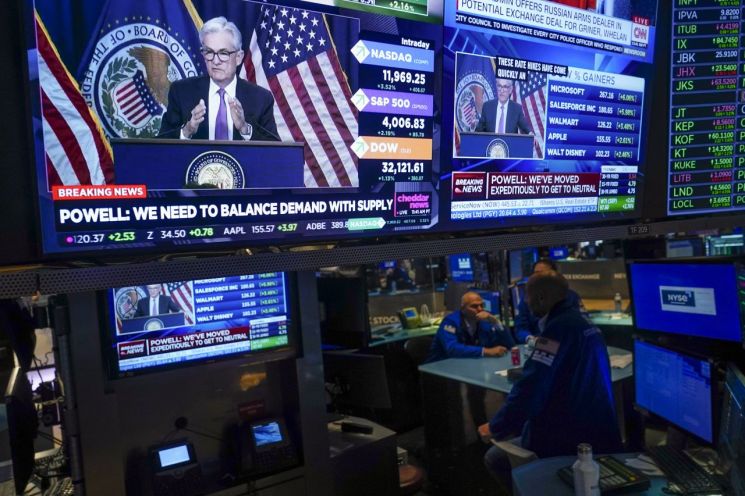 On the 27th of last month (local time), traders at the New York Stock Exchange (NYSE) in the United States watched Federal Reserve Chairman Jerome Powell's press conference. [Image source=Yonhap News]
As inflation rates in countries such as South Korea, the United States, and India have recently shown signs of slowing down, analyses suggest that global inflation may be nearing its peak. However, since prices remain high compared to previous years and uncertainties such as international oil prices persist, some experts caution against prematurely declaring the peak.
India's National Statistical Office announced on the 12th (local time) that the Consumer Price Index (CPI) for July recorded a 6.71% increase. This is the lowest figure in the past five months. India experienced a sharp rise in inflation since September last year, reaching 7.79% in April this year, but recent aggressive interest rate hikes have gradually cooled inflation.
The Reserve Bank of India (RBI) raised the benchmark interest rate by 0.5 percentage points from 4.9% to 5.4% on the 5th, totaling a 1.4 percentage point increase over the past three months to counter inflation. As money loosened during the COVID-19 pandemic was withdrawn and expectations for further rate hikes weakened, the Indian stock market also showed signs of recovery. The Bombay Stock Exchange's Sensex index, India's representative stock index, closed at 59,462.78 on the 12th, surpassing 59,000 for the first time in four months.
Earlier, the U.S. Department of Labor announced on the 10th (local time) that the year-on-year CPI inflation rate for July was 8.5%, lower than Wall Street's forecast of 8.7%, fueling expectations that inflation may have peaked. The U.S. import price index for July also fell 1.4% month-on-month, a larger drop than the 1.0% decline predicted by the Wall Street Journal (WSJ).
If U.S. inflation stabilizes, the Federal Reserve (Fed) may reduce the magnitude of its interest rate hikes, which boosted the stock market. On the 12th (local time) at the New York Stock Exchange (NYSE), the Dow Jones Industrial Average closed at 33,761.05, up 424.38 points (1.27%) from the previous day; the Standard & Poor's (S&P) 500 index rose 72.88 points (1.73%) to 4,280.15; and the Nasdaq index gained 267.27 points (2.09%) to close at 13,047.19.
With consecutive signs of easing inflation, expectations are growing that the Fed will opt for a 0.5 percentage point hike, known as a 'Big Step,' instead of a 0.75 percentage point 'Giant Step' at next month's Federal Open Market Committee (FOMC) meeting.
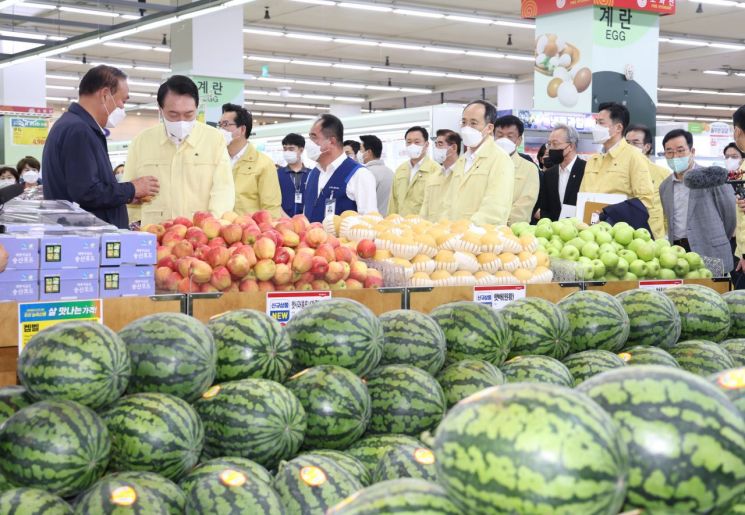 President Yoon Suk-yeol is checking fruit prices at Hanaro Mart Yangjae Branch in Yangjae-dong, Seocho-gu, Seoul on the 11th. [Image source=Yonhap News]
South Korea also saw a slight slowdown in import prices last month. According to the Bank of Korea, the import price index (provisional figure based on the Korean won, with 2015 as 100) for July was 153.49, down 0.9% from the previous month. Prices of mining products, coal, and petroleum products fell due to the decline in international oil prices, marking the first decrease in three months.
As import prices ease, voices are emerging that domestic inflation may also be nearing its peak. At a recent press briefing at the Government Complex Sejong, Deputy Prime Minister and Minister of Economy and Finance Choo Kyung-ho predicted, "Domestic inflation is expected to peak around September to October and then stabilize."
However, many experts argue that it is still too early to declare the peak of inflation. In the U.S., the absolute level of consumer price inflation remains high, and both domestic and international economic uncertainties are significant.
Thomas Barkin, President of the Federal Reserve Bank of Richmond, stated, "While the slowdown in inflation indicators is welcome, interest rate hikes must continue until inflation is fully under control," and Mary Daly, President of the Federal Reserve Bank of San Francisco, emphasized, "It is too early to declare victory in the war against inflation."
Domestically, concerns are growing that recent heavy rains have worsened crop yields, potentially destabilizing prices further. According to agricultural product price information from the Korea Agro-Fisheries & Food Trade Corporation (aT), as of the 12th, the average retail price of one head of cabbage was 6,865 won, a 53.7% increase compared to one year ago (4,466 won). Market analysts warn that if agricultural product prices surge on top of existing inflationary pressures, the annual consumer price inflation rate could exceed 5%.
© The Asia Business Daily(www.asiae.co.kr). All rights reserved.
![Clutching a Stolen Dior Bag, Saying "I Hate Being Poor but Real"... The Grotesque Con of a "Human Knockoff" [Slate]](https://cwcontent.asiae.co.kr/asiaresize/183/2026021902243444107_1771435474.jpg)

















