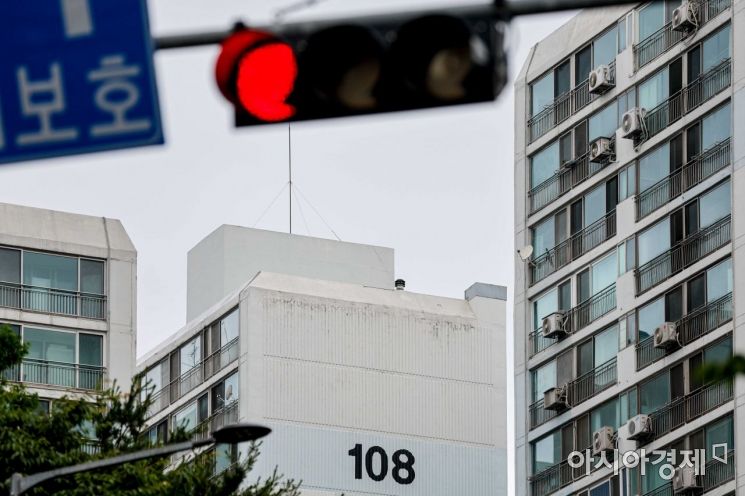
[Asia Economy Reporter Ryu Tae-min] As the housing market freezes solidly, the decline rate of apartment prices in the six major metropolitan cities has reached the highest level in 10 years. With growing concerns over consecutive interest rate hikes and economic recession, urgent sale listings have appeared, leading to a drop in asking prices.
According to the weekly apartment price trend for the second week of August announced by the Korea Real Estate Board on the 14th, the apartment transaction price change rate in the six major metropolitan cities was -0.10%. This marks the lowest point in 10 years since the first week of August 2012 (-0.10%).
One year ago, in August last year, the transaction price change rate in the six major metropolitan cities showed a weekly increase of 0.22% to 0.25%. However, as the housing market began to freeze, it dropped to the 0.00% range in December last year, and in the fifth week of January this year, it turned negative for the first time in 2 years and 5 months. The cumulative transaction price change rate since the beginning of this year was -1.07%.
By metropolitan city, Daegu experienced the largest decline, falling 0.16% in the second week of August. By district, Dalseong-gu in Daegu fell the most at -0.22%, followed by Dalseo-gu (-0.21%) and Suseong-gu (-0.17%).
Incheon followed with a 0.15% decline. In particular, Michuhol-gu’s decline sharply increased from -0.07% the previous week to -0.22% this week, and Gyeyang-gu also dropped more significantly from -0.03% to -0.18%, leading the downward trend in the Incheon area. In other metropolitan cities, the order of decline was Ulsan (-0.10%), Daejeon (-0.09%), Busan (-0.05%), and Gwangju (-0.02%).
Meanwhile, the apartment transaction supply-demand index in the six major metropolitan cities fell for five consecutive weeks, recording 87.6 in the second week of August. By region, Daegu was the lowest at 74.0, followed by Ulsan (84.7) and Incheon (86.1). On the other hand, in the remaining regions such as Daejeon (92.0), Busan (92.1), and Gwangju (98.6), the transaction supply-demand index still recorded the 90s, showing a significant disparity.
© The Asia Business Daily(www.asiae.co.kr). All rights reserved.
![Clutching a Stolen Dior Bag, Saying "I Hate Being Poor but Real"... The Grotesque Con of a "Human Knockoff" [Slate]](https://cwcontent.asiae.co.kr/asiaresize/183/2026021902243444107_1771435474.jpg)















