[Asia Economy Reporter Donghoon Jung] Amid the global supply chain restructuring and the weaponization of resources, the United States has passed the Inflation Reduction Act. As the importance of minerals and materials used in advanced industries such as semiconductors and batteries grows, there are already moves to implement protectionist policies related to lithium, a key raw material for batteries.
◆South American Lithium Protectionism... Lithium Prices Keep Rising=According to major foreign media on the 13th, Chinese electric vehicle giant BYD signed a contract with the Chilean government to develop a lithium mine but recently faced difficulties. The court invalidated the contract, ruling that there was no prior consultation between the government and indigenous people, who protested that lithium mining caused water shortages. The left-wing government of Chile, led by President Gabriel Boric, considers the privatization of raw material mining a 'vestige of corruption' and is pushing to establish a state-owned company to develop lithium, which is expected to raise barriers further.
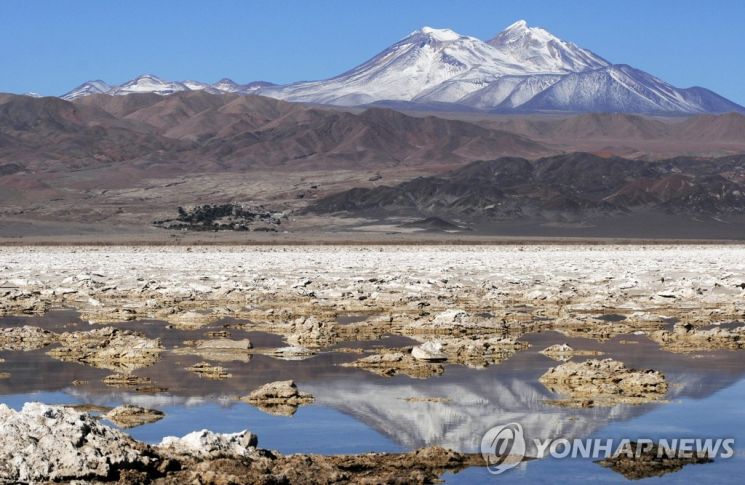
The mineral-rich area spanning Chile, Bolivia, and Argentina in South America is the main production site of lithium, a core raw material for electric vehicle batteries, accounting for 55% of the world's reserves. Chile, the leader of the so-called 'Lithium Triangle,' has recently been increasing its control over lithium mines citing environmental protection and resource security. If a constitutional amendment with such provisions is approved in the upcoming national referendum next month, Chile's environmental regulations on mining and indigenous rights will be further strengthened.
Bolivia nationalized its lithium industry in 2008 during the left-wing government led by President Evo Morales. Morales declared that Bolivia would become a 'mineral powerhouse' manufacturing batteries and electric vehicles and established a state-owned company. Bolivia's lithium plant began operations in 2013, but its 2021 production was only about half a day's worth of Chile's output, making it negligible.
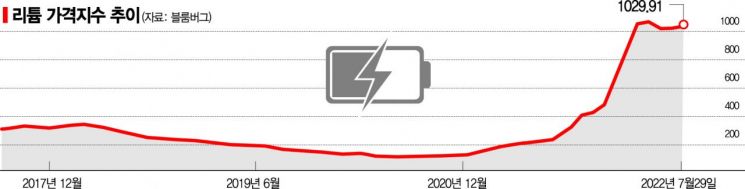
As this 'lithium protectionism' becomes more apparent, lithium prices continue to soar. While other minerals have peaked and are declining, lithium prices show no signs of falling. According to the Korea Resources Information Service, the price of lithium (99% lithium carbonate basis) was 80 yuan (about 15,500 KRW) per kilogram in July last year but has surged 472.5% to 458 yuan (about 88,742 KRW) currently. This is only a 2.7% drop compared to the all-time high of 471 yuan (about 91,260 KRW) recorded in April.
In contrast, prices of other battery materials such as nickel and cobalt, which surged after the Russia-Ukraine war, are sharply declining. The most expensive cobalt fell about 42% from $81,600 per ton (about 107.3 million KRW) in April to $46,995 (about 61.37 million KRW) currently. Nickel also dropped about 29% from $32,800 (about 42.5 million KRW) to $23,110 (about 28.51 million KRW) during the same period.
◆It Takes 7 Years to Build Mines and Factories Despite the Inflation Reduction Act=According to the Inflation Reduction Act, which passed the House on the 11th (local time) following the Senate, electric vehicle buyers can receive a tax credit of up to $7,500 (about 10 million KRW). However, to qualify, electric vehicle manufacturers must source at least 40% of battery materials such as lithium from the United States or countries that have free trade agreements (FTA) with the U.S., such as Canada, Chile, and Australia, by 2023. Furthermore, companies must increase this ratio to 80% by 2026.
The bill aims to exclude China, which dominates the battery value chain, and reorganize the global supply chain centered on the U.S. However, it is expected to be difficult to exclude China, which has strengthened its dominance over the global battery supply chain from mineral mining and refining to intermediate processing and finished product development.
Simon Moores, CEO of battery information company Benchmark Mineral Intelligence (BMI), said it takes seven years to build mines and refining plants producing battery material minerals and two years to construct battery factories, estimating that it would take nearly 10 years to create a completely new industry in the U.S. like this.
A spokesperson for Albemarle, a major lithium producer aiming to build a lithium processing facility in the southeastern U.S. in the late 2020s, said the bill is positive for attracting investment in the U.S. However, they also evaluated that "since the battery industry mainly operates in Asia and the U.S. supply chain is in its early development stage, it is not easy to meet the requirements and schedule for electric vehicle tax credits." They stated that while their mining projects will help build the relevant supply chain in the U.S. in the future, time is needed to achieve this.
© The Asia Business Daily(www.asiae.co.kr). All rights reserved.
![Clutching a Stolen Dior Bag, Saying "I Hate Being Poor but Real"... The Grotesque Con of a "Human Knockoff" [Slate]](https://cwcontent.asiae.co.kr/asiaresize/183/2026021902243444107_1771435474.jpg)

















