Automotive Semiconductors Gain Attention with Mobility Advances... 100 Trillion Won Market Emerges
Samsung Electronics, TSMC, Intel, Qualcomm, Nvidia, Tesla Eye Opportunities
Single-Digit Nanometer Process Automotive Semiconductors Expected... "Safety Remains Separate Challenge" Evaluated
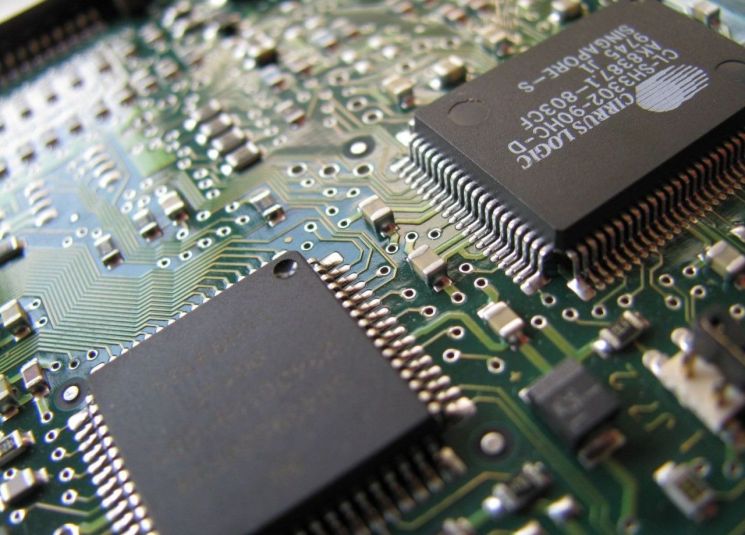
[Asia Economy Reporter Kim Pyeonghwa] With the advancement of mobility, market expectations for automotive semiconductors are growing. As electric vehicles and autonomous vehicles rapidly advance in technology, the demand for high-performance automotive semiconductors to support various functions is expected to increase steadily. This is why major semiconductor companies such as Samsung Electronics and Intel have recently taken steps to enter the automotive semiconductor business. Automotive semiconductors, which had lower performance compared to those for PCs or mobile devices, are now being upgraded to server-grade levels, with expectations that they could be produced using single-digit nanometer (nm, one billionth of a meter) processes.
Automotive Semiconductors with Low Profitability and Many Challenges... Why Are They Gaining Attention?
According to semiconductor industry insiders and related experts on the 13th, as the importance of automotive semiconductors grows, the number of market participants is increasing. Traditionally, the automotive semiconductor market was dominated by a few companies such as Germany's Infineon, the Netherlands' NXP, and Japan's Renesas. Major semiconductor companies familiar to the public, like Samsung Electronics, had not been prominent players in this market. This was due to the low profitability from small-volume, multi-product production and the high requirements for safety and technological standards, which created barriers. Additionally, automotive semiconductors accounted for only about 10% of the total market, making them a less significant revenue source.
Recently, this market situation has been changing. As technology development rapidly shifts from traditional internal combustion engine vehicles to electric and autonomous vehicles, automotive semiconductors are also undergoing transformation. The demand for high-performance, high-capacity products is increasing as data processing through various in-vehicle infotainment systems and sensors is required. The number of semiconductors included in a single vehicle is also rising. Furthermore, the automotive industry's semiconductor replacement cycle shortening from 7-8 years to 3-4 years is a positive factor for related demand.
Samsung Electronics has been supplying automotive semiconductors to automakers such as Audi, Volkswagen, Hyundai Motor Company, and Tesla, but it was not a major player in the automotive semiconductor market. The proportion of automotive products in Samsung Electronics' semiconductor sales was also minimal. However, with market demand increasing and Vice Chairman Lee Jae-yong of Samsung Electronics identifying the automotive electronics sector as a future core business, it is expected that related business efforts will be strengthened.
Samsung Electronics was the first in the industry to introduce automotive Universal Flash Storage (UFS) in 2017. Since then, it has provided high-performance solid-state drives (SSD) and DRAM automotive memory semiconductors to the market. In 2021, it announced three next-generation automotive system semiconductors, including automotive communication chips and infotainment processors. At the Semiconductor Exhibition (SEDEX) held in October of the same year, Samsung clearly demonstrated its interest in the automotive semiconductor business by exhibiting several of its automotive semiconductor products.
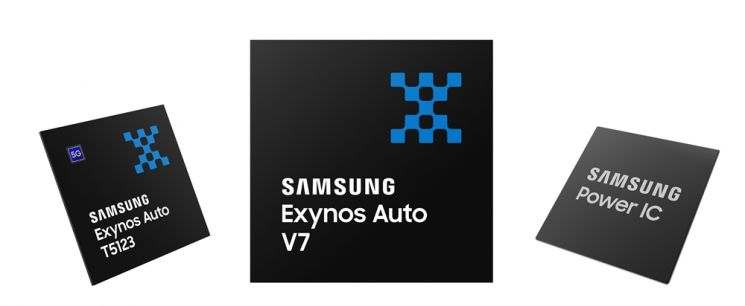 Image of automotive system semiconductor product released by Samsung Electronics in November 2021 [Source=Samsung Electronics]
Han Jin-man, head of strategic marketing at Samsung Electronics' Memory Business Division, expressed in December 2021, "We are committed to accelerating the autonomous driving era by timely providing advanced total memory solutions for automotive applications."
The entry of major companies such as Intel, Qualcomm, Nvidia, and Tesla into the automotive semiconductor market is also a key point to watch. For example, Intel officially announced its entry into the automotive semiconductor foundry (contract manufacturing) business this year. Qualcomm expanded its business by acquiring Swedish autonomous driving technology startup Veoneer in 2021 and also introduced automotive application processor (AP) products. Nvidia has introduced automotive chipsets and is collaborating with British automaker Jaguar Land Rover on related development.
Market research firm Omdia expects the global automotive semiconductor market to grow by 24.6% last year and by 17.8% this year due to these changes. It forecasts double-digit growth continuing until 2025. Corresponding related sales are expected to increase by 68%, from $50 billion (65.3 trillion KRW) last year to $84 billion (109.704 trillion KRW) in 2025. While the global semiconductor market faces a gloomy growth outlook due to supply chain crises and US-China conflicts, automotive semiconductors are expected to show a remarkable growth trend.
Will Automotive Semiconductors Also Move to Single-Digit Nanometer Processes? "Safety Assurance Is a Separate Issue," Experts Say
As demand and supply in the automotive semiconductor market increase, there is speculation that the pace of related technology development could accelerate. Previously, automotive semiconductors were used to control simple functions in vehicles, so there was no demand for high performance. Going forward, as electric and autonomous vehicles develop, automotive semiconductors are expected to evolve to server-grade performance and capacity. The introduction of advanced fine processes is also becoming more likely.
TSMC, which accounts for the majority of automotive foundry supply, has expanded investments in production facilities to produce 28nm microcontroller units (MCUs). MCUs are key components that play a central role in vehicle control. TSMC's new factory in Kumamoto Prefecture, Japan, is expected to include 12-16nm manufacturing lines, and there is speculation that automotive semiconductors could be produced at this facility. This is because one of the three major shareholders of the factory is Denso, a Japanese automotive parts company affiliated with Toyota Motor Corporation.
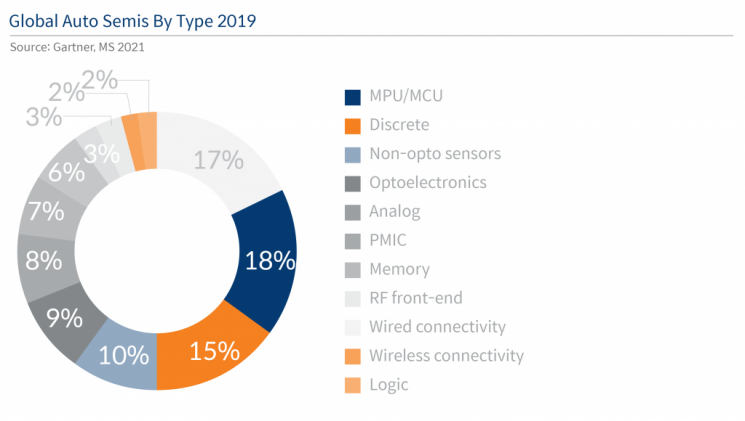 Market share graph by product of the global automotive semiconductor market released by market research firm Gartner in 2021 [Source=Mirae Asset Global Investments (Hong Kong)]
Samsung Electronics has announced plans to apply a 14nm process in MCU production. It is reported that Tesla's Full Self-Driving (FSD) chip is already being contract-produced using a 14nm process. As Tesla's autonomous driving technology advances, it is predicted that ultra-fine processes could be incorporated through collaboration.
The semiconductor industry believes that with major foundry companies like TSMC and Samsung Electronics competing in the 3nm process, it will not be difficult for automotive semiconductors using single-digit nm processes to emerge. The feasibility depends more on market demand than on technical issues.
An industry insider said, "While existing automotive semiconductors such as MCUs controlled relatively simple functions, semiconductors for electric and future autonomous vehicles must be highly advanced and high-performance. Since 14nm semiconductors are already being supplied, finer processes can be adopted in the future."
However, unlike semiconductors for PCs or smartphones, automotive semiconductors require higher levels of safety and durability, so whether these requirements can be met remains to be seen.
Kim Yang-peng, a senior researcher at the Korea Institute for Industrial Economics & Trade, explained, "Although high-performance semiconductors are increasingly used in autonomous and electric vehicles, requiring finer semiconductors, technological advancement and safety are different matters. Safety is critical for automotive semiconductors. Even if products are produced, it takes years of testing before they can be adopted."
© The Asia Business Daily(www.asiae.co.kr). All rights reserved.
![Clutching a Stolen Dior Bag, Saying "I Hate Being Poor but Real"... The Grotesque Con of a "Human Knockoff" [Slate]](https://cwcontent.asiae.co.kr/asiaresize/183/2026021902243444107_1771435474.jpg)

















