Non-Compliance Rate of 44.1% with Refund Standards in Rainy Weather
Korea Consumer Agency and Fair Trade Commission "Will Promote Revision of Standard Terms"
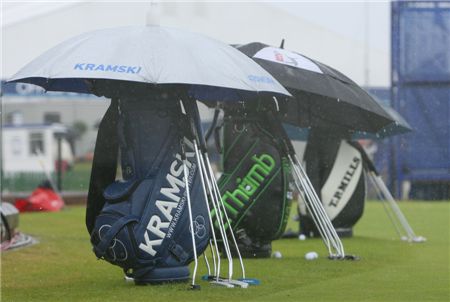
[Asia Economy Reporter Lee Seohee] Recent heavy rains have drawn attention to the regulations for golf course usage during severe weather. Golf is a sport heavily influenced by weather conditions, which also affect the safety of players and staff. To protect consumer rights and prevent safety accidents, the Fair Trade Commission has established standard terms and conditions for golf courses; however, since these are essentially recommendations, compliance rates remain low.
Heavy Rain Prevents Play but "No Refund"... 44.1% Non-Compliance with Refund Regulations
In May, an incident occurred where a man who insisted on continuing a golf game in fog accidentally hit a course assistant on the opposite side with a golf ball, causing injury. The user testified that he expressed his intention to stop playing to the golf course during the game, but the golf course staff encouraged him to continue by offering assistance via radio communication.
Choi Donghee (46), who recently visited a golf course in Pocheon, Gyeonggi Province, had a similar experience. Around the 8th hole of the 18-hole course, rain suddenly started, and he requested a refund for the remaining 11 holes, but was refused. Choi said, "At that time, the golf course only repeated that refunds were not possible according to their regulations," adding, "It was so rainy that it was hard to keep my eyes open properly, so I gave up playing and only received a 50,000 won refund for the cart fee."
Standard Terms Exist but...
 Homepage of a golf course located in Icheon, Gyeonggi-do. According to the standard terms and conditions for golf course use, cancellations on weekdays must be made at least 3 days before the reservation date, and cancellations on weekends must be made at least 4 days before the reservation date; however, these rules are not being followed.
 [Photo by Screen Capture]
If weather conditions are poor, such as heavy fog or rain, users can stop playing mid-game and receive a refund. According to the 'Standard Terms and Conditions for Golf Course Use,' if a game is interrupted due to natural disasters or force majeure such as heavy snow, rain, or fog, fees for unused holes are refunded. If no holes are played, the full amount excluding taxes and clubhouse facility fees is refunded; if two or more holes are played, a proportional refund is given based on 18 holes.
However, a survey conducted by the Korea Consumer Agency from February for one month on 170 golf courses (85 public, 85 private) found that 44.1% (75 courses) either did not specify refund regulations or refunded less than the standard. Nearly half of the surveyed courses did not comply with the Fair Trade Commission's recommended standard terms.
Many courses also failed to comply with regulations regarding 'voluntary cancellations' by users, which are not due to natural disasters like snow or rain. According to the standard terms, consumers can cancel reservations without penalties up to 3 days before on weekdays and 4 days before on weekends. However, only 22 courses (13%) on weekdays and 47 courses (27.8%) on weekends adhered to the free cancellation period. Some even charged the full fee as a penalty.
Experts Call for Strengthened Consumer Protection Measures
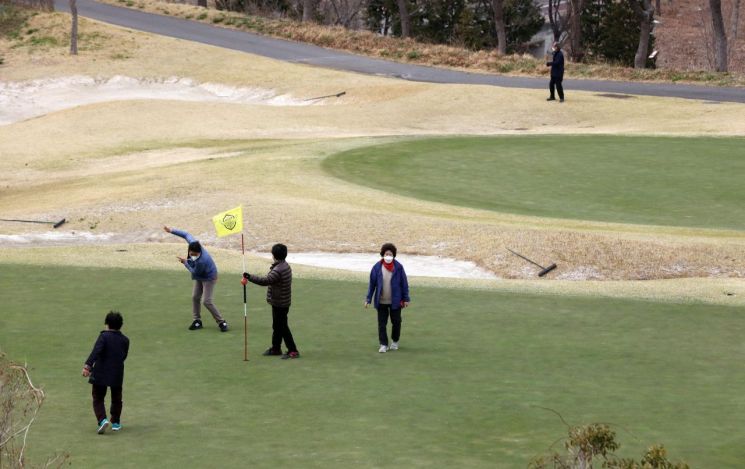
The reason many golf courses do not follow the standard terms is that there are no penalties for violations.
As a result, consumer complaints are increasing. An analysis by the Fair Trade Commission and Korea Consumer Agency of consumer consultations related to golf course use showed that 'refusal to refund unused fees' accounted for 297 cases (18.3%), the highest number. Over the past four years, a total of 1,627 consumer complaints about golf courses were filed with the Korea Consumer Agency, increasing annually except for a slight decrease last year. Notably, complaints surged by 38.2% in 2020, the first year of the COVID-19 pandemic.
The Korea Consumer Agency plans to revise the standard terms to reduce consumer damages. Yang Jonghyun, an investigator at the Korea Consumer Agency, told Asia Economy, "We are fully aware of the many consumer complaints regarding golf course use," adding, "We have proposed revisions to the Fair Trade Commission to ensure that businesses can guarantee consumer rights within feasible limits."
Some argue that active government intervention is necessary. Professor Lee Eunhee of Inha University’s Department of Consumer Studies said, "If businesses do not comply with the standard terms, it is appropriate for the Fair Trade Commission or similar bodies to intervene and encourage compliance," adding, "The standard terms contain the Fair Trade Commission’s ideal standards, but it is problematic to create them and then neglect enforcement."
© The Asia Business Daily(www.asiae.co.kr). All rights reserved.
![Clutching a Stolen Dior Bag, Saying "I Hate Being Poor but Real"... The Grotesque Con of a "Human Knockoff" [Slate]](https://cwcontent.asiae.co.kr/asiaresize/183/2026021902243444107_1771435474.jpg)
















