12 Sinkholes in Seoul Due to Recent Heavy Rain
Half of Seoul Sinkholes Occur During Summer Monsoon Season
Experts: "Areas at Risk of Sinkholes Should Be Assessed After Rain Stops"
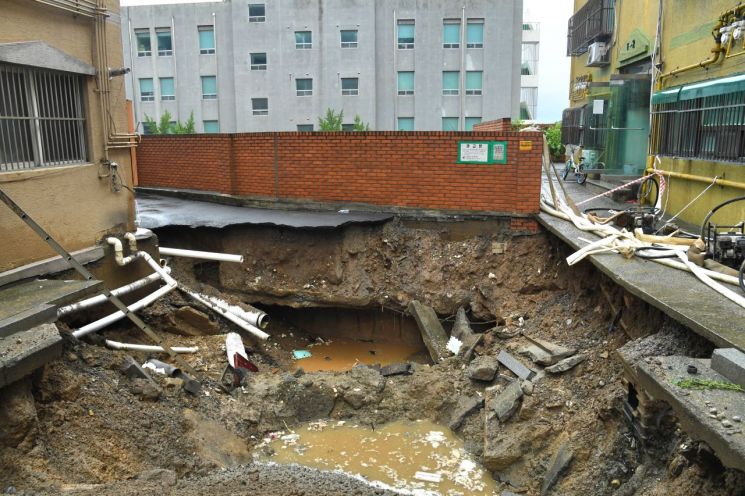 A residential area in Sinwol-dong, Yangcheon-gu, Seoul, where a sinkhole occurred on the 9th.
 [Image source=Yonhap News]
[Asia Economy Intern Reporter Kim Gunchan] Following the sinkhole that formed last week in Yangyang, Gangwon Province, causing a convenience store to collapse, sinkholes have also appeared across Seoul due to record-breaking heavy rains. Amid various causes such as heavy rainfall and changes in groundwater flow, experts emphasize the importance of investigations to prevent damage.
Due to the heavy rains that began on the 8th, Seoul's cumulative precipitation reached 525.0 mm as of 5 a.m. on the 10th. In Shindaebang-dong, Dongjak-gu, Seoul, 136.5 mm of rain fell within one hour. This is the highest hourly rainfall ever recorded, surpassing the previous record of 118.6 mm set in August 1942 after 80 years.
The record-breaking heavy rains caused numerous large and small sinkholes across Seoul, resulting in widespread damage. A sinkhole refers to a phenomenon where a certain area of land subsides, creating a depression or hole.
On the 10th, a large sinkhole appeared in a residential area in Sinwol-dong, Yangcheon-gu. This was a space usually used for parking vehicles at the entrance of a house, but the ground between buildings completely collapsed due to the heavy rain. On the same day, a sinkhole measuring 3.5 meters wide and 1.3 meters long appeared on the playground of an elementary school in Gwanak-gu. It was found to be large enough to swallow two to three adults.
According to Seoul City, as of 7 a.m. on the 11th, 12 sinkholes have been reported in Seoul. On the 8th, when the heavy rains poured, four sinkholes occurred in Seocho, Gangnam, Yeongdeungpo, and Dongjak districts. One of the causes of sinkhole formation is ground subsidence due to the monsoon and heavy rains. When rainwater seeps beneath paved surfaces, the soil becomes saturated and sinkholes can form.
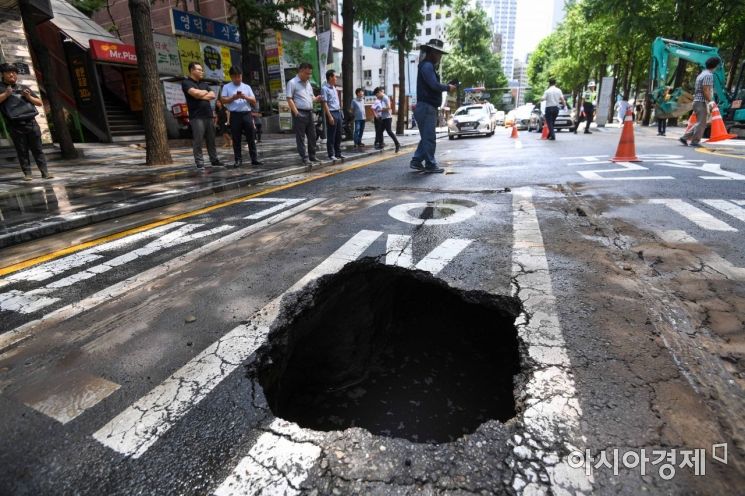 On August 1, 2019, a sinkhole occurred on Mugyo-ro near Cheonggye Plaza in Seoul, and workers are conducting recovery operations. Photo by Jinhyung Kang aymsdream@
According to the Ministry of Land, Infrastructure and Transport's Underground Safety Information System, a total of 77 ground subsidence incidents have occurred in Seoul since 2018, with 49% of these incidents happening during the monsoon season from June to August. Looking at the accident statistics, 11 incidents occurred in June, 9 in July, and 18 in August, showing a concentration during the summer monsoon season.
Recently, unexplained sinkholes have also been appearing in various locations. A representative case is the sinkhole that formed near Naksan Beach in Yangyang-gun on the 3rd. This large sinkhole, measuring 12 meters wide, 8 meters long, and 5 meters deep, caused the collapse of a nearby convenience store building. Local residents claimed that the ground in this area had subsided about ten times since early this year and demanded countermeasures.
Ground subsidence, a phenomenon where the ground sinks due to various factors, occurs nationwide. According to a report titled "Causes and Countermeasures of Urban Ground Subsidence" released by the National Assembly Legislative Research Office in January, there were 1,176 ground subsidence incidents nationwide over the past five years (2017?2021). The report analyzed that various causes, not just heavy rain, influence the occurrence of sinkholes.
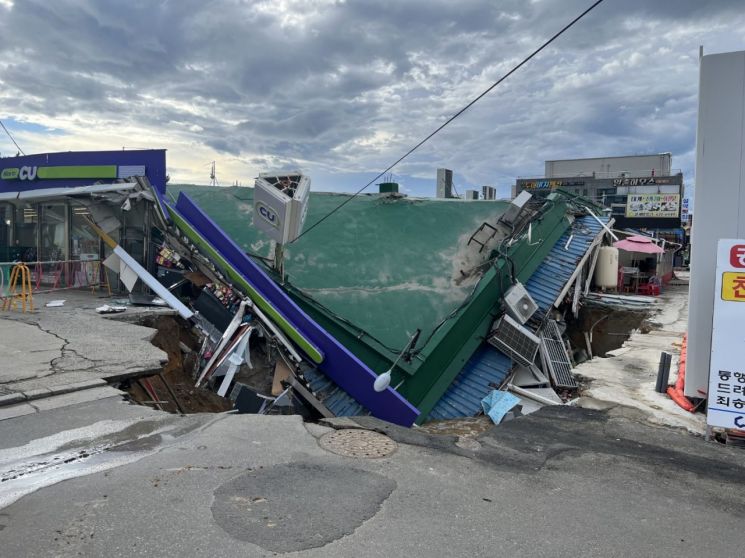 On the 3rd, a sinkhole measuring 12 meters wide, 8 meters long, and 5 meters deep occurred near a construction site close to Naksan Beach in Ganghyeon-myeon, Yangyang-gun, Gangwon Province, causing part of a nearby convenience store building to collapse. [Image source=Yonhap News]
According to the Legislative Research Office, the main causes of sinkhole formation include ① insufficient compaction of soft ground, ② changes in groundwater flow, and ③ leakage caused by damage to water and sewage pipelines. Population overcrowding is also related to sinkhole occurrences. The office analyzed, "Since 91.2% of the total population resides in urban areas that account for only 16% of the total land area, there is a high risk that ground subsidence-related collapses could lead to large-scale casualties and property damage."
Experts emphasize the need to investigate locations where sinkholes have occurred and areas with potential for occurrence. Professor Jung Changsam of the Department of Smart Construction Disaster Prevention at Induk University stated on the 11th during 'YTN Wise Radio Life,' "When there is a lot of water, it can penetrate weak spots in the ground, causing sudden rapid water flow that leads to sinkhole formation." He explained, "If water passes through tiny holes in the road and those holes gradually expand, the probability of sinkholes occurring in that area is high." He added, "If water movement is not blocked through construction in those areas, sinkholes can occur, so prevention is necessary. After the rain stops, all areas where sinkholes have occurred or have the potential to occur must be thoroughly inspected and checked."
© The Asia Business Daily(www.asiae.co.kr). All rights reserved.
![Clutching a Stolen Dior Bag, Saying "I Hate Being Poor but Real"... The Grotesque Con of a "Human Knockoff" [Slate]](https://cwcontent.asiae.co.kr/asiaresize/183/2026021902243444107_1771435474.jpg)

















