Argentina's 5 Trillion Won Plan
Balancing Focus from Steel to Diversified Sectors
Visited 3 Companies in Australia
Securing Key Raw Material Supply Chains
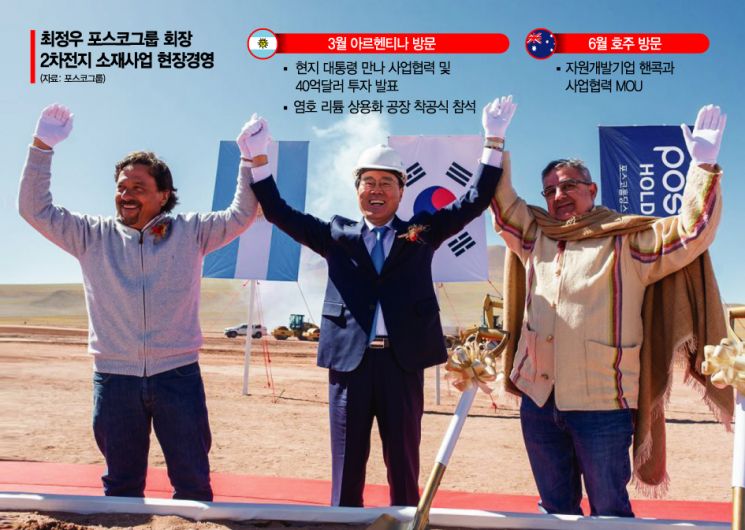
[Asia Economy Reporter Choi Seoyoon] Choi Jung-woo, chairman of POSCO Group, is accelerating investment in the secondary battery materials business. When it comes to secondary battery materials, he visits sites both overseas and domestically without distinction. In March this year, during his visit to Argentina, he announced a $4 billion (approximately 5 trillion KRW) investment plan. He also set a goal to increase the secondary battery materials business, which currently has sales of about 2 trillion KRW, to 41 trillion KRW by 2030, a 20-fold increase. Through this, the group plans to balance its profit structure, which is currently steel-centered, with the secondary battery materials business.
According to industry sources on the 12th, Chairman Choi has visited two overseas countries this year alone for the group’s new growth engine, the secondary battery materials business. In March, he personally visited Argentina and met with President Alberto Fernandez to announce a $4 billion investment plan. This is to produce lithium, an essential material for electric vehicle batteries and a core business area for Chairman Choi. The plan is to establish an annual production system of 100,000 tons by 2028.
The day after meeting the president, Chairman Choi attended and led the groundbreaking ceremony for a local lithium commercialization plant. At the event, he emphasized, "This is a historic day," and stated, "The brine lithium project will be the foundation of POSCO Group’s secondary battery materials business." The brine lithium plant is planned to have an annual production capacity of 25,000 tons of lithium hydroxide and aims for completion in the first half of 2024. Previously, POSCO Group acquired the Hombre Muerto lithium brine lake in Argentina in 2018 to establish the lithium commercialization plant. Approximately $830 million (about 950 billion KRW), including infrastructure investment and working capital, has been invested.
In June, he flew to Australia to personally oversee the supply chain of key raw materials for secondary battery materials, such as lithium and nickel. He visited three companies locally. He signed a strategic cooperation MOU with local resource development company Hancock for the development of mines including lithium, nickel, copper, and iron ore, and met with the chairman of First Quantum Minerals, a mining and smelting specialist company, to discuss additional business cooperation opportunities. He also met with the chairman and executives of Pilbara Minerals, with whom POSCO cooperates on lithium ore development and production joint ventures, to discuss expanding lithium concentrate supply and new project cooperation.
He does not overlook domestic sites either. In May last year, Chairman Choi attended the groundbreaking ceremony of the Yulchon Industrial Complex in Gwangyang, Jeollanam-do, expanding his on-site management efforts. At the ceremony, he said, "Localization of lithium is an important foundation for POSCO Group to grow into a 100-year company and will greatly contribute to securing the competitiveness of the domestic secondary battery industry, which is fiercely competing in the global market," emphasizing the significance of the secondary battery business.
Within POSCO Group, two main entities are responsible for the secondary battery materials business. The holding company POSCO Holdings oversees the entire secondary battery materials business, while the affiliate POSCO Chemical handles the cathode and anode materials business. POSCO Chemical focuses on production, and POSCO Holdings concentrates on securing raw materials such as nickel and graphite stably. Through this, POSCO Group is the only company in the world to build a ‘secondary battery materials value chain’ that produces and supplies everything from raw materials like lithium to precursors, cathode and anode materials, and next-generation secondary battery materials.
Along with the launch of the holding company, the growth targets for the secondary battery materials business were revised upward in May this year. The cathode production target by 2030 was set to increase by 152% from 400,000 tons annually to 610,000 tons, and production and sales systems for anode materials at 320,000 tons, lithium at 300,000 tons, and nickel at 220,000 tons were established, significantly raising growth goals. The sales target is 41 trillion KRW. This is comparable to the steel business sales scale, which accounted for 52% of the total POSCO Group sales as of the end of last year. The plan is to change the profit structure, which is heavily skewed toward steel, and build a balanced growth portfolio across sectors together with the secondary battery materials business.
A POSCO Group official said, "The secondary battery materials sector is a business that reflects the strong will of the group’s top management," and added, "Various management strategies, including the secondary battery materials business, will be discussed at the group management meeting in the fourth quarter of this year."
© The Asia Business Daily(www.asiae.co.kr). All rights reserved.
![Clutching a Stolen Dior Bag, Saying "I Hate Being Poor but Real"... The Grotesque Con of a "Human Knockoff" [Slate]](https://cwcontent.asiae.co.kr/asiaresize/183/2026021902243444107_1771435474.jpg)















