KB Jeonse Supply-Demand Index at 99.9... Lowest Level Since March 2019
Impact of Decreased Demand... Shift to Monthly Rent Also Plays a Role
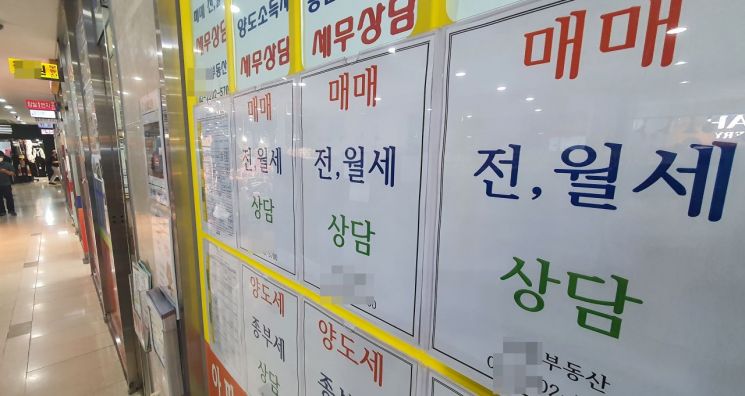
[Asia Economy Reporter Kim Hyemin] The jeonse supply-demand index in Seoul's Gangnam area has dropped to its lowest level in over three years. Contrary to initial concerns that an 'August Jeonse Crisis' would occur, the jeonse market is entering a stable phase. However, some point out that this 'unstable stability'?created as jeonse demand shifts to monthly rent due to rapid interest rate hikes?cannot be seen as overall stability in the rental market.
According to the weekly housing market trends released by KB Kookmin Bank on the 12th, as of August 8, the jeonse supply-demand index in Seoul's Gangnam area was recorded at 99.9. This is a 1.3-point drop compared to the previous week, falling below the 100 mark for the first time in about three years and five months since it recorded 99.8 on March 18, 2019. At that time, there was an incentive of a large increase in supply volume, such as the phased move-in of 10,000 households in Songpa Helio City.
The jeonse supply-demand index is an indicator showing the level of jeonse supply shortage. A value above the baseline of 100 means supply is insufficient, while below 100 means demand is insufficient. A KB Kookmin Bank official said, "The current situation is best understood not as supply increasing, but rather that the previous supply shortage issue has somewhat eased."
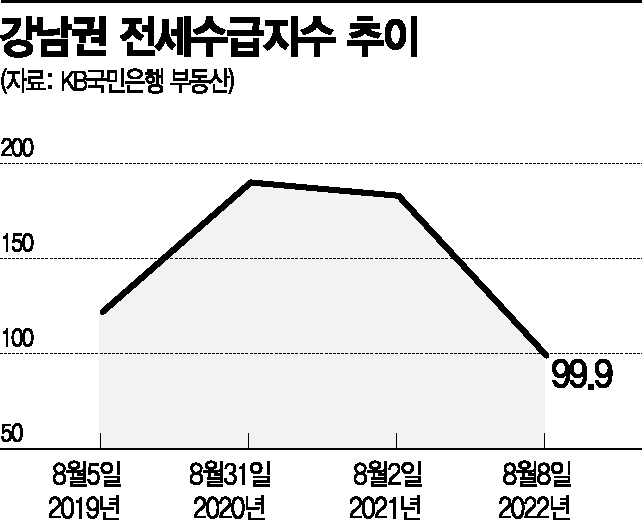
The trend of the jeonse supply-demand index in Gangnam has shown a supply shortage for the past three years. It steadily rose from the second quarter of 2019 and peaked at 196.5 on November 9, 2020. This was due to the increase in households renewing their jeonse contracts after the revised Lease Protection Act was implemented in August of that year, causing a jeonse crisis due to supply shortages. After fluctuating, it dropped to 118.2 by the end of June and fell below the baseline within seven weeks.
This appears to be more due to a decrease in jeonse demand rather than a dramatic increase in jeonse supply in Gangnam. According to Apartment Real Transaction Price (Asil), a real estate big data company, the jeonse supply in Seoul has remained between 30,000 and 32,000 cases for a month. A representative from a real estate agency in Gangnam said, "Summer is traditionally an off-season for moving, so there are not many people looking for either sales or jeonse," adding, "Rather, landlords who urgently need to put their jeonse on the market are feeling anxious."
Given this situation, jeonse prices are also falling. According to KB Kookmin Bank's data, as of August 8, jeonse prices in Seoul decreased by 0.05% compared to the previous week, marking five consecutive weeks of decline. For example, the actual transaction price for a new jeonse contract of an 84㎡ unit at Jamsil Els in Songpa-gu, Seoul, recently ranged between 1 billion and 1.3 billion KRW, down by about 300 to 500 million KRW compared to the peak price of 1.55 billion KRW at the end of last year.
However, the relative stabilization of jeonse prices is analyzed to be due to the rapid progression of the 'jeonse-to-monthly rent' shift. In fact, more people in the rental market recently are choosing semi-jeonse or semi-monthly rent over jeonse. This is because with the sharp rise in market interest rates, paying a bit more monthly rent has become cheaper than repaying jeonse loan interest. This means existing jeonse demand has moved to the monthly rent market. A KB Kookmin Bank official said, "It is necessary to observe future trends to see whether the current stability in the jeonse market will be maintained."
© The Asia Business Daily(www.asiae.co.kr). All rights reserved.
![Clutching a Stolen Dior Bag, Saying "I Hate Being Poor but Real"... The Grotesque Con of a "Human Knockoff" [Slate]](https://cwcontent.asiae.co.kr/asiaresize/183/2026021902243444107_1771435474.jpg)
















