Submission of Statement Regarding the US House of Representatives
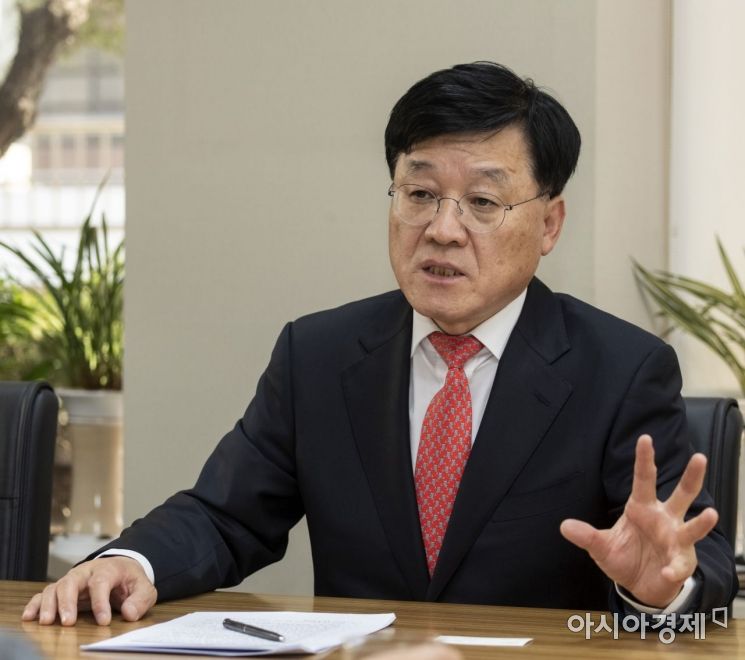 Jung Manki, President of the Korea Automobile Manufacturers Association. / Photo by Yoon Dongju doso7@
[Asia Economy Reporter Kiho Sung] The Korea Automobile Manufacturers Association (KAMA) has submitted a statement to the U.S. House of Representatives requesting an amendment to the Inflation Reduction Act (IRA) to include Korean-made electric vehicles as eligible for tax benefits.
According to the Automobile Manufacturers Association on the 12th, the association stated in a letter signed by Chairman Jeong Manki, "Considering the Korea-U.S. Free Trade Agreement (FTA) regulations, our government currently provides subsidies without discrimination between imported and domestically produced electric vehicles," and added, "We request an amendment to include Korean-made electric vehicles as eligible for tax benefits during the IRA bill discussions passed by the Senate."
The main point of the proposed amendment to the electric vehicle tax benefits is to remove the annual limit of 200,000 vehicles per manufacturer for subsidies (up to $7,500 per vehicle, approximately 9.76 million KRW) and instead provide purchase subsidies only for electric vehicles produced (final assembly) in the North American region.
Specifically, if the battery is equipped with core minerals mined and processed in countries that have FTAs with the U.S. at a certain ratio or higher, half of the tax credit benefit ($3,750, approximately 4.88 million KRW) is provided. The other half can be received only if the battery is equipped with battery components produced and assembled in North America at a certain ratio or higher. Above all, even if both conditions are met, only electric vehicles finally assembled in North America are eligible for the tax benefits.
For the domestic automobile industry, which currently produces all electric vehicles domestically and exports them overseas, it is expected that the implementation of this bill will inevitably impact exports to the U.S. and domestic automobile production.
Chairman Jeong emphasized in the statement, "Over the past 30 years, Korean automobile companies have invested more than $13 billion, directly and indirectly employing over 100,000 American automobile workers, making a significant contribution to the U.S. economy," and added, "We have also announced plans to expand investments in electric vehicle-dedicated manufacturing plants, robotics, urban air mobility, autonomous driving, and artificial intelligence (AI) fields."
He continued, "Korea has pursued policies that treat domestic and U.S.-imported electric vehicles equally in the domestic market, providing subsidies in line with the Korea-U.S. FTA," and stated, "We respectfully request the expansion of eligible countries to include Korean-made electric vehicles for the tax credit application."
© The Asia Business Daily(www.asiae.co.kr). All rights reserved.
![Clutching a Stolen Dior Bag, Saying "I Hate Being Poor but Real"... The Grotesque Con of a "Human Knockoff" [Slate]](https://cwcontent.asiae.co.kr/asiaresize/183/2026021902243444107_1771435474.jpg)















