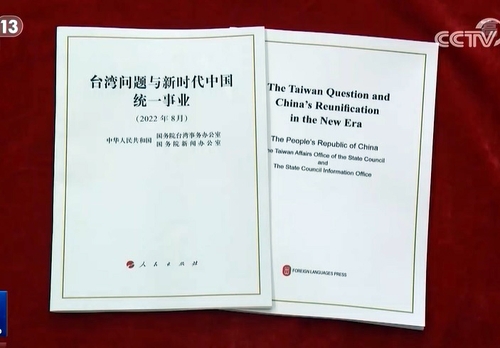
[Asia Economy Reporter Song Seung-seop] In the Taiwan White Paper published by China for the first time in 22 years, China firmly expressed its intention to apply the Hong Kong-style "One Country, Two Systems" after Taiwan's unification. One Country, Two Systems refers to the arrangement after the return of Hong Kong's sovereignty, where China retains sovereignty over foreign affairs and defense for 50 years while granting a high degree of autonomy.
On the 11th, Zheng Zijian, a WeChat account under Beijing Youth Daily, analyzed the "White Paper on the Taiwan Issue and the New Era of China's Unification Cause" published the previous day by the Taiwan Affairs Office of the State Council and the State Council Information Office, reporting that it mentioned peaceful unification methods and Taiwan's social system after unification, which had not been included in previous Taiwan White Papers.
The White Paper stated that the unification process will face the fact that the social systems of China and Taiwan are different, and argued that One Country, Two Systems is the most inclusive way to resolve this issue. Just as China designates Hong Kong as the "Hong Kong Special Administrative Region," it is interpreted that Taiwan will be designated as the "Taiwan Special Administrative Region" to apply Hong Kong-style autonomy. The phrase "no troops or administrative personnel will be stationed in Taiwan," mentioned in the White Papers released in 1993 and 2000, has disappeared.
While recognizing a high degree of autonomy, the White Paper added the premise of "securing national sovereignty, security, and development interests." This is interpreted as a measure to prevent anti-China figures from gaining a foothold through the Hong Kong National Security Law. It can also be read as an intention to apply Hong Kong's system, which revised the election system to allow pro-China figures to govern, as is. Additionally, for the first time, the White Paper included content that foreign consular offices could be established in Taiwan after unification.
As a prerequisite for peaceful unification, the "1992 Consensus" was mentioned for the first time. The 1992 Consensus refers to the common understanding reached by China and Taiwan in 1992. It acknowledges "One China," but each side expresses it in its own way. China views the 1992 Consensus as meaning that both sides belong to one China and strive for unification, whereas Taiwan denies it, stating that no agreement has been reached on political claims.
Wang Wenbin, spokesperson for the Chinese Ministry of Foreign Affairs, said at a regular briefing on the same day, "We urge relevant countries to strictly adhere to the 'One China' principle, properly handle Taiwan-related issues, stop interfering in China's internal affairs or acting inconsistently in words and deeds, and fulfill their promise not to support Taiwan independence in practice." He added, "Relying on foreign countries to seek independence is a dead end, and attempting to suppress China through Taiwan will surely fail."
He further stated, "Anyone or any force that interferes in China's internal affairs and tries to obstruct China's great cause of unification will hit their heads against the Great Wall of Steel made of the blood and flesh of 1.4 billion Chinese people and bleed."
Chinese local media also evaluated that the Taiwan White Paper reflects the authorities' strong will to realize unification. The People's Daily, the official newspaper of the Chinese Communist Party, praised, "The White Paper confirmed that Taiwan is part of China and showed the firm will of the Chinese Communist Party and the Chinese people to pursue national unification," adding, "It described the stance and policies to promote national unification in the new era."
On the other hand, Taiwan strongly opposed the plan to apply the Hong Kong-style One Country, Two Systems. At a press conference on the 11th, Au Chang-an, spokesperson for Taiwan's Ministry of Foreign Affairs, expressed refusal, saying, "Only the people of Taiwan can decide Taiwan's future."
© The Asia Business Daily(www.asiae.co.kr). All rights reserved.
![Clutching a Stolen Dior Bag, Saying "I Hate Being Poor but Real"... The Grotesque Con of a "Human Knockoff" [Slate]](https://cwcontent.asiae.co.kr/asiaresize/183/2026021902243444107_1771435474.jpg)















