"Touching the Circuit Breaker with Wet Hands in an Emergency Is Dangerous"
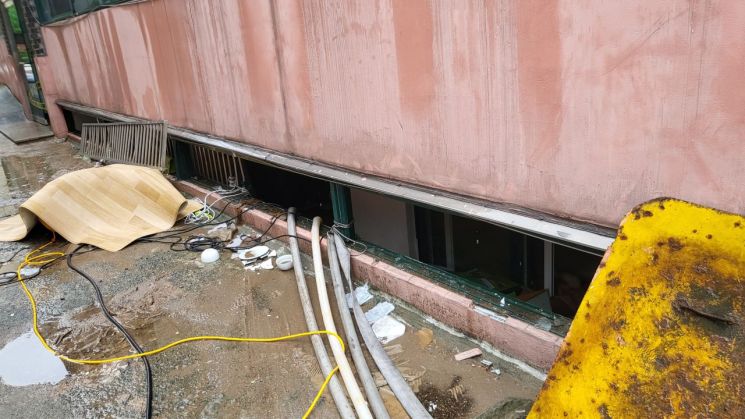 On the evening of the 8th, around 9:07 PM, three family members were trapped in a semi-basement of a villa near Gwanak-gu, Seoul, due to flooding caused by heavy rain, and despite reporting the incident, they ultimately died. According to residents, a sinkhole formed right in front of the villa where the accident occurred, causing water to flow rapidly inside, isolating the family and preventing their rescue. The photo shows the accident site. [Image source=Yonhap News]
[Asia Economy Reporter Kim Jung-wan] Amid the record-breaking heavy rain that struck the central region starting on the 8th, three members of a family living in a semi-basement in Gwanak-gu, Seoul, lost their lives. Experts emphasized the importance of evacuation time when residing in semi-basements.
On the 11th, Professor Jung Chang-sam of the Department of Smart Construction Disaster Prevention at Induk University appeared on YTN Radio and explained, "Semi-basements have small glass windows that are in contact with the ground, so when water rises above ground level, the water pressure causes the glass to break, allowing water to rush in all at once. When water fills the house, the pressure is applied to only one side, making it impossible to open the door. It’s the same as when a car door won’t open after being submerged in water on the street."
Professor Jung stressed that "time is extremely important" during semi-basement flooding. He said, "As soon as the glass breaks and before the water level rises, you must get outside immediately. Vulnerable groups and those at risk tend to want to stay in a safe place when danger arises, which causes them to miss the golden time, leading to tragic incidents."
Regarding the risk of electric shock during flooding, he said, "In flood situations, touching the circuit breaker box with wet hands can actually be dangerous." He added, "If you evacuate in advance with enough time, it is correct to turn off the circuit breaker and gas valve. However, in urgent situations like water flooding a semi-basement, escaping your body out is the most important thing."
On Seoul City's decision to ban underground and semi-basement buildings for residential purposes, he responded, "It is fortunate that such measures are being made, albeit late, but in fact, 5% of Seoul’s households, about 200,000 households, live in semi-basements. That is a very large number." He continued, "Similar incidents happened before, and similar measures were proposed but not implemented because those residents do not have high incomes and are in difficult situations." He added, "It would be good if gradual progress is made through inducement of rental housing as announced this time. Since the number of households is so large, I think it will not be easy to solve the problem all at once."
Professor Jung also explained, "Most of the old areas have sewer systems that are about 50 years old. Since the water is connected as one system, if the downstream is not cleared, working on the upstream will not solve the problem." He added, "I think it is best to carry out partial construction in the aging areas and the downstream sewer connected to them all at once, so that the flow can be managed while looking at the entire connection from downstream."
© The Asia Business Daily(www.asiae.co.kr). All rights reserved.
![Clutching a Stolen Dior Bag, Saying "I Hate Being Poor but Real"... The Grotesque Con of a "Human Knockoff" [Slate]](https://cwcontent.asiae.co.kr/asiaresize/183/2026021902243444107_1771435474.jpg)















