Emergency Relief and Housing Support for Disaster Victims, Livelihood Stabilization, Small Business Recovery, Tax and Finance, Local Government Financial Assistance: Comprehensive Support Plans Established and Implemented Across Five Key Areas
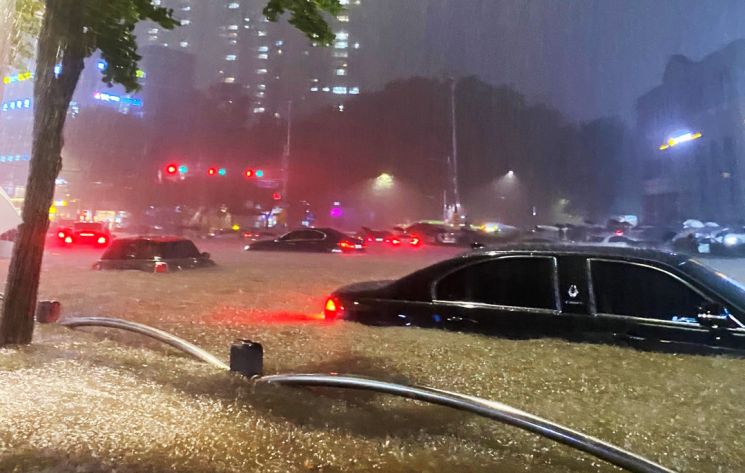
[Asia Economy Reporter Lim Cheol-young] The government has established and is implementing a comprehensive government-wide support plan to ensure early stabilization of residents' lives and prompt recovery assistance for areas affected by the heavy rain that began on the 8th, mainly in the metropolitan area.
According to the Ministry of the Interior and Safety on the 11th, the government plans to form a Central Joint Investigation Team composed of related ministries such as the Ministry of Environment and the Korea Forest Service to conduct investigations as soon as local governments complete on-site inspections and damage assessments of affected facilities. If the damage amount estimated by local governments is certain to exceed the criteria for declaring a special disaster area, a preliminary on-site investigation will be conducted even before the Central Joint Investigation Team operates, and the procedure for declaring a special disaster area will proceed accordingly.
In particular, the government has prepared a comprehensive support plan in five areas?emergency relief and housing support for disaster victims, livelihood stabilization, recovery for small business owners, tax and finance, and local government financial assistance?in anticipation that the heavy rain damage will be recognized as eligible for national support.
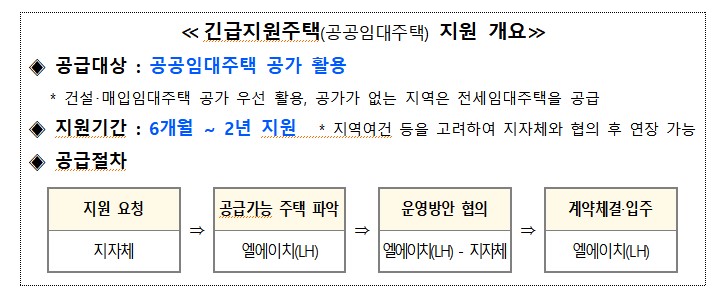
First, to minimize inconvenience for disaster victims, various forms of temporary housing facilities such as community centers, school gymnasiums, and lodging facilities will be secured and provided until evacuees return home. For those requiring long-term temporary housing due to damaged homes, public rental housing will be supported. An Integrated Volunteer Support Group will also be organized and operated to ensure systematic volunteer activities at disaster sites, including relief efforts for disaster victims.
The Ministry of the Interior and Safety plans to take measures to promptly disburse restoration funds (74.8 billion KRW from disaster countermeasure funds) for private facilities such as houses damaged by the heavy rain, even before the restoration plan is finalized, in consultation with the Ministry of Economy and Finance and other related ministries. Together with the three major home appliance companies, a joint repair team will operate to provide free repair services for home appliances damaged by flooding. The joint repair team has been operating since the 11th in Sillim-dong, Gwanak-gu, Seoul, and additional teams will be deployed in other local governments upon request in coordination with the 33 home appliance companies.
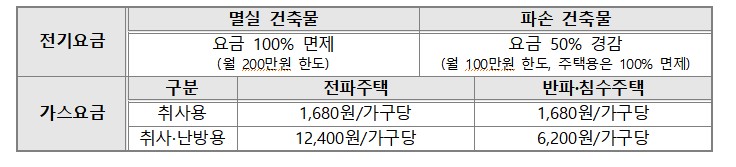
Additionally, the Ministry of Health and Welfare will implement exceptions for disaster victims regarding national pension contributions (exemption for up to one year, with extension if the reason persists), exemption from overdue payment collection (up to six months), reduction of health insurance premiums (up to 50% for three months, or six months if both personal and property damage occur) in areas declared as special disaster zones, and exemption from overdue payment collection (up to six months). The Ministry of Trade, Industry and Energy will promote reductions and deferrals of electricity bills (one month, up to 2 million KRW) and gas bills (one month) for destroyed buildings and others.
The Ministry of Science and ICT, in consultation with telecommunications companies, will implement discounts on communication service fees for affected residents (up to 12,500 KRW per mobile line, 100% off monthly landline fees, 50% off monthly internet fees), and full exemption of radio usage fees for wireless stations in the affected areas (for six months). Discounts on fees for paid broadcasting services (IPTV, cable TV, satellite broadcasting, etc.) will also be pursued in cooperation with service providers.
The Korea Post will provide free delivery for about six months for relief-related mail sent between relief organizations such as the Korean Red Cross and the National Disaster Relief Association, or sent by relief organizations to disaster victims in special disaster areas. Customers with Korea Post savings accounts can receive exemptions from handling fees for interbank transfers and reissuance of deposit and fund passbooks, and customers with Korea Post insurance can benefit from deferred payment of premiums and refund loan interest.
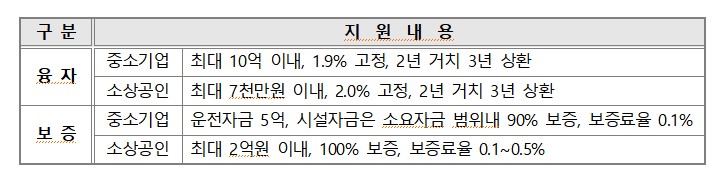
Furthermore, the Ministry of SMEs and Startups will provide loans with a fixed interest rate of 2.0% and terms of two years grace and three years repayment, up to 70 million KRW per business, to small business owners affected by the disaster. For affected small and medium-sized enterprises, loans with a fixed interest rate of 1.9% and terms of two years grace and three years installment repayment will be provided up to 1 billion KRW per company. The Financial Services Commission will cooperate with policy financial institutions and financial sectors (banks, mutual finance, etc.) to provide emergency management stabilization funds to SMEs and small business owners, and support extensions of loan maturities and repayment deferrals for existing loans. Small business owners who suffered damage equivalent to flooding or more can receive support up to 2 million KRW from local government disaster relief funds after confirmation of damage by the local government head.
Additionally, under local tax-related laws, local government heads can extend the payment deadlines for local taxes such as acquisition tax and local income tax for affected residents by up to one year, or defer collection of local tax assessments and arrears for up to one year, providing local tax benefits. Preferential loan interest rates within 0.3% and maturity extensions up to one year will also be implemented through Saemaeul Geumgo.
The National Tax Service will extend the payment deadlines for comprehensive income tax, value-added tax, and corporate tax by up to nine months for affected residents lacking payment capacity due to flood damage, suspend forced collection measures such as sale of seized real estate for up to one year, provide tax credits for income and corporate taxes if business assets are lost by 20% or more due to the heavy rain, and postpone tax audits until the end of the year if businesses face difficulties.
The Financial Services Commission plans to cooperate with financial sectors (banks, savings banks, insurance companies, etc.) to defer or extend loan principal and interest repayments for flood-affected households by up to one year, and implement measures such as premium payment deferrals and early insurance claim support. In particular, for flooded vehicles, active counseling and guidance will be provided through insurance companies and the Financial Supervisory Service’s Financial Counseling Center to ensure prompt compensation for vehicle damages.
Meanwhile, once the flood recovery plan is finalized, the government will promptly provide restoration funds using available resources such as disaster countermeasure funds, budget reallocations, and contingency funds, and will also consider support plans for emergency restoration costs to prevent secondary damage such as flood debris and waste disposal, as well as permanent restoration costs using the Disaster and Safety Special Tax.
Lee Sang-min, head of the Central Disaster and Safety Countermeasures Headquarters, emphasized, "The government, related agencies, and local governments will make every effort to ensure that disaster victims can fully return to their daily lives and livelihoods," and requested, "Related agencies and local governments should thoroughly prepare and execute support for affected residents and promptly carry out damage investigation procedures so that the government's support directions can be effectively implemented on the ground."
© The Asia Business Daily(www.asiae.co.kr). All rights reserved.
![Clutching a Stolen Dior Bag, Saying "I Hate Being Poor but Real"... The Grotesque Con of a "Human Knockoff" [Slate]](https://cwcontent.asiae.co.kr/asiaresize/183/2026021902243444107_1771435474.jpg)

















